
Amsakar-Li Claudia Leadership Brings Positive Growth to Batam
There are several simple ways to observe how a city grows. Among them are looking at the roads people use every day, seeing industrial activity becoming more vibrant, observing incoming investment, and examining the impact of that growth on people’s lives.
In Batam, that growth is moving in one direction: infrastructure is being strengthened, investment is being accelerated, and the economy is being pushed so that its benefits are increasingly tangible.
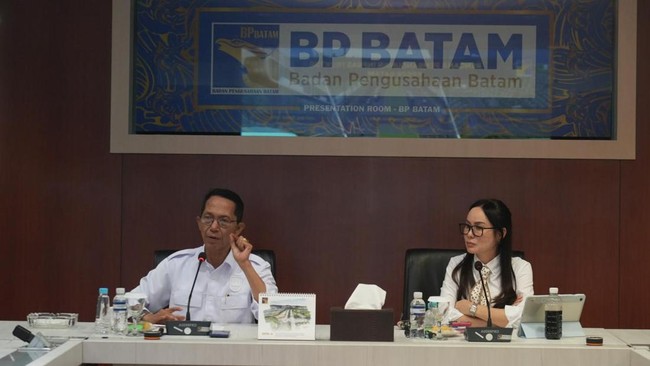
Behind this process, BP Batam Head Amsakar Achmad and Deputy Head of BP Batam Li Claudia Chandra have adopted a leadership approach that does not only involve working from behind a desk. They are also known for actively going into the field, seeing infrastructure conditions first-hand, listening to problems, and ensuring that the work carried out truly answers Batam’s needs.
For Amsakar, development is not merely about completing projects. There is a responsibility to ensure that every piece of work has benefits and supports the community’s economic activity.
“We must not stop at the numbers. The most important thing is that this investment keeps moving, projects are realised, jobs are created, industry develops, and it provides a multiplier effect for Batam’s economy,” he said in a statement on Saturday (29/8/2026).
It should be remembered that economic growth requires a strong foundation. One of these is infrastructure. Therefore, road construction and repair are an important part of maintaining the pulse of Batam’s activity as a city of industry, trade, services and investment.
As is known, as of 3 August 2026, 12 of the 19 road repair works in Batam had been 100% completed. A number of priority points have been finished, including Jalan Gajah Mada in front of Southlink, the section near the Sei Ladi Bridge, the road above the Yos Sudarso Underpass, and the Volex area.
Work activity also does not stop at the road surface. Drainage improvements are also an important part of making infrastructure more functional and reducing the potential for flooding.
On a larger scale, the improvement of Jalan Gajah Mada, the Landing Point Fly Over-Simpang Lalan Madani segment, had reached 39.194% as of 24 August 2026. The road will be widened into two carriageways, each with three lanes.
Infrastructure like this is not just about concrete, asphalt or road widening. Behind it lies worker mobility, goods distribution, industrial activity, public travel, and Batam’s investment competitiveness.
Amsakar also ensured that the acceleration of development continues while paying attention to quality and safety. “The acceleration is carried out in a measured manner without neglecting the quality and safety aspects of the work,” he said.
This is the leadership character that Amsakar continues to demonstrate: going down to see problems, listening to needs, and then ensuring that work moves forward.
On the other hand, Li Claudia Chandra is considered able to bring her own colour to Batam’s leadership. As the first woman to lead Batam together with the Head of BP Batam, Li Claudia is known for being firm when speaking about rules, services and development interests. Nevertheless, that firmness goes hand in hand with an approach that is close to the community.
Li Claudia is also not reluctant to go into the field, seeing infrastructure conditions first-hand, engaging in dialogue with and listening to community complaints. On various occasions, she has shown her humanist side when interacting with mothers and children. For her, development must not lose its human touch.
“We want Batam to become a place that provides certainty for growth, space for the business world to develop, while creating economic benefits that are felt by the community.”
Firmness on rules and closeness to the community are two complementary sides. Development requires clear rules to create certainty. At the same time, development also requires leaders who understand what the community feels on the ground.
Batam’s infrastructure foundation is moving in tandem with investment growth. Based on BP Batam’s bottom-up method, Batam’s investment in the first half of 2026 reached Rp 38.97 trillion, or 55.67% of the 2026 investment target of Rp 70 trillion. Compared with the same period the previous year, this achievement grew by 62.75%.
Meanwhile, based on LKPM data, Batam’s realised investment in the first half of 2026 reached Rp 29.89 trillion, consisting of foreign investment (PMA) of Rp 17.80 trillion and domestic investment (PMDN) of Rp 12.09 trillion.
Regardless of that, for Amsakar and Li Claudia, the measure of success does not stop at investment value. Rather, the impact of incoming investment capital will be seen when employment opportunities for the community increase.
The number of workers in Batam recorded in the first half of 2026 reached 40,943 people, up from 30,979 people in the same period the previous year. This means there was an increase of 9,964 workers, with growth of 32.16%. This figure shows how investment is beginning to be translated into more tangible economic activity.
Now, Batam is no longer enough as merely a city that attracts investors. Batam is considered to need to become a city that makes investors want to grow, expand and build a long-term business ecosystem.
Therefore, the sectors being developed are increasingly diverse, ranging from high-technology manufacturing, digital, data centres, artificial intelligence, energy, international logistics, aerospace, international trade and finance, to health tourism.
Connectivity is the binding element and infrastructure is the foundation for Batam. Services and business certainty are the strengthening factors, while investment is one of the growth engines for Batam.
Amsakar and Li Claudia understand that Batam is in an important phase. Competition between cities and countries to attract investment is increasingly fierce. Therefore, speed of service must be matched by quality infrastructure and certainty.
At this point, success is not measured by how many investors come. Moreover, besides coming, investors must also feel safe to grow.
In the end, the leadership of Amsakar and Li Claudia can be seen not only from what is said, but from what is done. Moreover, they are the type of leaders who go down to see roads and infrastructure. Assessment of them can also be seen from the work that continues to be accelerated, from growing investment, from the thousands of workers absorbed, and from efforts to build an increasingly competitive economic ecosystem.
Amsakar brings a development approach that emphasises work, acceleration and results. On the other hand, Li Claudia complements this with firmness on rules as well as an approach that is close to the community.
Both meet on one big message: Batam must not only grow on paper. Batam’s growth must be visible on the roads, felt in economic activity, present in employment opportunities, and give hope for the community’s future.
Therefore, Rp 38.97 trillion in investment in the first half of 2026 is not the finish line. Likewise, a completed road is not merely a project to be ticked off. All of it is part of a larger journey: turning trust into investment, investment into industry, industry into jobs, and growth into benefits for the community.
This is Batam on the move. Batam whose infrastructure is being strengthened, whose economy is growing, whose investment is moving, and which is led with presence rather than merely from behind a desk. Starting from Batam, real growth contributions continue to be built for Indonesia.