
Amran Unveils New Strategy to Boost Rice Production, Aiming to Increase Farmer Prosperity
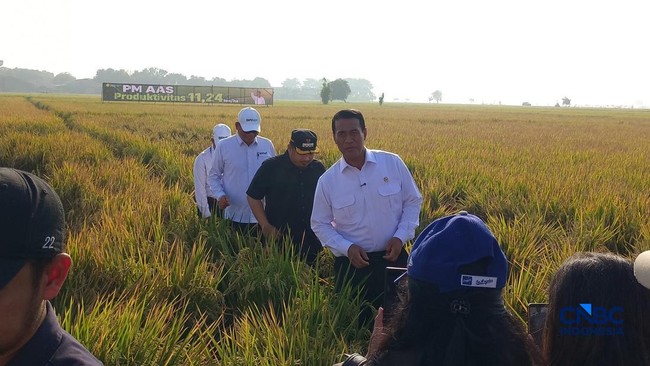
Subang, CNBC Indonesia - Minister of Agriculture Amran Sulastomo is preparing rice seed subsidies to expand the implementation of the Advanced Agriculture System (PM AAS), which is claimed to be capable of increasing rice productivity by up to twofold. Next year, the government aims for these seed subsidies to cover at least 1 million hectares (ha) across Indonesia.
“The method is that for the first year, God willing, next year we will subsidise seeds for at least 1 million hectares across Indonesia,” said Amran when met at the Sukamandi Rice Crop Assembly and Modernisation Centre, Subang, West Java, on Wednesday (2/9/2026).
PM AAS has been tested for two years and is now being implemented in approximately 10-11 provinces. Amran stated that the method is capable of increasing productivity from an average of 5-6 tons to 10-13 tons of unhusked rice (gabah) per hectare.
“What used to be an average of 5.5 tons is now becoming 11 tons, 12 tons, or even 13 tons per hectare,” he said.
According to Amran, this increase in productivity occurs because the plant population per hectare is increased, from approximately 360,000 clumps to between 800,000 and 1 million clumps.
Although it requires additional seeds and fertiliser, Amran noted that production costs only increase by about Rp2 million per hectare. Meanwhile, additional farmer income can reach up to Rp65 million per hectare, assuming a production calculation of 10 tons of unhusked rice at a cost of production (HPP) of Rp6,500 per kg.
“The cost is higher by Rp2 million per hectare, but the income rises; recently, there was an increase of up to Rp65 million per hectare (assuming 10-ton productivity). Previously, 5 tons per hectare was valued at Rp30-35 million per hectare,” he explained.
Amran further mentioned that this additional income could be even higher in some implementations, depending on productivity and crop maintenance. Assuming productivity increases by 5 tons per hectare, the implementation of PM AAS across 1 million hectares has the potential to generate an additional 10 million tons of unhusked rice. Amran believes this productivity boost will directly impact farmer welfare and strengthen national food security.
In addition to increasing plant population, this method utilises a direct seeding system, meaning it does not require the nursery and seedling transplantation process.
“This is direct seeding, so from the rice seed, it is sown directly. There are no longer costs for nursery processes. This is advantageous in terms of time, as nursery processes can take 2-3 weeks for seeding and another month for transplanting,” Amran explained.
He added that this acceleration also allows farmers to plant more frequently within a single year.
“Since it is direct, performing three planting cycles in one year is very possible,” he concluded.