
Amran Uncovers Counterfeit Fortified Rice Sold at Rp 42,000 per Kg
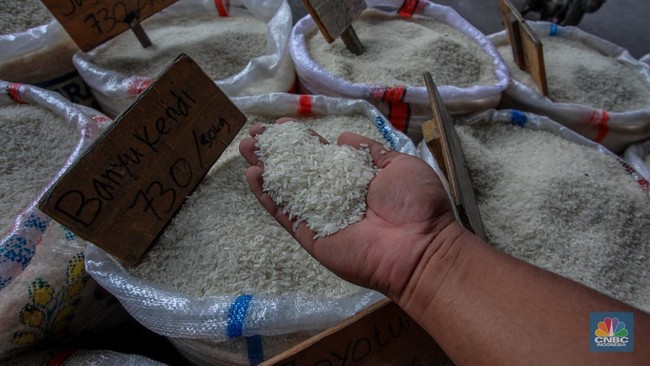
Jakarta, CNBC Indonesia - The government is expanding its investigation into alleged irregularities in the distribution of fortified rice. In addition to probing suspected rice mafias, the government is also examining fortified rice sold at prices far higher than medium and premium rice, to ensure the public is not disadvantaged merely because of fortification claims on packaging.
Head of the National Food Agency (Bapanas), who also serves as Minister of Agriculture, Amran Sulaiman, stressed that the investigation is a follow-up to President Prabowo Subianto’s directive to eradicate rice mafias.
“There is a rice mafia, we will eradicate it, and that is the order of President Prabowo. (Currently) fortified rice is being sold at prices reaching more than Rp 42,000 per kilogram. After we examined it, it did not meet the requirements for fortified rice. This harms consumers and oppresses the people,” Amran said in his statement, quoted on Wednesday (5/8/2026).
The findings originated from Bapanas monitoring in the Jakarta area of 15 special rice samples, consisting of three fortified rice samples and 12 rice samples with nutritional claims.
Laboratory test results showed 80% of samples had nutritional content that did not match the claims on the packaging label. One sample was even sold for up to Rp 42,500 per kg, yet test results showed its nutritional parameters did not correspond to the percentage of the Nutritional Adequacy Rate (AKG) stated on the label.
Deputy for Consumption Diversification and Food Safety at Bapanas, Andriko Noto Sutanto, said the fortified rice sample also lacked a distribution permit for Fresh Food of Plant Origin (PSAT). The product is no longer found in circulation.
“So actually, fortified rice is intended to address the problem of nutritional deficiencies experienced by many low-income people, so its price must be affordable for them. So if there is fortified rice that is also claimed to be organic rice, diabetic rice with a low glycaemic index that is enriched, that constitutes overclaiming and violates labelling regulations. The rice priced at Rp 42,000 (per kg) is now no longer available; it has been withdrawn from circulation. The problem is that it also had no distribution permit,” Andriko explained.
He explained that the samples monitored by Bapanas consisted of fortified rice and rice with nutritional claims, so the nutritional content stated on the label must match the test results.
“So fortified rice is rice enriched with nutritional value. For fortification, there is an SNI (Indonesian National Standard). (Then) rice enriched with nutritional value. It can contain two (nutrients), or more, on average two. That is why it falls into the special rice group,” he elaborated.
“Special rice includes fortified rice or enriched rice. It is stated in the distribution permit. Micronutrients added to rice related to improving nutritional value, targeting our brothers and sisters who are still poor, that is what we call fortified rice,” he continued.
In line with these findings, the government is deepening its examination of fortified rice products circulating in the market. Monitoring is not only focused on the claimed vitamin and mineral content, but also covers the physical quality of the rice, net weight conformity, product legality, production processes, and the accuracy of information on packaging labels.
Director of Supervision of Food Safety and Quality Standards Implementation at Bapanas, Police Brigadier General Hermawan, stressed that fortification is an effort to improve the nutritional value of food, but must not be used as a reason to sell rice at excessive prices.
“Rice sold at high prices must be in line with the quality and benefits received by the public. Not only will the nutritional content be examined, but also the basic quality of the rice, net weight, legality, production process, and the accuracy of information on the label,” Hermawan said.
The government will also compare the selling price of fortified rice with the price of medium and premium rice in the market. All components that form the price will be examined, from raw material costs, use of fortificant kernels, mixing processes, laboratory testing, certification, packaging, distribution, to the margins set by business operators.
“The inclusion of the words ‘fortified’, ‘enriched with vitamins’ or similar claims cannot automatically be used as a basis for setting very high prices. It must be explained what nutrients were added, how much content there is, how the production process works, and whether the claim has been proven through testing,” Hermawan said.
In addition to testing vitamin and mineral content, the government will also examine the basic quality of the rice, such as moisture content, degree of milling, percentage of broken grains and groats, damaged grains, chalky grains, foreign matter, presence of pests, colour, aroma, and other parameters according to applicable standards.
“A product must not be claimed to have added vitamins and minerals while the quality of the rice does not match the class and price paid by consumers. Fortification must be an added value, not a cover to hide inadequate quality,” he said.
Monitoring also covers the conformity of the product’s net weight with the information on the packaging, including product name, composition, nutritional content, quality class, identity of the producer or packer, distribution permit, storage instructions, and various claims stated.
“Labels are not merely a promotional tool. Information on labels is a form of accountability of business operators to the public. Every claim must be true and verifiable,” he said.
Furthermore, the government will trace the legality of products and their production processes, including distribution permits, producer identity, raw material sources, origin of fortificant kernels, production facilities, quality control systems, testing documents, and distribution channels. The government is also investigating the reasons why a product is no longer found in certain retail outlets, including the possibility of production cessation, voluntary withdrawal, packaging changes, or shifts in distribution channels.
Hermawan stressed that the development of fortified rice must not disrupt the availability of medium and premium rice in the market.
“Fortification must not be used as a reason to reduce the production of medium and premium rice, then direct most production to high-priced categories. We support food innovation, but affordability and availability of rice for the public must remain the priority,” Hermawan asserted.
“The higher the price of a product, the greater the obligation of business operators to prove its quality and benefits. The public must not pay dearly merely because of claims on packaging that are not supported by product quality and accountable test results,” he stressed.
The government will announce the results of the examination after laboratory testing, document verification, and clarification with producers are completed. If violations are found regarding nutritional content, rice quality, net weight, labelling, legality, or production processes, the government will take action in accordance with statutory regulations.
Source: jawawa.id (https://jawawa.id/newsitem/amran-uncovers-counterfeit-fortified-rice-sold-at-rp-42-000-per-kg-1785927135)
Originally published by CNBC Indonesia (https://www.cnbcindonesia.com/news/20260805151036-4-756799/amran-temukan-beras-fortifikasi-abal-abal-harganya-tembus-rp-42000-kg), translated from Indonesian