
Amran Targets Merauke Food Estate to Generate Rp13 Trillion, Here's the Formula
The Minister of Agriculture, Amran Sulaiman, is targeting a surge in agricultural revenue in the Merauke region of South Papua, aiming to increase it from the current approximately Rp1.3 trillion to Rp13 trillion per year. This target is set alongside efforts to increase planting frequency to three times a year, raise paddy productivity, and strengthen agricultural budget support for South Papua in 2026.
Amran noted that while Merauke’s paddy fields currently generate around Rp1.3 trillion annually, the potential can be multiplied several times over. “If this is well-maintained, I calculate that the revenue could reach Rp13 trillion. However, the requirements are three planting cycles and a production yield of 7 tonnes. There are now new methods capable of reaching 10 tonnes,” Amran stated during a joint paddy planting event in the Semangga District, Merauke, South Papua, on Saturday (4/7/2026).
He explained that this increase is not an unfounded target. Currently, the planting index (IP) in Merauke is at level 2, which is higher than the national average of 1.6–1.7. This means farmers in Merauke can already plant paddy twice a year, and the government is now pushing to increase that frequency to three times.
Amran also noted that paddy productivity in the region is improving. While harvests previously yielded around 3 tonnes per hectare, production is now moving towards the 4, 5, 6, and even 7 tonnes per hectare range. “This is progress for the welfare of our people,” he said.
Beyond production increases, Amran claimed that farmer incomes in Merauke are also surging. He cited data from the Regent of Merauke, Yoseph Bladib Gebze, which indicated that the people’s paddy field printing programme and land optimisation have driven farmer incomes up by as much as 300%.
On the same occasion, Amran emphasised that the paddy field printing programme in Merauke is not for corporations, but for the local community. He dismissed claims that residents were opposing the programme. “All printed land belongs to the people, the community, and the local sons and daughters of Merauke, South Papua,” he said.
According to Amran, there is actually additional demand for new paddy field openings from the community. One such request came from Urumb Village, which requested an additional 2,000 hectares of paddy field printing.
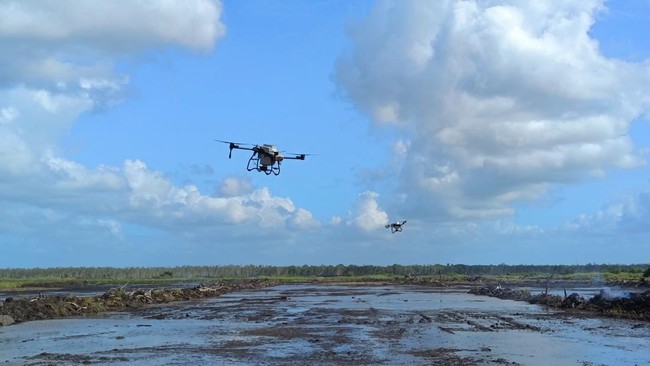
Amran added that agricultural modernisation is becoming visible in Merauke. He highlighted the use of drones for planting, as well as tractors, rice transplanters, and combine harvesters, noting that agricultural technology in Merauke is now on par with developed nations. “Today, planting was done using drones, meaning the technology used in Merauke, South Papua, is on par with Japan, the United States, and other developed countries,” Amran remarked.
In addition to preparing for land expansion and intensification, the government is increasing budget support for South Papua. He revealed that the total agricultural development assistance for South Papua Province in 2026 reaches Rp1,330,546,412,000, or approximately Rp1.33 trillion. This budget includes food crops (Rp75.955 billion), horticulture (Rp108 million), plantations (Rp2.433 billion), livestock (Rp6.482 billion), agricultural land and irrigation (Rp1.144 billion), agricultural infrastructure and facilities (Rp97.393 billion), and agricultural assembly and modernisation (Rp3.497 billion).
Furthermore, Amran promised support for post-harvest infrastructure requested by the local government, specifically the construction of dryers and warehouses in Merauke this year.
Meanwhile, the Regent of Merauke, Yoseph Bladib Gebze, stated that his regency possesses vast agricultural potential. Out of a total of 4.6 million hectares in Merauke, approximately 1.2 million hectares will be cultivated as productive agricultural land.
He mentioned that the central government’s people’s paddy field printing and land optimisation programmes are beginning to transform Merauke’s agricultural production capacity. Of the 17,000 hectares under the paddy field printing programme, about 3,000 hectares were planted last year, and planting area and paddy production are targeted to continue increasing this year.
“There are 12 districts in Merauke Regency currently implementing people’s paddy field printing and land optimisation. Therefore, if we calculate, our agricultural production in Merauke will increase, not just by 100%, but by up to 300%,” Yoseph said.
With the combination of field expansion, increasing the planting index to three times a year, targeting productivity of 7 tonnes per hectare, and an additional agricultural aid of Rp1.33 trillion, the government is pushing Merauke to become one of the food hubs in eastern Indonesia.
Source: jawawa.id (https://jawawa.id/newsitem/amran-targets-merauke-food-estate-to-generate-rp13-trillion-heres-the-formula-1783155064)
Originally published by CNBC Indonesia (https://www.cnbcindonesia.com/news/20260704144248-4-748038/amran-bidik-lumbung-pangan-merauke-hasilkan-rp13-t-begini-rumusnya), translated from Indonesian