
Amran Prepares Seed Subsidies to Boost Rice Production via New Method
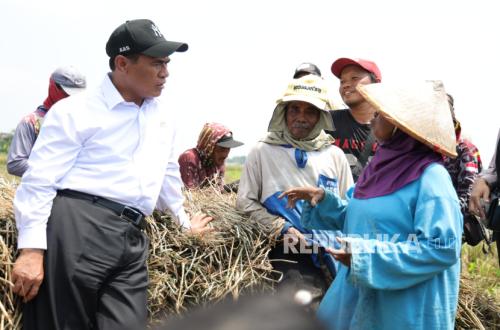
The Minister of Agriculture, Andi Amran Sulaiman, is preparing seed subsidies to expand the implementation of the Advanced Agriculture System (PM-AAS). Next year, the government targets these subsidies to support the application of PM-AAS on at least 1 million hectares of rice land across Indonesia.
Amran stated that PM-AAS was developed to increase both productivity and farmer income. The method has been tested for two years and is now being implemented in various regions, with harvests reportedly reaching over 10 tonnes of dry harvested grain (GKP) per hectare.
“For the first year, God willing, we will subsidise seeds next year,” the Minister said in Subang, West Java, on Wednesday (2/9/2026).
Based on testing by the Agency for Agricultural Assembly and Modernisation (BRMP), the implementation of PM-AAS during the first 2026 planting season was carried out on approximately 2,000 hectares across 15 provinces. From 18 regencies in 13 provinces that have reached harvest time, yield analysis by the Central Bureau of Statistics (BPS) showed an average productivity of 10.34 tonnes of GKP per hectare.
This figure is higher than the average productivity of non-PM-AAS land, which reaches 6.32 tonnes of GKP per hectare. This represents an additional production of approximately 4.02 tonnes per hectare, or an increase of 63.46 per cent.
Twelve out of 18 testing sites, or about 66.7 per cent, also achieved a minimum productivity of 10 tonnes of GKP per hectare. In several other locations, PM-AAS productivity ranged between 9 and 11 tonnes per hectare.
Amran noted that the test results demonstrate that productivity increases can be achieved through plant population management. Under the PM-AAS method, the population, which previously stood at around 360,000 clumps per hectare, can be increased to approximately 800,000 to 1 million clumps.
“This is a twofold increase; what used to be 5 or 6 tonnes is now 11 to 13 tonnes per hectare,” the Minister said.
He explained that each clump produces an average of about 13.8 grams of grain. With a population of around 800,000 clumps, production can reach approximately 11 tonnes per hectare. Higher populations can drive yields to 12–13 tonnes per hectare, depending on land conditions and crop maintenance.
The implementation of this method does not rely solely on increasing population. The Head of BRMP, Fadjry Djufry, stated that PM-AAS is a technology package that combines high-yielding superior varieties, a dense planting system through the ‘jajar legowo’ method, water management using the alternate wetting and drying (AWD) method, integrated weed, pest, and disease control, as well as nutrient management tailored to local needs.
“PM-AAS is not only aimed at increasing productivity but also at building a more efficient and adaptive cultivation system,” said Fadjry.
Regional implementation results also show increased production. In Polewali Mandar, West Sulawesi, a 100-hectare PM-AAS demonstration plot produced approximately 12.5 tonnes per hectare, up from previous productivity levels of around 7–8 tonnes per hectare.
In Sidrap, South Sulawesi, a farmer named Abdullah also recorded an increase in yields from approximately 5–6 tonnes per hectare to 11 tonnes per hectare after participating in the programme. Another farmer, Nurdin, noted that the yields of the Inpari 48 variety he planted increased compared to previous seasons.
According to Amran, the additional cost of implementing PM-AAS is relatively small compared to the increase in income obtained by farmers. He mentioned that the additional requirement for seeds and fertiliser is around Rp 2 million per hectare, while additional income can reach approximately Rp 35 million, or even higher depending on productivity and maintenance.
“The additional cost is only Rp 2 million, but the additional income is Rp 35 million,” said Amran.
To accelerate adoption at the farmer level, the government will provide seed subsidies with a target of at least 1 million hectares next year. Amran stated that regions demonstrating commitment to accelerating PM-AAS implementation will be prioritised for this support.
“At least 1 million hectares. If that happens, it will increase welfare,” he said.
Amran calculated that if implementation on 1 million hectares results in an average additional production of 5 tonnes per hectare, national grain production could potentially increase by about 5 million tonnes. If the coverage is expanded to 2 million hectares, the additional production could potentially reach approximately 10 million tonnes.
He assessed that this productivity increase is vital because national rice production has remained relatively stagnant for about 20 years at around 5.3 tonnes of dry milled grain (GKG) per hectare, or approximately 6.3 tonnes of GKP per hectare. Therefore, technology is one of the instruments to drive production without relying solely on increasing land area.
In addition to increasing productivity, PM-AAS uses a direct seeding system. This system streamlines the nursery process, eliminating the seedling stage that usually requires about two to three weeks.
Amran said this time efficiency opens opportunities to increase the planting index. With shorter planting times, farmers are believed to be able to pursue planting patterns of up to three times per year.
“It is direct, so three plantings per year is very possible,” he concluded.