
Amran Orders Revocation of Problematic Fortified Rice Distribution Permits
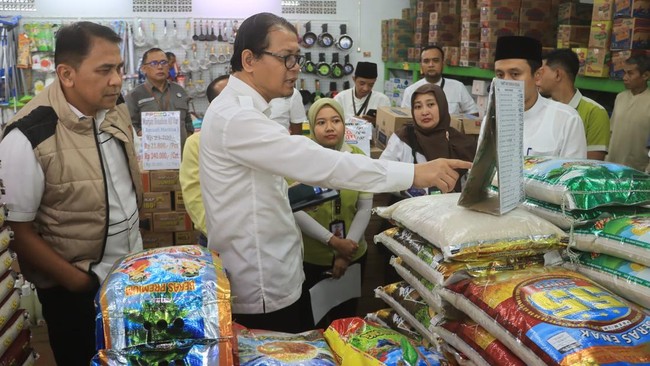
The head of the National Food Agency (Bapanas), who is also the Minister of Agriculture, Amran Sulaiman, has ordered the revocation of distribution licences for a number of fortified rice brands and rice with nutritional claims, after they were proven not to meet requirements based on laboratory test results.
The order was issued after Bapanas found that the majority of fortified rice and nutrition-claim rice samples monitored in April 2026 in the Jakarta area did not comply with applicable regulations.
“As head of Bapanas, I order the Secretary-General and the Deputies: revoke their licences. Pass the order down the line. That is my authority. Revoke their licences and they must not distribute, because these are laboratory results,” Amran said firmly in a statement quoted on Thursday (30/7/2026).
Beyond revoking distribution licences, Amran also requested that the suspected violations be processed legally through the Food Task Force.
“Then for the criminal side, send it to the Food Task Force. Today the Secretary-General will write directly to the Food Task Force. Next, I will write directly to the National Police Chief. This will be a long process. I will pursue it. I am prepared to risk everything for the sake of farmers and the Indonesian people,” he said.
Based on the results of monitoring 15 samples, comprising three fortified rice samples and 12 nutrition-claim rice samples, laboratory results showed that only three of the 12 nutrition-claim rice samples met the requirements, while the other nine did not comply with the regulations. In addition, three samples failed to display nutritional value information in the form of the Nutritional Adequacy Rate (AKG) percentage on their packaging.
On that occasion, Amran also highlighted the high price of fortified rice, which he considered disproportionate to the quality of the product being sold. According to him, some products are marketed far above the Highest Retail Price (HET) of premium rice, yet their nutritional content does not match the laboratory test results.
“Now, for those that do not match lab results, imagine this — the average is Rp22,000 per kilogram, but some are being sold at up to Rp42,000 per kg. Does that make sense? These are just our first samples, and the estimated consumer losses could reach Rp71 trillion,” he said.
From the monitoring results, one sample was found to be sold at up to Rp42,500 per kg. However, laboratory test results showed that one of its nutritional parameters did not match the AKG percentage stated on the packaging.
Amran considers this finding to mark a new chapter in the quality surveillance of fortified rice. He said the inspections were carried out following reports and complaints from the public.
“This is something new. There is a new chapter. There is an Indonesian National Standard (SNI) for fortified rice. These are the requirements. So this is the second emergency. But this is still provisional. We will check again. They clearly have not repented, which is why we are checking directly. This came from public reports and complaints,” Amran explained.
He then asked the authorities to take action against producers who do not comply with the rules, so that the issue of rice prices does not continue to burden the public.
“They say rice prices are expensive — go after those (non-compliant producers). Instead, it is the government being chased. Some ask: where is the proof of self-sufficiency? There is the proof — there are the culprits. Enough,” he said firmly.
As a follow-up, Bapanas will expand its surveillance of fortified rice and nutrition-claim rice. The next round of monitoring is targeted to cover 40 brands across 11 provinces, with at least 200 samples to be tested through accredited laboratories.
For information, fortified rice producers are required to hold a Fresh Food of Plant Origin (PSAT) distribution licence issued by Bapanas together with the Regional Food Safety Competent Authority (OKKPD).
Fortified rice must also comply with Indonesian National Standard (SNI) 9372:2025, which regulates the content of vitamin B1, folic acid, vitamin B12, iron and zinc in every 100 grams of product.