
Amran Imposes Moratorium on New Fortified Rice Product Permits
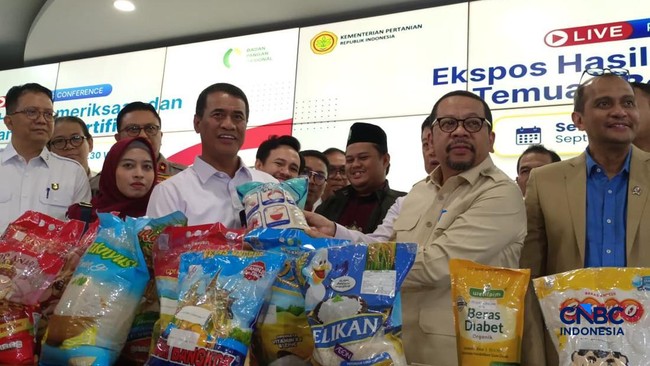
Jakarta, CNBC Indonesia — The government has temporarily suspended the issuance of marketing permits for new fortified rice products after finding discrepancies in the nutritional content and quality of products on the market. The moratorium will remain in place while law enforcement investigates producers suspected of fraud.
National Food Agency (Bapanas) chief and Agriculture Minister Amran Sulaiman said the moratorium on permits for new fortified rice products was introduced to prevent manipulation from harming consumers again.
“For fortified rice, we have taken the step of imposing a moratorium on permits for new products. This must not happen again. It is simply deceiving our consumers,” Amran said in a statement quoted on Monday (2 November 2026).
Meanwhile, permits for 25 fortified rice brands found to have breached regulations have been suspended. The move follows action against two fortified rice producers with a total of nine brands. Both are now being investigated by the Indonesian National Police (Polri), after alleged discrepancies were found between the rice’s nutritional content and quality and the claims on its packaging.
Most recently, the Polri Food Task Force, North Sumatra Regional Police and other agencies uncovered alleged violations by a producer identified by the initials PT UDS in Deli Serdang, North Sumatra, on 30 October 2026.
PT UDS is known to own four fortified rice brands: PBK, GNB, GNM and IMC.
National Police Criminal Investigation Department director for special economic crimes and head of the Polri Food Task Force, Senior Commissioner Suhasto, said the case began with monitoring and the collection of samples by Bapanas officers. The samples were then tested in a laboratory to verify their quality and nutritional content.
“The enforcement action was based on expert examinations and laboratory results for samples collected by Bapanas officers. When we compared the laboratory results with the information on the packaging, we found discrepancies,” Suhasto said.
According to the examination, PBK and GNB rice sold for as much as Rp19,300 per kilogram. Neither brand stated a quality grade on its label, their zinc content did not match the claims—in fact, it exceeded 120 per cent of the claimed amount—and they failed to meet premium-rice standards.
GNM rice sold for up to Rp19,000 per kg, while IMC reached Rp18,200 per kg. Both were also found to have zinc content that did not match their claims, although their rice quality remained consistent with the medium-grade classification.
Suhasto stressed that the enforcement action was based on laboratory evidence and expert testimony, not mere suspicion.
“We must act professionally. Every enforcement measure must have a clear basis, including laboratory test results and expert testimony. We cannot take action abruptly without verifiable evidence,” he said.
Earlier, on 21 October 2026, Polri announced action against fortified rice producer PT DTA, which owns five brands: WJK, IMF, IHJ, CMS and DTR.
The alleged violations involving those brands included discrepancies in vitamin and mineral content, rice quality that did not match premium claims, and problems with marketing permits and nutritional information on packaging.
This brings the total to two producers, with nine fortified rice brands between them, that have been announced as subjects of investigations.
Amran said the government would continue to pursue producers who engage in fraud, adding that the action had been ordered by President Prabowo Subianto.
“Agreed—these actors behind irregularities in fortified rice must be eradicated. The fortified-rice mafia must be eradicated. We have reported this to the National Police chief, and it is an order from President Prabowo. The food mafia must disappear from Indonesia,” Amran said.
Consumers could face losses of Rp89 trillion
On 15 September 2026, Bapanas announced that it had found 25 fortified rice brands suspected of breaching administrative requirements and rules on nutritional content and quality. The brands came from 11 producers.
The findings followed Bapanas monitoring of fortified rice sales in 11 provinces during July and August 2026. The agency collected 190 samples representing 27 trade names.
Testing found that all 25 problematic brands failed to meet the nutritional claims on their packaging. Other issues included invalid marketing permits and premium-quality claims that did not reflect the actual quality of the rice.
Bapanas estimates that the practices could cause consumer losses of Rp89 trillion, calculated from the difference between the prices paid and the specifications promised for the products.
Amran said the moratorium on permits for fortified rice would be one of the government’s measures to prevent similar practices from recurring, while legal proceedings against producers suspected of violations continue.
Source: jawawa.id (https://jawawa.id/newsitem/amran-imposes-moratorium-on-new-fortified-rice-product-permits-1793595076)
Originally published by CNBC Indonesia (https://www.cnbcindonesia.com/news/20261102105323-4-781450/tok-amran-moratorium-izin-edar-produk-baru-beras-fortifikasi), translated from Indonesian