
Amran: Illegal Rice Imports Betray the Hard Work of 115 Million Indonesian Farmers
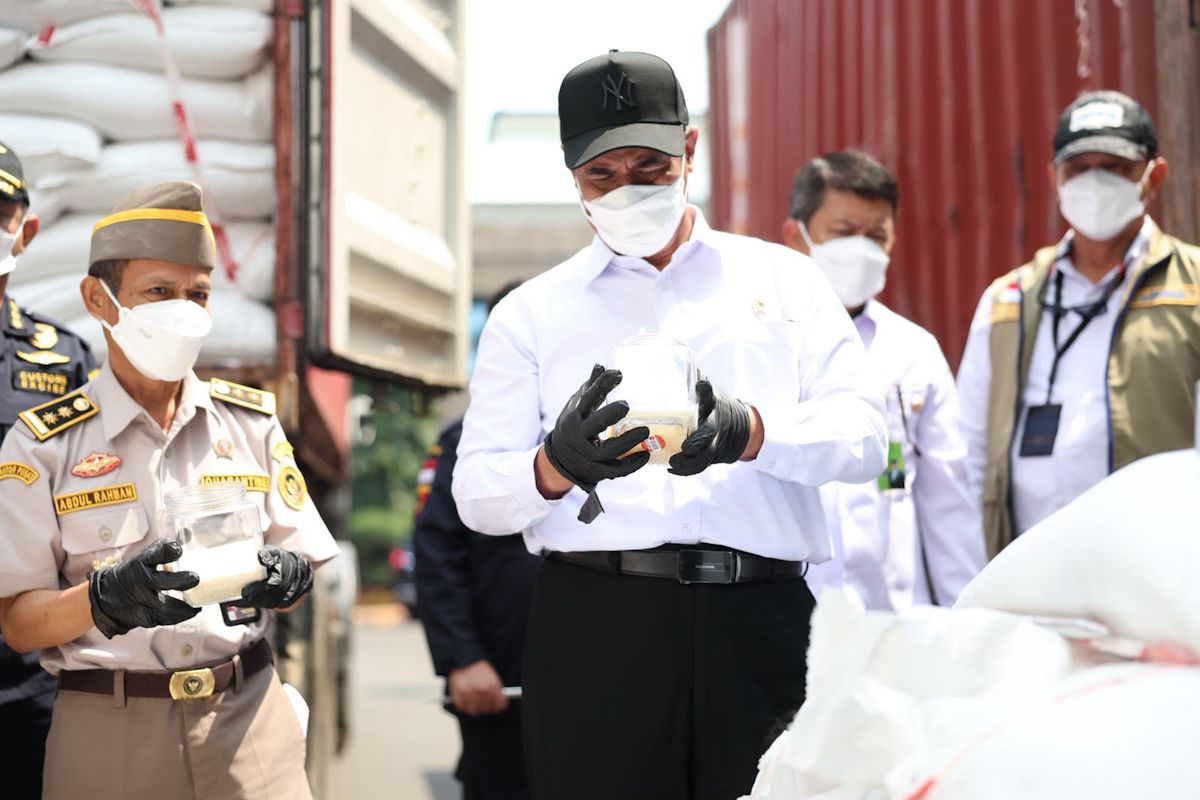
Jakarta (ANTARA) - The Minister of Agriculture and Head of the National Food Agency (Bapanas), Andi Amran Sulaiman, has emphasised that the entry of illegal rice must be eradicated as it betrays the hard work of 115 million Indonesian farmers and disrupts the nation’s ambition to achieve self-sufficiency without imports.
“This harms farmers; 115 million farmers suffer due to illegal rice imports. We have achieved self-sufficiency (including rice), yet smuggling persists,” Amran stated in Jakarta on Wednesday.
He made these remarks in response to enforcement actions against the illegal importation of rice, salt, and compressed bales, conducted by the Directorate General of Customs and Excise of the Ministry of Finance in Jakarta on Tuesday (22/9).
Amran asserted his full support for these actions, noting that the government must not allow space for illegal practices that disadvantage farmers. According to him, approximately 115 million farmers are the parties harmed when illegal rice enters and circulates in the domestic market.
He noted that this issue requires serious attention, as it is not the first time violations have occurred in the rice sector. He referenced several previous cases handled by the government, including issues regarding premium and medium-grade rice, as well as alleged violations involving fortified rice.
“This harms both rice farmers and consumers. Previously, violations involving premium rice being sold as medium-grade rice resulted in losses of up to Rp98 trillion, while alleged violations in fortified rice reached Rp89 trillion. There are even perpetrators who are repeat offenders; it is a recurring issue because it is highly lucrative,” Amran explained.
Therefore, Amran insisted that practices harming farmers and the public must be eradicated collectively. He described such practices as an enemy that the government must confront.
“This is an enemy of the state. It harms 286 million people, including 115 million farmers. This is what we must oppose,” he asserted.
The Minister of Agriculture also expressed appreciation to the Minister of Finance, Suahasil Nazara, and the Directorate General of Customs and Excise for their enforcement actions against illegal imports. He hopes that supervision and law enforcement in the food sector will continue to be strengthened.
He emphasised that eradicating the ‘food mafia’ is part of the directives from President Prabowo Subianto. The government will continue to strengthen oversight and take action against various violations in the food sector.
The enforcement of illegal rice imports by the Directorate General of Customs and Excise is part of the government’s effort to protect the domestic market, safeguard farmers and consumers, and ensure that food self-sufficiency achievements are not disrupted by illegal trade practices.
Between August and September 2026, the Directorate General of Customs and Excise conducted four enforcement operations in the Malacca Strait, Tanjung Perak Port, bonded zones in Bogor, and Tanjung Priok Port.
Through these operations, Customs seized 30 containers containing rice and salt that did not match customs declarations, as well as approximately 1,435 bales of suspected second-hand clothing. The total value of the seized goods is estimated to reach Rp27.34 billion.
In one case at Tanjung Perak Port, East Java, 15 containers of imports from India were declared in customs documents as ammonium chloride. However, physical inspections revealed 202,450 kg of rice and 211,000 kg of salt. Laboratory tests by Surabaya Customs subsequently confirmed the contents were indeed rice and salt. The value of the goods in these 15 containers is estimated at approximately Rp7.85 billion.
Finance Minister Suahasil Nazara emphasised that the illegal entry of rice into Indonesia tarnishes the nation’s food self-sufficiency achievements.
Amidst the hard work of the government and farmers to increase domestic production, rice smuggling has the potential to disrupt the market and harm both farmers and consumers.
“The smuggling of rice into Indonesia actually tarnishes food self-sufficiency. Self-sufficiency is achieved through our own production. We work on the policy side, and our farmers work on planting paddy with high productivity, but this is tainted by such smuggling,” said Suahasil.
He noted that the size of the Indonesian market makes it an attractive target for various foreign commodities to enter the domestic market. Therefore, supervision must be strengthened to protect the market and the interests of the public.
“This is being done because the Indonesian market is large and enticing for all global players across various goods. We must protect our market,” he said.
He reiterated that illegal rice ultimately harms farmers and consumers. In addition to potentially disrupting the domestic rice market, illegally imported rice cannot be verified in terms of storage, shipping, packaging, or quality.
“In the case of rice, it is our farmers and consumers who suffer. Because with illegal rice, the storage, shipping, packaging, and quality cannot be accounted for,” he concluded.
Source: jawawa.id (https://jawawa.id/newsitem/amran-illegal-rice-imports-betray-the-hard-work-of-115-million-indonesian-farmers-1790186331)
Originally published by Antara (Indonesian) (https://www.antaranews.com/berita/5755656/amran-masuknya-beras-ilegal-khianati-kerja-keras-115-juta-petani-ri), translated from Indonesian