
Amran Exposes Rice Company Raking in Abnormal Profits of Rp 2 Trillion per Month
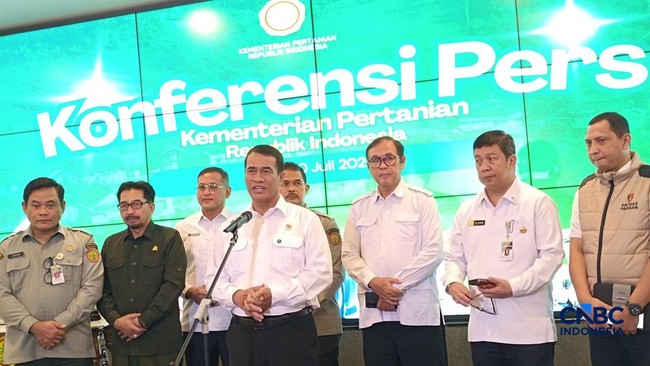
Jakarta, CNBC Indonesia – Agriculture Minister Amran Sulaiman has revealed the results of an analysis of the national rice trade, indicating that suspected rice mafia practices remain rampant. Based on the study, the government estimates that losses from premium rice circulating below quality standards have reached Rp 98 trillion.
This also answers the viral issue of a rice mill with a monthly income of Rp 2 trillion during the harvest season, raised by President Prabowo Subianto. Amran said Prabowo was very polite in raising the matter, when in fact it is a genuine issue that harms farmers.
“These trillions of rupiah are not legitimate business profits. This is stealing the people’s rights. It is fraud,” Amran stated firmly at a press conference at his office in Jakarta on Thursday (30/7/2026).
According to Amran, such large losses have occurred despite the substantial food security budget disbursed by the government. In 2025, the food security budget stood at Rp 144.6 trillion, channelled through ministries and agencies at Rp 59.42 trillion, state-owned enterprises at Rp 63 trillion, transfers to the regions at Rp 22.17 trillion, and financing of Rp 0.05 trillion.
With that budgetary support, the national rice production value reached Rp 537 trillion, with rice output of 34.69 million tonnes. However, the distribution of profits is considered uneven. Farmer household income reached only Rp 1.87 million out of an allocation of Rp 215 trillion, whilst rice milling units (RMU) captured the largest share, up to Rp 259 trillion.
Indeed, according to the Agriculture Ministry’s findings, one group of companies is suspected of raking in illicit profits of up to Rp 2 trillion per month through rice quality fraud.
Amran explained that the analysis shows the national rice supply chain remains dominated by large business groups. He said some players exploit government subsidies for commercial purposes to the tune of 40% and sell rice above the Highest Retail Price (HET).
Field supervision findings also show that 85.56% of premium rice samples failed to meet Indonesian National Standards (SNI). Of the total premium rice in circulation, around 39.75%, equivalent to 12.2 million tonnes, is estimated to breach quality standards, causing losses of up to Rp 98 trillion.
In his presentation, Amran also highlighted inequality in the control of unhusked rice supplies. Of a total national unhusked rice production of around 65 million tonnes per year, 1,056 large-scale mills control around 40% of supply, or 25 million tonnes per year. That figure is equivalent to the absorption of 161,401 small-scale mills, which also take in 25 million tonnes of unhusked rice per year.
He said the long rice distribution chain—from farmers, collectors, distributors, sub-distributors, wholesalers to retailers—also creates profits for intermediaries estimated at Rp 313.08 trillion.
Therefore, the government is encouraging distribution through the Red and White Village/Sub-district Cooperatives so that the distribution route is shorter and the margins enjoyed by farmers and consumers can be larger, with a potential value of up to Rp 50 trillion.
Source: jawawa.id (https://jawawa.id/newsitem/amran-exposes-rice-company-raking-in-abnormal-profits-of-rp-2-trillion-per-month-1785383443)
Originally published by CNBC Indonesia (https://www.cnbcindonesia.com/news/20260730094930-4-754992/amran-bongkar-ada-perusahaan-beras-raup-untung-tak-wajar-rp-2-t-bulan), translated from Indonesian