
Amran Exposes Fraudulent Scheme Involving 25 Brands of Fake Fortified Rice
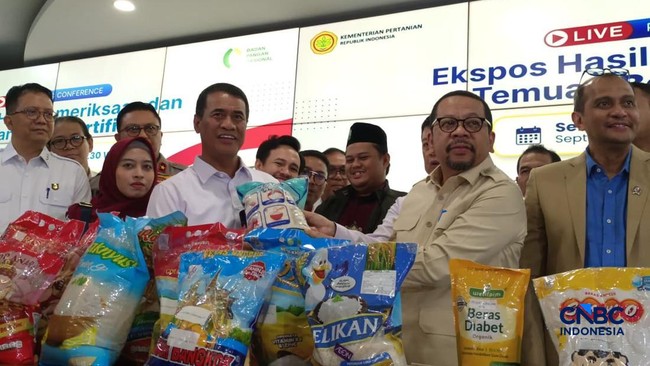
Jakarta, CNBC Indonesia - The Minister of Agriculture and Head of the National Food Agency (Bapanas), Amran Sulaiman, has released a list of 25 brands of fortified rice that have been declared non-compliant with standards (TMS).
All brands with the non-compliant status were announced using initials, namely WFO, WFR, TKS, IMF, NUR, TKL, HOK, BRV, IMR, IHJ, IAK, PBK, GNB, DTR, TKR, WJK, PLK, MKY, IMC, PTK, ARP, ARN, SKM, GNM, and TAR.
Amran stated that these trademarks are products marketed as fortified rice, but after laboratory testing, their contents are suspected to be inconsistent with the labels provided.
“It turns out there is an allegation of switching from premium to fortified rice. They claim it is fortified. After we checked in four credible labs, we found it does not match the labels,” Amrol said during a press conference at his office in Jakarta.
He noted that the selling prices of these products were also recorded far above their fair market value. One of the highest was the brand with the initial WFO, which was recorded being sold at Rp57,600 per kg, while its fair price is Rp13,500 per kg. This represents a suspected fraudulent price difference of Rp44,100 per kg.
Furthermore, the WFR brand was recorded being sold at Rp42,500 per kg, compared to a fair price of Rp13,500 per kg. There was also WJK, sold at Rp33,800 per kg, despite a fair price of Rp14,900 per kg.
Overall, the findings noted an average selling price of Rp23,385 per kg, whereas the average fair price is Rp13,68 89 per kg. The average suspected fraudulent difference reached approximately Rp9,695 per kg.
Amran emphasised that fortified rice is intended for vulnerable groups, including the poor, pregnant women, breastfeeding mothers, toddlers, and those related to stunting prevention.
“Fortification is for stunting, the poor, pregnant women, and toddlers; it is not for fraud by individuals or rent-seekers. This must be dealt with firmly,” he asserted.
The government estimates that the suspected consumer losses due to these practices could reach Rp89 trillion.
“It is an allegation; we maintain the presumption of innocence. However, the suspected loss is Rp89 trillion,” Amran stated.
Government to Take Decisive Action
On another occasion, Amran emphasised that the government will take firm action against perpetrators proven to have manipulated products marketed as fortified rice. Violators will face sanctions, including the revocation of permits and a ban on marketing rice in Indonesia.
Amran stated that this step is part of strengthening the supervision of rice trade to ensure the public receives safe food that complies with regulations.
“We have instructed the new Deputy Secretary-General to monitor and act. Those who violated the fortified rice regulations have already had their permits revoked. They are no longer permitted to market rice in the Republic of Indonesia,” Amran asserted.
He added that the government is not only monitoring fortified rice but also the distribution and pricing of premium rice. The government ensures that no practices occur that could harm the public.
He also ensured that the availability of premium rice in the market remains secure. He requested Perum Bulog to optimise the distribution of premium rice, as stocks are plentiful, including immediate supply to retail stores and modern retail networks.
According to him, the government must ensure public needs are met and no supply shortages occur in the market. Therefore, strengthening distribution is a vital part of maintaining food stability.
Supported by the House of Representatives (DPR RI)
Amran’s statement also received support from Member of Commission IV of the DPR RI, Endang S. Thohari. He assessed that the supervision of fortified rice products needs to be tightened because these products are intended for those requiring additional nutritional intake.
“I strongly support the work of the Minister of Agriculture. The fortified rice that has been circulated to the public is very detrimental to those in need,” said Endang.
Endang noted that analyses of several products found companies suspected of falsifying the quality of fortified rice. He expressed regret, as the public expects fortified rice to possess the promised nutritional benefits.
“It turns out that after analysis, some companies were found to be falsifying quality. This is very regrettable because the public expects fortified rice to be of high quality, containing vitamins and antioxidants for pregnant women and children facing stunting,” he said.
Consequently, Endang urged stricter supervision, including direct inspections of retail outlets selling fortified rice. He believes this step is essential to protect the public from non-compliant products.
He also called for strict sanctions for proven violators, as such practices are deemed harmful to public health.
Source: jawawa.id (https://jawawa.id/newsitem/amran-exposes-fraudulent-scheme-involving-25-brands-of-fake-fortified-rice-1789818772)
Originally published by CNBC Indonesia (https://www.cnbcindonesia.com/news/20260919180352-4-769236/amran-bongkar-modus-jahat-25-merek-beras-fortifikasi-abal-abal), translated from Indonesian