
Amran: 25 fortified rice brands found fraudulent, consumers estimated to have lost Rp89 trillion
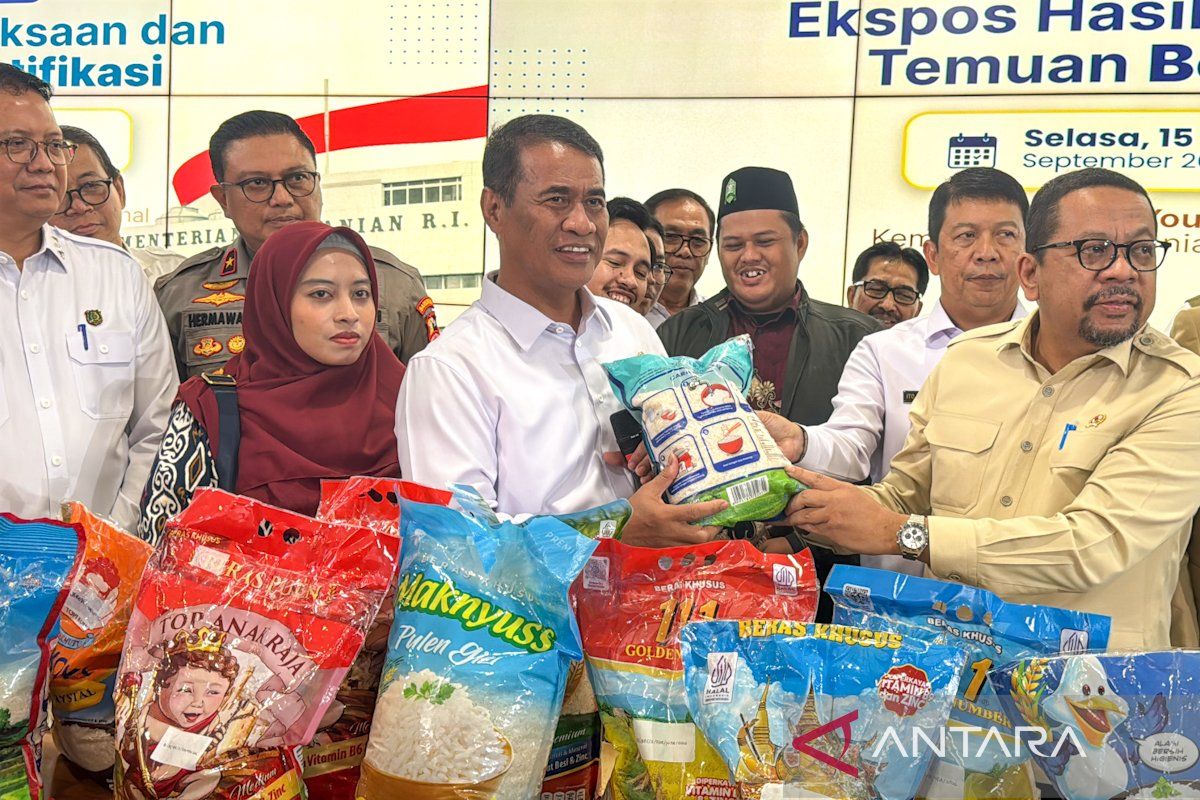
Jakarta (ANTARA) - Minister of Agriculture and head of the National Food Agency (Bapanas), Andi Amran Sulaiman, has revealed findings against 25 fortified rice brands allegedly not meeting the standards and contents stated on their labels, causing losses to consumers of up to Rp89 trillion.
“First, we have ordered a recall; second, the revocation of their licences; third, they are being processed. The total losses are estimated at Rp89 trillion,” said Amran during a presentation of the examination results and findings on fortified rice at the Ministry of Agriculture’s central office in Jakarta on Tuesday.
He stated that 25 fortified rice brands failed to meet the content and quality requirements under SNI 9314:2024 for fortified rice kernels and SNI 9372:2025 for fortified rice.
The rice brands alleged to have committed violations are WFO, TKS, IMF, NUR, TKL, HOK, BRV, IMR, IHJ, IAK, PBK, GNB, DTR, TKR, WJK, PLK, MKY, IMC, PTK, ARP, ARN, SKM, GNM, TAR, and CMS.
In response to these findings, he said the government has taken firm action by ordering the withdrawal of the products from circulation, revoking licences, and processing those allegedly involved in accordance with applicable law.
Amran explained that the findings are a serious concern for the government because rice is a strategic foodstuff affecting the interests of the wider public. The government is not only ensuring rice availability, but also the quality and safety of the products consumed by the public.
He explained that the findings began with an examination of products marketed as fortified rice.
Based on tests conducted at the IPB Bogor Laboratory, the BRMP Laboratory, Saraswanti Indo Genetech (SIG), and the certified Eurofins Angler Biochemlab, products were found that allegedly did not contain the fortification levels stated on their labels.
“After we checked in the laboratory, it turned out they did not match their labels. This is what we are acting on,” said Amran.
The government recorded 25 brands alleged to have committed fraud over content discrepancies. Amran noted that fortified rice has a specific purpose: to help meet the nutritional needs of vulnerable groups, including the poor, pregnant and breastfeeding mothers, toddlers, and other groups requiring nutritional support.
“Fortification is not meant to replace premium rice. It is for vulnerable groups, stunting sufferers, the poor, pregnant and breastfeeding women, and toddlers. If it is sold at a very high price, it is clearly off target,” said Amran.
Beyond the content issue, he said the government found a very large price disparity. Products that should have been priced at around Rp13,000–Rp13,500 per kilogram were found being marketed at up to Rp57,000 per kilogram.
According to Amran, this price difference is highly detrimental to the public, especially when the product purchased turns out not to provide the fortification content as promised.
“The highest was sold at Rp57,000. It should be around Rp13,500. The difference can reach Rp44,100 per kilogram. This is very detrimental to consumers,” he said.
The government estimates that consumer losses from the alleged practice could reach around Rp89 trillion. This figure is an estimate and remains part of an ongoing investigation together with law enforcement authorities.
The minister stressed that the government will not tolerate any party profiting at the public’s expense, particularly given that these products relate to groups in need of nutritional support.
“Do not let anyone make things difficult for ordinary people. We want everyone to grow together, but no one should harm ordinary people,” said Amran.