
Amnesty Criticises Constitutional Court Ruling on Presidential Criticism
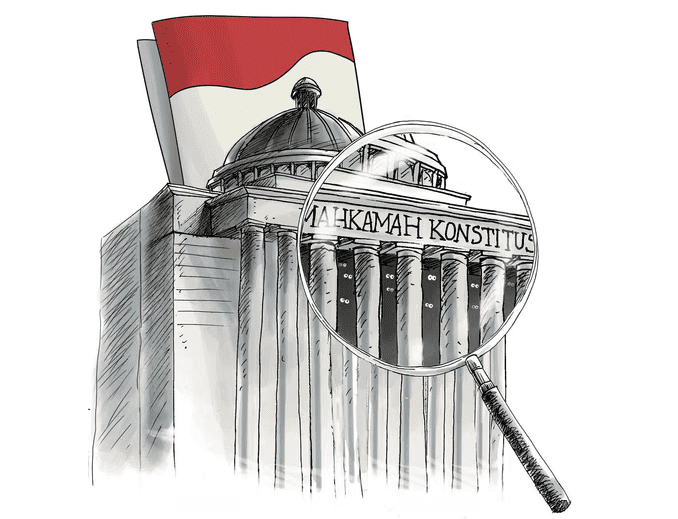
Amnesty International Indonesia has assessed that the Constitutional Court’s ruling on articles concerning insults against the president and vice president still leaves a threat to freedom of expression. The organisation believes the court should have annulled the criminal provisions entirely, rather than merely narrowing the parties entitled to file complaints.
Amnesty International Indonesia Media Manager Haeril Halim said the court’s latest ruling demonstrated an inconsistent stance in protecting citizens’ constitutional rights. He noted that the court had a different track record when it annulled the presidential insult article in the old Criminal Code in 2006.
“The Constitutional Court is inconsistent in protecting citizens’ constitutional rights to be free from elastic articles on insulting the president and vice president. In 2006, the court revoked the insult article from the old Criminal Code, but now it has contradicted itself by echoing the DPR,” Haeril said in a statement on Wednesday (19/8).
The statement was issued in response to Constitutional Court Decision Number 275/PUU-XXIII/2025, which partially granted a petition for judicial review of Articles 218, 219, and 220 of Law Number 1 of 2023 concerning the Criminal Code.
In its ruling, the court did not annul Articles 218 and 219, which regulate the criminal offence of attacking the honour or dignity of the president and vice president. However, the court altered the provisions regarding who may lodge a complaint over such matters.
The court declared Article 220 paragraph (1) of Law Number 1 of 2023 conditionally unconstitutional unless it is interpreted to mean that prosecution may only be pursued based on a direct complaint from the president and/or vice president. Consequently, family members, sympathisers, supporters, volunteers, and third parties acting on behalf of the head of state may no longer file complaints over alleged insults.
Haeril acknowledged that the restriction could prevent abuse of the article by parties who are not the direct targets of the act. However, he said the decision had not eliminated the core problem because citizens could still face criminal proceedings if the president or vice president themselves reported criticism deemed to attack their honour or dignity.
“Nevertheless, the space for criminalising citizens who criticise the president remains open if the president and/or vice president report the matter to law enforcement,” he said.
According to Haeril, the court should have taken a stronger position as an institution safeguarding freedom of expression. The failure to annul Articles 218 and 219 in their entirety, he said, means that space for freedom of expression in Indonesia still faces the threat of criminalisation.
He reminded that freedom of expression is a right guaranteed under national law and international human rights law, including the 1945 Constitution. That freedom, Haeril said, may be restricted under certain conditions, including to protect the reputation of others. However, international human rights standards, he said, recommend that protection of reputation should not be pursued through criminal punishment.
Haeril assessed that the use of criminal law against citizens’ expression could potentially create fear within society. That condition, he warned, could lead citizens to remain silent and avoid criticising the government for fear of facing legal proceedings.
“Criminalisation in the space of expression like this will instead create a climate of fear in society and is a form of repressive tactic to silence criticism in the public sphere,” he explained.
Beyond the issue of freedom of expression, Amnesty also highlighted the historical roots of the presidential insult provisions. Haeril said the article is linked to regulations inherited from the Dutch colonial administration, which were once used to provide legal protection to the Queen of the Netherlands.
According to him, the existence of similar provisions in Indonesia’s current legal system is a separate problem because the article is considered potentially to provide special treatment to those in power. It is also deemed inconsistent with the principle of equality before the law.
“Moreover, historically the presidential insult article is a legacy of the colonial government. The Dutch used the article to protect the Queen of the Netherlands. It is deeply ironic that the government still maintains this article inherited from the colonial era,” Haeril said.
He added that the presidential insult article, throughout its history, has often been associated with efforts to limit criticism of the government. Therefore, he assessed that a restriction targeting only the complaint mechanism is insufficient to ensure that space for public criticism remains safe.
The Constitutional Court’s ruling on 12 August 2026 was the result of a review of three articles in the new Criminal Code. Besides determining that complaints must come from the president and/or vice president who are the direct targets, the court affirmed that the mechanism constitutes an absolute complaint offence and that complaints may be submitted in writing.
Meanwhile, the petition to annul Articles 218 and 219 in their entirety was rejected by the court. The petitioners had previously argued that the two provisions represented the reappearance of the lèse-majesté offence from the Dutch colonial era, which granted legal privilege to those in power and contradicted the principle of equality before the law.
Amnesty International Indonesia assessed that the matter is not resolved merely by limiting who may file a complaint. As long as criminal articles concerning insults against the president and vice president are maintained, Haeril said, the potential for criminalising citizens’ criticism remains open.
Source: jawawa.id (https://jawawa.id/newsitem/amnesty-criticises-constitutional-court-ruling-on-presidential-criticism-1787133116)
Originally published by Media Indonesia (https://mediaindonesia.com/politik-dan-hukum/923566/amnesty-soroti-putusan-mk-soal-kritik-presiden), translated from Indonesian