
Amikom Hosts ‘Battle of Surabaya’ Screening to Help Young People Rediscover the Meaning of Heroism
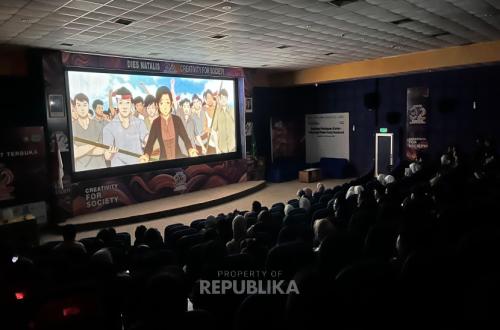
SLEMAN — Ahead of Heroes’ Day on 10 November, Universitas Amikom Yogyakarta held a screening of the animated film Battle of Surabaya at the university’s cinema on Monday (9 November 2026). Attendees included pupils and teachers from SMA Masjid Syuhada Yogyakarta, Amikom students and village-government representatives, including village heads, local officials and community members.
Amikom rector Prof Suyanto said the screening was one way to encourage young people to recall the values embodied by the nation’s heroes. He hoped they would learn from the spirit of sacrifice, courage and compassion portrayed in the film, and apply those values to life today.
Heroes’ Day, he said, was an opportunity for everyone to reflect on what struggle means in everyday life. He drew attention to the story’s ending, in which the character Musa is able to forgive others. Even John Wright, depicted as a villain, is shown to have a humane side and to be capable of forgiveness.
“To be successful, as well as following the example of our heroes, we should do things for other people. As Prof Gun said, make other people happy. Sometimes we have to make sacrifices ourselves,” he said in an interview after the screening on Monday (9 November 2026).
Suyanto also connected the value of sacrifice with the concept of jiwa mutmainah: a state in which a person can exercise self-control and put others’ welfare first. In his view, the spirit of heroism can be expressed by overcoming one’s ego and benefiting the people around us.
He hoped young people would not only learn about the nation’s history of struggle, but also be inspired to practise sacrifice, compassion and kindness in their daily lives.
“When people reach that level, God will give them miracles. I hope those who watched this will receive a miracle from God, because they have made sacrifices — and that is really about overcoming one’s own ego,” he said.
Suyanto also urged young people to become “foreign-exchange heroes” through creative work. He said contributing to Indonesia could mean producing goods with economic value that can reach global markets.
He recounted his experience developing animation, including the challenges he faced when his early work failed to find a market. That experience led him to study storytelling, intellectual-property management and international film-industry networks.
“Folktales and cultures that have grown in different regions are sources of ideas that can continue to be developed. This can be a way for us to preserve history,” he said.
Prof Gunawan Sumodiningrat, a professor at Universitas Gadjah Mada’s Faculty of Economics and Business, said the screening offered an opportunity to reflect on the nation’s struggle to win independence.
The struggle against colonial rule was intended to give Indonesians the freedom to determine their own aspirations and direction, he said. This meaning of independence is consistent with the goals of the nation and state set out in the preamble to the 1945 Constitution.
“The purpose of life as a nation and state is, in fact, to do good for others. In Javanese philosophy, this is called Memayu Hayuning Bawana,” Gunawan said.
He also encouraged young people to understand the philosophy of Sangkan Paraning Dumadi, which concerns awareness of life’s origins, its purpose and the direction people should take. The spirit of independence, he said, should be realised through self-reliance, including being able to meet one’s needs, work, earn an income and benefit others.
Gunawan stressed that self-reliance was not limited to an individual’s ability to support themselves; it also involved contributing to the wider community. This contribution begins with oneself and one’s family, then extends to society, communities and the nation.
“It starts with being able to support oneself and one’s family, and ultimately the country and nation,” he said.
Gunawan further linked the film’s themes of struggle with the digital era and the creative economy. Digitalisation, he said, gives people opportunities to document their activities and potential, as well as develop that potential into something of economic value.
He described film as an important medium: it can record history and portray life, while also being developed into creative work with economic value and the potential to provide livelihoods.
“Film actually records and captures all aspects of life,” he said.
Digitalisation makes it possible for a work to be documented, valued and developed into a source of income, he added. The screening therefore also carried a message about building self-reliance through technology and creativity.
“This may seem a long way from the Battle of Surabaya, but it can become a reality: we have to be able to support ourselves,” he said.
Source: jawawa.id (https://jawawa.id/newsitem/amikom-hosts-battle-of-surabaya-screening-to-help-young-people-rediscover-the-meaning-of-heroism-1794279090)
Originally published by Republika (https://rejogja.republika.co.id/berita/to9l6h291/gelar-nobarbattle-of-surabayaamikom-ajakgenerasi-muda-temukan-kembali-makna-kepahlawanan), translated from Indonesian