
Amikom Appoints New Professor, Prof Arief Setyanto Highlights AI's Role in Education and Agriculture
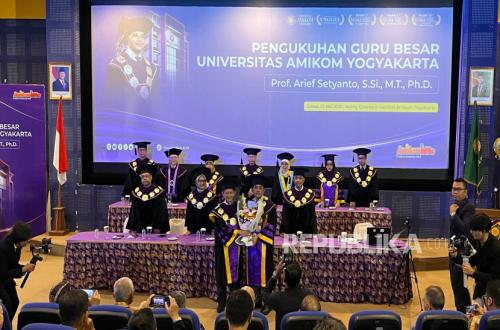
Universitas Amikom Yogyakarta has inaugurated Prof Arief Setyanto, SSi, MT, PhD, as a professor in the field of Artificial Intelligence and Computer Vision during an open senate session held on Tuesday (5/5/2026). This inauguration marks an important milestone in strengthening research and innovation in digital technology.
In his scientific oration titled ‘Computer Vision and Artificial Intelligence in the Digital Transformation of Education and Precision Agriculture’, Prof Arief highlighted the importance of digital sovereignty amid the rapid development of global technology.
He asserted that in the national interest, computer vision and AI can play a significant role in supporting sectors such as education, agriculture, manufacturing, and health. However, he believes that AI development must be accompanied by adequate infrastructure readiness, as well as ethics and regulations.
“In the era of globalisation, we face the risk of dependency on platforms and infrastructure provided by other countries. Artificial Intelligence and computing systems are core technologies where data management is key to digital sovereignty,” he said.
In his research, Prof Arief has developed AI model compression to reduce the need for computing resources such as CPU, GPU, and electricity consumption. This is considered important for expanding AI technology adoption, including in areas with limited digital infrastructure. One practical implementation developed is the concept of a smart class based on computer vision to monitor the learning process.
“Education today is shifting with the advent of AI. When asking students, they can get answers via ChatGPT. Whether students understand or not, we don’t know. AI can actually personalise education,” he stated.
“This product we call a smart class. So there’s a camera that focuses, and it will analyse my performance as a lecturer. Recordings of the lecturer’s audio and video teaching become the basis for evaluating lecturer performance. For students too, we use object detection, followed by expression analysis,” he added.
Besides in the education sector, computer vision technology is also being developed for agriculture through innovations in smart spraying drones. Prof Arief highlighted how AI-based vision technology is now able to transform farming methods. This technology is expected to improve agricultural efficiency through real-time object detection, making the spraying process more selective and targeted.
“We have a very small object detector installed on the drone. So when spraying, not everything is sprayed. For example, for oil palm plants, only the fruit stalks are sprayed. With that, we hope fertiliser use decreases, harvest levels increase by 10-20%, and chemical use drops by 30%,” he said.
He also emphasised the importance of digital sovereignty, stating that technology is not only about mastering and utilising it, but also about maintaining national independence from dependency on platforms and infrastructure provided by other countries.
On this occasion, the Rector of Universitas Amikom Yogyakarta, Mohammad Suyanto, expressed his hope that the newly received highest academic position can be utilised wisely.
“Mr Arief has already applied his knowledge, and hopefully his knowledge will be beneficial. Knowledge is hoped to be used wisely. Wisdom is higher than just being smart,” he said.
The Head of LLDIKTI V for the Special Region of Yogyakarta, Prof Setyabudi Indartono, congratulated Amikom on the new professor’s inauguration. He hopes that his research works will not stop here, but will produce new innovations to be developed.
“The oration was extraordinary. It described tools that can detect in the teaching and learning process, both for lecturers and students,” he said.
“We very much hope that a professor does not stop creating and innovating. His productivity will be greater, his innovations more numerous,” he added.