
Amid Fortified Rice Controversy, Here Are the Retail Prices
Jakarta, CNBC Indonesia - Amid the uproar over problematic or non-compliant fortified rice, products enriched with vitamins and minerals are still displayed on the shelves of modern retail stores.
Fortified rice is regulated under two standards: SNI 9314:2024 for fortified rice kernels and SNI 9372:2025 for fortified rice. Every 100 grams of fortified rice must contain a minimum of 0.25 milligrams of vitamin B1, 0.25 to 0.38 milligrams of folic acid, 1.0 to 1.5 micrograms of vitamin B12, 3.50 to 5.25 milligrams of iron, and 3.0 to 4.5 milligrams of zinc, with a mixing ratio of fortified kernels to milled rice of at least 1 percent.
Supervision by the National Food Agency (Bapanas) in DKI Jakarta in June 2026 found that out of 15 brands of fortified rice, only three met the requirements, while 12 others were declared non-compliant. The retail prices of these products ranged from Rp17,580 to Rp42,500 per kilogram.
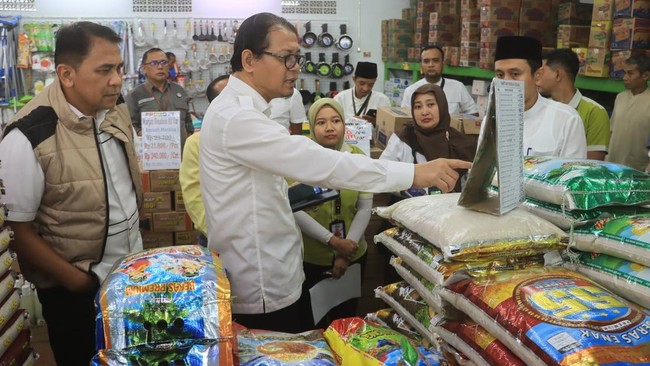
Based on CNBC Indonesia’s observation at two modern retail outlets in Tebet, South Jakarta, on Monday (3/8/2026), fortified rice was neatly arranged on special rice shelves alongside premium rice, medium rice, and Bulog’s SPHP rice.
Several brands of fortified rice were still being sold. The Hok-1 Gohan brand was priced at Rp85,000 per 5-kilogram pack, or around Rp17,000 per kilogram. Meanwhile, the Anak Raja Nusantara brand was sold for Rp101,500 per 5-kilogram pack, or about Rp20,300 per kilogram.
Another product, Topi Koki Short Grain Heritage, was priced at Rp59,500 per 2.5-kilogram pack, equivalent to around Rp23,800 per kilogram.
Based on the packaging, these rice products stated that they had been enriched with vitamins and minerals. Some listed added Vitamin D3 and Zinc, Vitamin B6 and Zinc, or Zinc and Vitamin B6. The composition also stated that the milled rice was mixed with approximately 1 percent fortified rice kernels containing vitamins and minerals.
This rice has been added with micronutrients, such as vitamins and minerals, by mixing fortified rice kernels into ordinary rice. Fortification is carried out to help improve the community’s intake of nutrients without changing the way rice is consumed daily.
Compared to fortified rice, the price of Bulog’s SPHP rice, which was also sold at the location, was lower. The Stabilisation of Food Supply and Prices (SPHP) programme rice was priced at Rp74,500 per 5-kilogram pack, or Rp14,900 per kilogram.
A modern retail employee named Leni said that the Anak Raja Nusantara rice being sold was medium-grade rice that had been enriched with vitamins.
“This is medium-grade, but it has added vitamins,” the employee told CNBC Indonesia. According to her, the most affordable rice option in the store remained Bulog’s SPHP rice.
“The cheapest here is SPHP, Rp74,500, then Hok-1 at Rp85,000,” she said.
When asked whether there had been any withdrawal of fortified rice products amid the growing controversy, Leni confirmed that no such action had taken place. In fact, the current stock had just arrived a few days ago.
“No, there hasn’t been any. This stock just came in a few days ago. Nothing has been withdrawn,” she concluded.
Previously, the Head of the National Food Agency (Bapanas), who is also the Minister of Agriculture, Amran Sulaiman, ordered the revocation of distribution permits for several brands of fortified rice and rice with nutritional claims that were proven not to meet requirements based on laboratory tests.
The order was issued after Bapanas found that the majority of samples of fortified rice and rice with nutritional claims supervised in the Jakarta area in April 2026 did not comply with applicable regulations.
“As the Head of Bapanas, to the Primary Secretary and Deputies, revoke the permits. Order your subordinates. That is my authority. Revoke the permits and do not allow them to be distributed, because these are laboratory results,” Amran stressed in his statement, quoted on Thursday (30/7/2026).
In addition to revoking distribution permits, Amran also requested that the alleged violations be processed legally through the Food Task Force.
“Then for the criminal aspect, send it to the Food Task Force. Today, the Primary Secretary will immediately write to the Food Task Force. After that, I will write directly to the National Police Chief. This is a long process. I will pursue it. I am ready to stake everything for the farmers, for the Indonesian people,” he said.
Based on the supervision results of 15 samples, consisting of three samples of fortified rice and 12 samples of rice with nutritional claims, laboratory results showed that only three of the 12 samples with nutritional claims met the requirements. The other nine samples did not comply with the provisions. In addition, three samples did not include nutritional value information in the form of the Nutritional Adequacy Rate (AKG) percentage on the packaging.
On that occasion, Amran also highlighted the high price of fortified rice, which he deemed disproportionate to the quality of the product sold. According to him, some products were marketed far above the Highest Retail Price (HET) for premium rice, but their nutritional content did not match the laboratory test results.
“Now, those that do not match the lab results, imagine, even crazier, the average price is Rp22,000 per kilogram, but there are some sold for up to Rp42,500 per kg. Does that make sense? This is just from the samples we took, the estimated consumer loss could reach Rp71 trillion,” he said.
From the supervision results, one sample was found to be sold for up to Rp42,500 per kg. However, laboratory tests showed that one of its nutritional parameters did not match the AKG percentage stated on the packaging.
Amran assessed that this finding marks a new chapter in the quality control of fortified rice. He said the inspection was carried out following reports and complaints from the public.
“This is new. A new chapter. There is an SNI for fortified rice. These are the requirements. So this is a second emergency. But this is still temporary. We will re-check it,” he said.
Source: jawawa.id (https://jawawa.id/newsitem/amid-fortified-rice-controversy-here-are-the-retail-prices-1785757923)
Originally published by CNBC Indonesia (https://www.cnbcindonesia.com/news/20260803143732-4-756100/di-tengah-heboh-beras-fortifikasi-bermasalah-ini-harganya-di-ritel), translated from Indonesian