
Amid Digital Platform Onslaught, Komdigi Urges Local Media Not to Sacrifice Journalistic Ethics
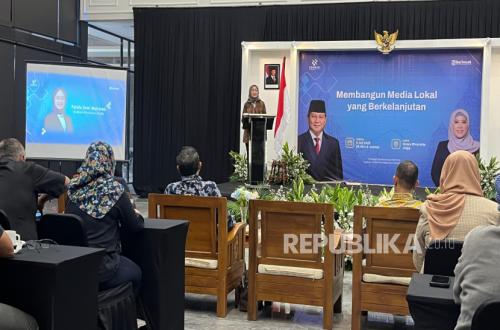
Amid the rapid flow of digital information and the proliferation of content creators, local media are seen as having a significant opportunity to strengthen their position. Changes to digital platform algorithms that now favour local content provide a momentum for regional media to deliver information relevant to the community while maintaining public trust.
Director of Media Ecosystem at the Ministry of Communication and Digital Affairs (Komdigi), Farida Dewi Maharani, acknowledged that technological developments have drastically altered the media landscape. The public no longer relies solely on professional media for information, but also on social media and various digital platforms where anyone can become a content creator.
‘What is most apparent is that the public no longer consumes information solely from professional media. The choices are now far more diverse. Anyone can become a content creator and disseminate information,’ she said during a workshop on building sustainable local media in Yogyakarta on Wednesday.
Farida noted that this shift carries significant consequences. The abundance of information makes it increasingly difficult for the public to distinguish between truth, facts, and manipulation or hoaxes. Social media algorithms also tend to promote emotional and sensational content because it attracts user attention more easily.
‘The question is, will the media get swept up in chasing algorithms just for traffic and popularity, or will it maintain verification, integrity, and professionalism?’ she asked.
Farida stressed that amidst the flood of disinformation, the public needs media that uphold professional journalistic standards. She argued that a media outlet’s greatest asset is not the number of clicks or traffic, but public trust. She urged media in Yogyakarta to face the era of disruption wisely by maintaining journalistic ethics, rather than being carried away by the pursuit of algorithms for traffic and popularity alone.
‘Without trust, there will be no reader loyalty. Without loyalty, the sustainability of the media will be increasingly difficult,’ she said.
According to Farida, local media have an advantage because they understand the character of the community, culture, and regional issues that global platforms or general content creators do not possess. She therefore encouraged the media to continue transforming through improving human resources, utilising technology, and distributing content across multiple platforms without abandoning journalistic principles.
‘Local media have a great opportunity to become part of the region’s identity, as well as a credible information provider and a supporter of development,’ she said.
On the same occasion, the Chairman of the Press Council’s Commission for Complaints and Enforcement of Press Ethics, Muh Jazuli, stated that the media industry is currently experiencing ‘turbulence’ due to two major factors: technological developments and internal media issues.
He noted that technological advances have caused the public to shift from mainstream media to social media, where anyone can now produce content without any journalistic training.
‘Change cannot be avoided. The only thing that never changes in this world is change itself,’ he said.
However, this situation has created an uneven playing field for mainstream media. Professional media are required to comply with the Press Law, the Journalistic Code of Ethics, reporting guidelines, and various other regulations, while content on social media can circulate without any verification process.
Jazuli warned that the threat to the media does not only come from outside, but also from the declining ethical standards within the media itself. He revealed that the number of complaints to the Press Council continues to rise. In 2024, there were around 600 complaints, which increased to approximately 1,200 cases in 2025. As of the end of June 2026 alone, the number of complaints has already exceeded 700 cases.
The majority of these reports, he said, actually come from verified media outlets and journalists with ‘utama’ (primary) status. The most common violations include unbalanced reporting, failure to verify, accepting bribes, and extortion of sources.
‘Mainstream media operate within a very strict regulatory framework, while social media can convey anything without clear boundaries,’ he said.
‘If it involves extortion, it is no longer just an ethical violation, but has entered the realm of criminal offence,’ he added.
Although the public often receives information from social media first, Jazuli believes that mainstream media remains the reference point when the public wants to verify the truth of information.
For this reason, he also urged press members to prioritise journalism that not only conveys facts but also considers the social impact of every report. According to him, journalists must be able to minimise potential negative impacts, for example by avoiding the use of visuals that trigger trauma or provocative narratives, and by prioritising verified information.
‘As journalists, we must always calculate the impact of every journalistic product we publish. The principle is to minimise the harm that might arise from a report, not merely to chase sensation or profit,’ he said.