
Amid Debate over Relocating Its Habitat, a Javan Rhino Calf Is Born in Ujung Kulon
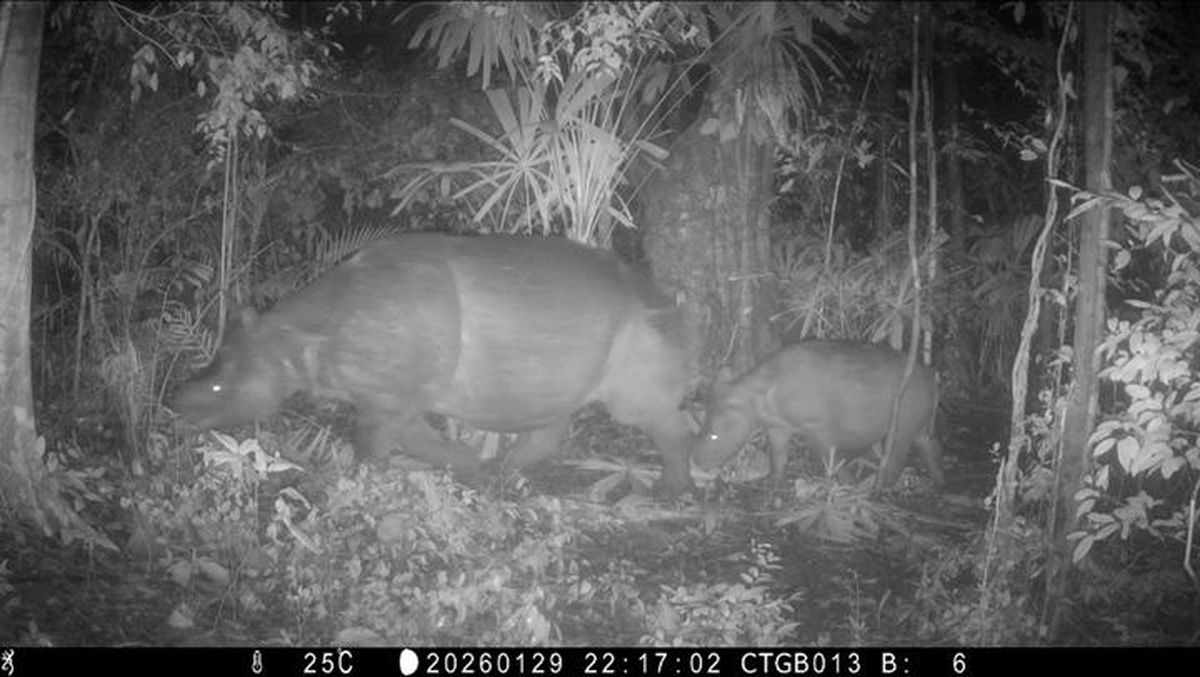
Amid discussion promoted by the Indonesian central government about moving the habitat of the one-horned rhinoceros from Ujung Kulon, Banten, to Alas Purwo in East Java, a Javan rhino (Rhinoceros sondaicus), also known as the one-horned rhino, has been born.
The endemic animal was born in its natural habitat at the westernmost tip of Java, to a mother named Desy.
“This is a blessing and a great hope for the conservation of the Javan rhino, the world’s rarest species, which is found only in Indonesia,” said Mahfudz, Acting Director General of Natural Resources and Ecosystem Conservation, in an official statement published on Monday (16 November).
An estimated 100 one-horned rhinos currently live in their natural habitat in Ujung Kulon National Park (TNUK), in Sumur district, Pandeglang regency, Banten.
A camera trap recorded the newborn wallowing with its mother, identified as Desy, on 10 October 2026.
Desy is one of the Javan rhinos known to have given birth repeatedly. Her mate is named Musofa.
Over the past eight years, Desy has given birth to five calves: Arjuna in 2013, Arum in 2015, Hawa in 2018, Syauki in 2024, and the fifth calf recorded on 10 October 2026.
“The birth is evidence that Ujung Kulon’s habitat remains ideal and that intensive protection efforts are effective,” he said.
Desy’s latest birth also demonstrates that efforts to secure the area through intensive patrols and protection of the habitat from disturbances have created a safe environment for the animals to breed naturally.
“This is not only a source of joy for TNUK, but for Indonesia and the world. We are committed to strengthening protection, including efforts to rationalise the habitat through the Javan Rhino Study and Conservation Area (JRSCA),” Mahfudz said.
Camera-trap footage identifying Desy’s calf was captured at about 9.35pm on 10 October 2026. The calf appeared healthy and was estimated to be between one and two months old.
TNUK’s management has urged communities around the Javan rhino’s natural habitat to protect the rare animal and conserve nature, so that the rhinos can continue to live safely in their natural surroundings.
“Desy herself appears to be in very good condition and is experienced in caring for her young. Our team will continue intensive monitoring around the site to ensure the mother and calf remain safe without being disturbed,” said Ardi Andono, head of TNUK, in a statement published on Monday (16 November).
Debate over habitat relocation
The central government was previously reported to be planning to move part of the Javan rhino population from Ujung Kulon National Park in Banten to Alas Purwo National Park in East Java.
The plan was first made public by Hashim Djojohadikusumo, the President’s Special Envoy for Climate and Energy. Hashim, the younger brother of President Prabowo Subianto, said that the presence of Javan rhinos in Ujung Kulon posed risks in the event of an earthquake, tsunami or volcanic eruption.
One concern, he said, was activity at Anak Krakatau volcano.
“In Ujung Kulon, there is a Javan rhino sanctuary. There is a new problem with Anak Krakatau. If there is a tsunami caused by an earthquake or an eruption, our Javan rhinos could become extinct,” Hashim said at a media briefing for the 31st UN Climate Change Conference (COP31) in Antalya, Türkiye, on Thursday (12 November), as quoted by detik.com.
Hashim said the disaster risks had prompted the government to consider moving some Javan rhinos to Alas Purwo. Relocation would mean the population was no longer dependent on a single habitat.
The proposed move would use a conservation-financing scheme. The government has also begun presenting the project to potential investors at COP31 in Antalya, Türkiye.
Hashim said he was optimistic that donor organisations and investors would support the conservation effort. Indonesia, he said, had potential to develop conservation-financing partnerships, given that it has 57 national parks.
He cited Indonesia’s cooperation with Norway on forest protection and climate-change mitigation. Under the partnership, Norway provided Indonesia with an additional US$100 million, or about Rp1.8 trillion, in recognition of its success in reducing deforestation.
The Ministry of Forestry, which is legally responsible for managing national parks, said Alas Purwo National Park might not be suitable as a second habitat for the Javan rhino. The ministry stressed that habitat relocation cannot be undertaken arbitrarily and requires scientific research and a comprehensive assessment.
“The proposal still requires scientific research and a comprehensive assessment to ensure the area is suitable as a habitat capable of supporting the safety and survival of the Javan rhino,” the ministry said in a post on the Ujung Kulon National Park office’s Instagram account on Sunday (15 November).
The idea of developing a second habitat for Javan rhinos is not new. Since the 1980s, several locations—including Mount Honje, an area now part of Mount Halimun Salak National Park, and Cikepuh—have been discussed as possible alternative habitats.
Although the relocation plan has emerged, Ristianto Pribadi, head of the Ministry of Forestry’s Bureau of Public Relations and International Cooperation, stressed that protection of the Javan rhino must continue and be strengthened.
“Strengthening protection of the primary habitat and developing a second habitat are two efforts that need to proceed side by side,” he added.
The ministry said saving the Javan rhino requires careful planning, a strong scientific basis and a shared commitment.
“This is not simply about moving animals, but about ensuring the future of Indonesia’s rare and treasured species,” it said.
The Javan rhino is one of the world’s rarest rhino species and is now found only in Indonesia, specifically in Ujung Kulon National Park, Banten. The one-horned animal is classified as Critically Endangered.
Local government response
Pandeglang regency’s administration, meanwhile, has rejected the proposal to move Javan or one-horned rhinos from Ujung Kulon.
“I strongly oppose moving Javan rhinos, which are an icon of Pandeglang regency, out of the area,” said Pandeglang Deputy Regent Iing Andri Supriadi, in a statement published on Monday.
He said that, given the many organisations predicting natural-disaster threats to the rhinos’ habitat, the government should conduct studies on how to mitigate those risks without moving the animals from their natural home.
“With the potential for natural disasters identified, I hope the central government will take steps to prevent them from affecting Pandeglang. The Javan rhino must be kept in Pandeglang,” he said.
Iing said the one-horned rhino was a symbol and an icon of the Pandeglang administration, adding that people in southern Banten were proud to be home to one of the world’s rarest animals.
“I ask the central government, or those proposing this programme, to review and reassess it,” he said.
Source: jawawa.id (https://jawawa.id/newsitem/amid-debate-over-relocating-its-habitat-a-javan-rhino-calf-is-born-in-ujung-kulon-1794867625)
Originally published by CNN Indonesia (https://www.cnnindonesia.com/nasional/20261116170730-20-1427785/di-tengah-wacana-habitat-dipindahkan-bayi-badak-lahir-di-ujung-kulon), translated from Indonesian