
Amid Challenges, LPEI Continues to Help SMEs Enter Global Markets
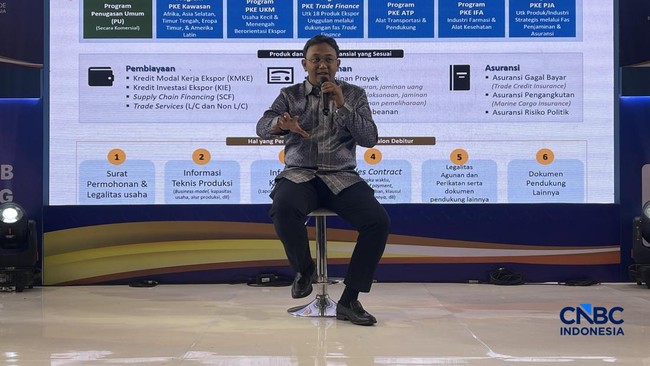
Jakarta, CNBC Indonesia – The Indonesian Export Financing Agency (LPEI), also known as Indonesia Eximbank, continues to support micro, small and medium-sized enterprises (MSMEs) in reaching global markets amid economic uncertainty. LPEI Department Head of NIA, Business Ecosystem & Partnership Agnes Rahadian said that, as a Special Mission Vehicle, LPEI’s principal mandate is to promote national exports through three pillars: financing, guarantees and insurance.
LPEI has allocated up to Rp13.85 trillion for its Special Export Assignment (PKE) programmes. The allocation is divided among nine PKE programmes: those covering Africa, South Asia, the Middle East, Eastern Europe and Latin America (KWS); the Small and Medium Enterprise programme (UKM); and Trade Finance (TFC).
The other programmes cover the Transport Equipment and Supporting Industries (ATP); Pharmaceutical and Medical Equipment Industries (IFA); Guarantees and Insurance (PJA); Aviation Industry (GIA); Mandalika Tourism (MDK); and support for the Priority Tourism Destinations (DPSP).
“We often meet business owners who have only just started thinking about exporting. That does not mean they have no domestic business: they may have been operating domestically for a long time, but have only recently considered exporting. At LPEI, we have a coaching programme for new exporters,” she said at the live-stage session ‘Strengthening Indonesian SME Products to Enter Global Markets: From Financing Support to Easier Export Transactions’ at Trade Expo Indonesia (TEI) on Thursday, 15 October 2026.
Rahadian said the coaching programme gives SMEs classes and a curriculum covering the basics of export procedures, pricing and its components, how to attract overseas buyers, and other topics. She said all the necessary procedures are taught.
“Our financing is export-oriented, but that does not mean we do not support businesses at an earlier stage. We are ready to support transactions with an export orientation,” she stressed.
LPEI also supports MSMEs seeking financing, subject to the required criteria. It can provide bid guarantees for tenders entered by Indonesian businesses overseas. Its insurance offerings include Marine Cargo Insurance and Trade Credit Insurance.
Indonesia Eximbank Insurance Division Head Ilham Mustafa said the two insurance products were designed to provide protection. Trade Credit Insurance can be used by Indonesian businesses if an overseas buyer fails to pay.
“We pay if a buyer defaults. The insurance can be used once a deal has been agreed and the goods have been shipped, if there is concern about whether payment will be made. Insure it with LPEI. If payment falls due and the buyer fails to pay, notify us; we will investigate and, if the default is confirmed for a covered reason, we will pay,” he explained at the 2026 TEI Business Forum, themed ‘Access to Trade Financing and Export Insurance’.
Commercial insurance coverage includes buyer insolvency and non-payment. Political risks covered include government actions, contract frustration, transfer restrictions, currency problems and war.
Marine Cargo Insurance, meanwhile, provides protection if goods are damaged in transit. Ilham said this type of insurance was widely used, including in e-commerce, where protection is often bundled with purchases.
Spice exporter Ari Irawan said he had experienced the benefits of LPEI’s support, including its insurance. At times, he said, some destination countries require insurance.
“We have used Marine Cargo Insurance from this year as a way of ‘being prepared before it rains’,” he said.
Irawan’s main export markets are India and Pakistan, along with newer destinations including South Korea, Taiwan, Egypt, Vietnam and Malaysia. His products include cloves, pepper, Java turmeric and other spices.
Susila Brata, Director of Customs Facilities at the Finance Ministry’s Directorate General of Customs and Excise, said global issues could not be avoided and would disrupt global supply chains, including international transport. These difficulties also posed a challenge for Indonesia and could affect financing.
“We also support incentives for a range of industries. In addition, we have financial attachés overseas who coordinate with trade attachés and can help businesses gain access in their destination markets,” Brata said.