
America in Turmoil Over China's Entry on Blacklist
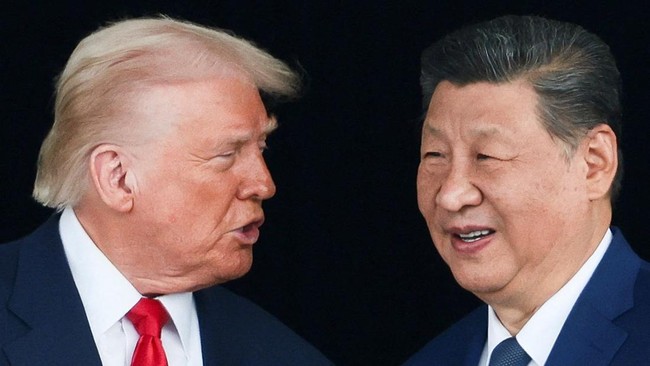
Leaders of the world’s two largest economies are scheduled to meet on 14 May 2026. US President Donald Trump and Chinese President Xi Jinping are set to convene in Beijing to discuss the increasingly uncertain geopolitical situation.
The Trump administration, which previously adopted a firm stance on export controls for technology to China, now appears to be softening its approach. Meanwhile, the Xi Jinping administration is becoming more selective about accepting technology supplies from the US in its country.
The trade war and policy controversies between the US and China have been heating up since the Joe Biden era and continued into the Trump administration. The upcoming 14 May meeting is anticipated to determine the extent to which the US will confront China economically and technologically.
Earlier this year, a new controversy arose involving the Department of Defense (DoD)/Pentagon. The Pentagon added Chinese tech giants Alibaba and Baidu to the blacklist of companies accused of supporting China’s military.
This Pentagon decision is suspected to have triggered divisions within the US government. The blacklist was subsequently cancelled just minutes later. This also caused confusion among investors and policymakers.
Although the blacklist document was quickly removed, shares of the two Chinese giants plummeted sharply following the announcement, according to NewFortuneTimes on Friday (8/5/2026).
The incident reveals divisions within the Trump administration. One faction pushes for stronger actions against China, while another seeks to avoid negative impacts on ongoing diplomatic negotiations ahead of the Trump-Xi Jinping meeting.
The Pentagon’s blacklist, known as the ‘1260H list’, has been under scrutiny in recent years. Companies on this list face restrictions on government contracts, investments, and access to US technology.
Over time, the blacklist has expanded to include several major Chinese companies involved in strategic industries such as semiconductors, artificial intelligence (AI), batteries, and telecommunications. Some companies previously added include Tencent, Huawei, and CATL.
According to a Bloomberg report, the latest attempt to update the blacklist descended into chaos due to debates among Pentagon and White House officials.
The report states that some US national security officials supported adding Alibaba and Baidu to the blacklist. At the same time, concerns grew in the White House regarding plans to remove Chinese chipmakers YMTC and CXMT from the blacklist.
Some officials believe removing these two Chinese chip producers would weaken the US position in the technological war against China. Additionally, such a decision could cause political shockwaves in Washington.
This turmoil is reportedly the reason for the swift removal of Alibaba and Baidu from the additional blacklist shortly after its announcement. It also embarrassed the officials involved in compiling the blacklist. Moreover, the inconsistency of future US policies has become a major question.
Analysts assess that this internal division in the US government reflects broader challenges facing the Trump administration, namely balancing economic cooperation with national security concerns.
In recent months, Washington and Beijing have appeared to maintain a fragile ‘ceasefire’. China has eased restrictions on exporting rare earth minerals, while the US has delayed technology restrictions targeting Chinese companies.
Despite this temporary stability, tensions between the two countries remain high in areas such as semiconductor technology, AI, and trade policies.
Experts believe the meeting next week will play a crucial role in determining whether the US and China will foster more positive cooperation in the future or revert to mutual antagonism.