
Ambassador Djauhari outlines four key areas for Indonesia-China cooperation
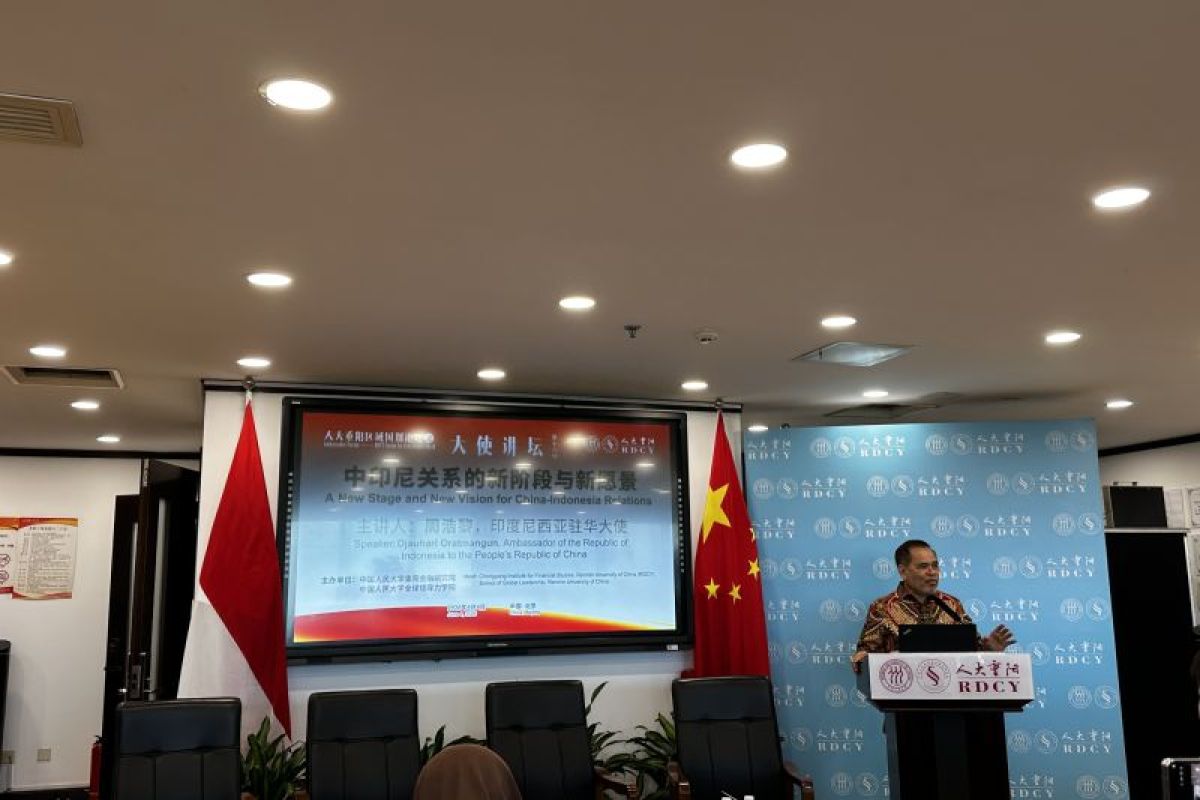
Beijing (ANTARA) - The Ambassador of the Republic of Indonesia to China and Mongolia, Djauhari Oratmangun, has emphasised four key areas that will serve as the focus for a new chapter in Indonesia-China cooperation: artificial intelligence (AI), energy security, food security, and human resource development.
Djauhari shared these insights during the 18th Ambassador Forum discussion, titled “A New Stage and New Vision for China-Indonesia Relations,” organised by the Chongyang Institute for Financial Studies (RDCY) and the School of Global Leadership at Renmin University in Beijing on Thursday (4/6).
According to Djauhari, the first area, artificial intelligence, is a strategic sector that can be utilised to support healthcare, education, disaster management, social protection, and the development of smart cities to improve public quality of life. “AI is becoming increasingly important as many countries face rising fiscal pressures and greater demands for public services. AI can assist governments in providing better services with limited resources, making AI sovereignty increasingly vital,” said Djauhari.
Beyond AI, the second area is energy security. Cooperation in the energy sector is seen as having great prospects. Indonesia, the world’s largest palm oil producer and holder of approximately 40 per cent of global geothermal potential, can synergise with China, which has become a global leader in renewable energy. “Every data centre, smart factory, and digital platform ultimately depends on a reliable electricity supply. Indonesia possesses several unique advantages in the energy sector,” he noted.
In the third area, food security, Djauhari assessed that climate change affecting global food production presents opportunities for broader collaboration. The use of technologies such as AI-based agriculture, smart irrigation, and precision farming could enhance agricultural productivity. “Indonesia’s Free Nutritious Meal programme will further increase demand for domestically produced food and strengthen agricultural supply chains. This opens opportunities for cooperation that can provide direct benefits to the community,” he added.
The fourth focus is human resource development through research cooperation, internship programmes, vocational education, university-level exchanges, and the development of curricula related to AI technology.
In his presentation, Djauhari also highlighted the close economic ties between the two nations. For over a decade, China has been Indonesia’s largest trading partner and has consistently ranked among the top three sources of foreign investment for Indonesia. In 2025, the bilateral trade value between Indonesia and China reached approximately USD 167 billion, while Chinese investment in Indonesia reached around USD 7.5 billion. According to Djauhari, over the last decade, the trade value between the two countries has tripled, while Chinese investment in Indonesia has grown approximately twelvefold.
“The success of the Indonesia-China partnership is also reflected in various concrete projects that have become symbols of South-South cooperation. In infrastructure, one such example is the Jakarta-Bandung High-Speed Railway, the first high-speed train in Southeast Asia,” he said.
He also highlighted Indonesia’s commitment to promoting industrial downstreaming, particularly regarding nickel, which is a vital raw material for electric vehicle batteries and the global energy transition. As the world’s largest nickel producer, Indonesia holds a strategic position in the future industrial supply chain. “When I first arrived in China, there were no Chinese electric vehicle brands in Indonesia. Last year, that number reached 16 companies, demonstrating that the investment climate in Indonesia is steadily improving,” said Djauhari, who has been stationed in Beijing since 2018.
During the Q&A session, a participant asked about the greatest legacy Ambassador Djauhari wishes to leave after nearly eight years of service in China. “If there is one contribution I am proud of, it might be helping to strengthen the habit of dialogue between the leaders of our two nations. Because I believe that no matter how strong the challenges we face in the future, as long as dialogue remains a habit, the relationship between Indonesia and China will remain rational in difference, constructive in challenge, and optimistic about the future,” he stated.
Concluding his presentation, Djauhari emphasised that the primary goal of Indonesia-China cooperation should not only be oriented towards economic growth or technological advancement but must also provide tangible benefits to the people. “Technology has value when it can improve human life. Development has meaning when it can expand opportunities, and cooperation will succeed when it can serve humanity,” he concluded.
Source: jawawa.id (https://jawawa.id/newsitem/ambassador-djauhari-outlines-four-key-areas-for-indonesia-china-cooperation-1780818823)
Originally published by Antara (Indonesian) (https://www.antaranews.com/berita/5595315/dubes-djauhari-paparkan-empat-bidang-utama-kerja-sama-indonesia-china), translated from Indonesian