
Ali Sastroamidjojo: The Marhaenist Diplomat Behind the 1955 Asian-African Conference
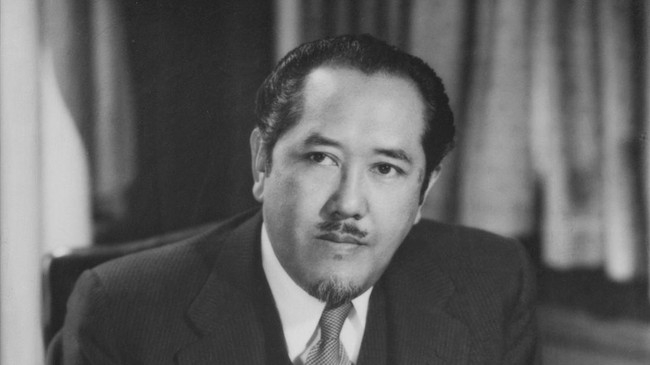
On Heroes Day, 10 November 2026, President Prabowo Subianto awarded Mr Ali Sastroamidjojo the title of National Hero. The state honoured a statesman who played an important role in strengthening Indonesia’s position on the international stage, particularly through the 1955 Asian-African Conference in Bandung.
The award was established by Presidential Decree No. 93/TK/2026 and recognised Ali’s contributions to politics and diplomacy. It also offers an opportunity to revisit his life in greater depth, not simply as a former prime minister but as a Marhaenist diplomat who helped bring together national ideology, the anti-colonial struggle and international diplomacy.
Ali Sastroamidjojo may not receive as much attention in popular accounts of Indonesian history as Sukarno, Mohammad Hatta or Sutan Sjahrir. Yet the Republic’s first decade was shaped not only by leaders who articulated the ideas of revolution, but also by statesmen who translated those ideas into government, negotiations and international relations.
Ali was an important figure in this latter group. He belonged to a generation of nationalists who received political education in Europe, fought colonialism, helped build the Republic’s government and then broadened Indonesia’s diplomatic horizons towards Asian-African solidarity.
The term ‘Marhaenist diplomat’ is used here as an interpretative category for understanding Ali’s political character, rather than as a formal title or an exclusive historical designation.
Marhaenism provides a framework for examining the relationship between nationalism, commitment to the people, Indonesian socialism and the anti-colonial outlook that developed within Sukarno’s political tradition and the Indonesian National Party (PNI). In this context, Ali was a figure who brought Marhaenist nationalism into the practice of state diplomacy.
Building the Republic: The journey of a nationalist
Ali Sastroamidjojo was born in Grabag, Central Java, on 21 May 1903. His legal studies at Leiden University in the Netherlands and his political experience in the Indonesian Association (Perhimpunan Indonesia) formed the intellectual foundations of a nationalist who understood the independence struggle through the perspectives of law, politics and international relations. The Meester in de Rechten degree he obtained in 1927 was not merely an academic achievement, but also an important asset in his political and diplomatic career.
His experience in the Netherlands placed Ali among the nationalist movement’s intellectual circles, which developed a more systematic vision of Indonesian independence. The Indonesian Association, formerly known as the Indische Vereeniging, evolved into a political student organisation that asserted an Indonesian identity and opposed colonialism.
In that milieu, nationalism came to be understood not as allegiance to a local community or a particular ethnic identity, but as a project to establish an independent and sovereign nation. In 1927, Ali was arrested by the Dutch colonial government alongside several Indonesian Association activists, including Mohammad Hatta. The arrests showed that the political activity of Indonesian nationalists in Europe was regarded as a threat to colonial legitimacy.
For Ali, this experience helped shape a political outlook that treated independence as a fundamental issue. He did not become a diplomat through the colonial bureaucratic tradition, but as a nationalist who had directly experienced the anti-colonial struggle.
After returning to Indonesia in 1928, Ali became involved in political and legal activities. He later joined the Indonesian National Party, founded by Sukarno in 1927 and one of the leading forces in the independence movement.
The PNI advanced a form of nationalism centred on mobilising the people, rejecting colonialism and establishing an independent Indonesian state. Marhaenism developed within this political tradition as a conception of nationalism rooted in the interests of ordinary people.
Sukarno’s Marhaenism meant more than charitable support for the poor. It was an ideology of struggle linking nationalism with social and economic liberation.
In Sukarno’s conception, the Marhaen included small farmers, labourers and groups subjected to structural oppression under the colonial system. Sukarno later developed Marhaenism through its relationship with socialism and Marxist thought, emphasising its application to Indonesian society.
Ali did not create Marhaenism. However, as a PNI cadre and a member of a generation shaped by the anti-colonial struggle, he belonged to an ideological environment in which the people were the basis of political legitimacy for independence. Ali’s nationalism cannot be separated from this tradition, although his thinking did not always correspond exactly to every aspect of Sukarno’s ideological formulation.
After the 1945 Proclamation of Independence, Ali took part in consolidating the Republic. He served as Deputy Minister of Information, Minister of Teaching, and Minister of Education and Culture. He was also involved in diplomacy and negotiations to defend the Republic’s existence amid conflict with the Netherlands.
This experience shows that Ali’s nationalism had two connected dimensions: the struggle to build a state at home and the effort to secure recognition and legitimacy internationally.
Ali later served as prime minister from 1953 to 1955 and from 1956 to 1957. Under the parliamentary democracy system, he led cabinets through coalition-building and political negotiations. His governments faced cabinet instability, competition between parties and complex civil-military relations.
Nevertheless, this period was also an important phase in the development of Indonesian diplomacy, particularly in expanding the anti-colonial agenda and strengthening relations with Asian and African countries.
Ali’s journey from the Indonesian Association to the Republic’s government thus illustrates the continuity between the nationalist movement and state diplomacy. He represented a generation that saw independence not as the end of the struggle, but as the beginning of the work to establish political, economic and international sovereignty.
Bandung 1955: Indonesia leads a newly independent world
Ali’s most significant contribution to the history of Indonesian diplomacy was his role in the 1955 Asian-African Conference. Held in Bandung from 18 to 24 April 1955, the conference brought together 29 Asian and African countries to discuss colonialism, peace, international cooperation and the future of newly independent states. Ali Sastroamidjojo was elected conference chair, while Roeslan Abdulgani served as secretary-general.
Bandung did not emerge suddenly as a diplomatic event. It was the result of a political process involving Indonesia, India, Pakistan, Burma and Ceylon, now Sri Lanka. At the Colombo Conference in April 1954, the five countries discussed international issues and the possibility of expanding Asian cooperation.
Ali led Indonesia’s delegation at that meeting and helped propose a conference involving countries from Asia and Africa.
The process leading to Bandung showed that Indonesian diplomacy was not built through unilateral decisions. It required coordination among countries, the development of a shared agenda, negotiations over participation and the management of differing interests.
Ali held a strategic position in this process as both prime minister and leader of Indonesia’s delegation. He connected national political aspirations with the mechanisms of multilateral diplomacy.
Sukarno gave the conference a forceful ideological articulation. In his opening address in Bandung, he presented the experience of colonialism as a historical issue linking the peoples of Asia and Africa. He argued that political independence had to be understood as part of a broader struggle to build an international life free from domination.
As conference chair, Ali performed a different but complementary role: managing the forum, leading meetings, maintaining communication among delegations and helping build consensus amid differing political views.
The Bandung Conference produced the Ten Principles of Bandung, affirming respect for sovereignty and territorial integrity, equality among nations, the peaceful settlement of disputes and opposition to intervention.
These principles became an important foundation for the development of Asian-African solidarity and Global South politics. Bandung gave countries that had previously been subordinated under colonialism a platform to express their international aspirations more independently.
From the perspective of international relations, Ali’s diplomacy can be viewed through the concept of strategic autonomy. This is a contemporary analytical framework, not terminology explicitly formulated by Ali.
Through the Bandung diplomacy, Indonesia expanded its international room for manoeuvre by building relationships across blocs and avoiding subordination to great-power rivalry. The ‘independent and active’ foreign policy gained practical expression through multilateral cooperation and anti-colonial solidarity.
This is where Ali’s character as a Marhaenist diplomat can be seen: Marhaenism did not stop at the idea of liberating the Indonesian people from colonialism, but can also be understood in the context of solidarity with other nations facing similar experiences.
Indonesian nationalism had an international dimension because national independence was seen as connected to the liberation of oppressed peoples. Ali helped translate this outlook into diplomacy that recognised equality between states and advocated political space for postcolonial nations.
Bandung, however, should not be reduced to the achievement of a single figure. Its success was the collective product of the sponsoring countries, diplomats, political leaders and delegates, who had differing interests.
Ali’s contribution mattered precisely because he exercised formal leadership within that collective process. Diplomatic success depends not only on a leader’s rhetoric, but also on the ability to manage differences and reach agreement.
Bandung later inspired the development of Third World solidarity and the Non-Aligned Movement, although the two were not identical. The Asian-African Conference provided a political and normative foundation for developing countries to pursue sovereignty, peace and international cooperation.
In this history, Ali Sastroamidjojo holds an important place as one of the statesmen who connected Indonesia’s anti-colonial vision with the formation of an international agenda.
The Marhaenist diplomat: nationalism, Sukarno and the politics of liberation
Ali Sastroamidjojo’s relationship with Sukarno should be understood through a combination of ideological affinity, political complementarity and distinct institutional roles. Sukarno was the originator of Marhaenism and the leading articulator of Indonesia’s revolutionary nationalism. Ali was a senior PNI cadre with experience in government and diplomacy, enabling him to translate some of that ideological outlook into the practice of state politics.
In the early 1960s, Ali’s association with Marhaenism became more explicit. After being elected PNI chairman in 1960, he took part in strengthening the party’s ideology, which increasingly drew on Sukarno’s thought.
The PNI’s Ninth Congress gave Sukarno the title ‘Father of Marhaenism’, while strengthening Marhaenism’s position within Guided Democracy.
An important development came in 1963. At a celebration marking the PNI’s 36th anniversary on 7 July, Ali presented Marhaenism as scientific socialism in the Indonesian context.
The PNI’s Tenth Congress in Purwokerto in August and September 1963 subsequently adopted this formulation. In 1964, a session of the congress’s working body in Lembang reaffirmed Marhaenism as Marxism applied in accordance with Indonesian conditions.
This development shows that Ali was not merely a symbolic follower of Sukarno. He helped give organisational legitimacy to an interpretation of Marhaenism that increasingly integrated nationalism, socialism and class struggle.
Under his leadership, the PNI underwent a process of ideological radicalisation and strengthened its mass orientation, particularly by emphasising the interests of workers and farmers as the political base of the Marhaen.
This process unfolded amid internal struggles within the PNI. Ali and Surachman belonged to a more radical tendency close to Sukarno, while several other figures maintained a more conservative outlook.
These differences concerned the interpretation of Marhaenism, the PNI’s position under Guided Democracy, relations with the Indonesian Communist Party (PKI) and leadership contests within the party. Ali’s embrace of Sukarno’s Marhaenism therefore had strategic and organisational dimensions, rather than being solely a matter of ideological conviction.
The PNI’s Marhaenism remained distinct from PKI communism. Although it accepted the formulation of Marhaenism as Marxism applied in Indonesia, the PNI retained its own nationalist base, organisational identity and political conception.
Marhaenism itself became an arena of contest over who had the right to represent the people, how Indonesian socialism should be defined and how nationalism should relate to class struggle.
Marhaenism also had a distinctive relationship with Pancasila. Marhaenism was an ideology of social and national struggle oriented towards the liberation of the people, while Pancasila was the state’s philosophical foundation, integrating nationalism, humanity, democracy, social justice and belief in God.
The two were connected in Sukarno’s thought, but cannot simply be treated as identical. Ali helped strengthen the ideological relationship between PNI Marhaenism and Sukarno’s political outlook during Guided Democracy.
Reading Ali as a Marhaenist diplomat therefore offers a broader perspective than a biography of a state official. It shows how an ideology can move beyond the domestic sphere and take shape through diplomacy.
Marhaenism, rooted in the concerns of ordinary Indonesians, found international resonance in the struggle against colonialism, domination and inequality between nations. Ali was one of the figures who connected Indonesian nationalism with Asian-African solidarity through diplomatic work.
President Prabowo Subianto’s decision to award Ali Sastroamidjojo the title of National Hero on 10 November 2026 thus has broader historical significance. The state’s recognition is not limited to honouring a former prime minister or chair of the Asian-African Conference; it is also a reminder that diplomacy was integral to the independence struggle and the establishment of Indonesian sovereignty.
Ali showed that the struggle of a nation does not take place only on battlefields or through revolutionary speeches. It also unfolds in conference rooms, at negotiating tables and in international forums where countries seek recognition and equality.
Source: jawawa.id (https://jawawa.id/newsitem/ali-sastroamidjojo-the-marhaenist-diplomat-behind-the-1955-asian-african-conference-1794707470)
Originally published by CNBC Indonesia (https://www.cnbcindonesia.com/opini/20261115081108-14-785316/ali-sastroamidjojo-sang-diplomat-marhaenis-aktor-di-balik-kaa-1955), translated from Indonesian