
ALFI: Intermodal integration will strengthen Indonesia’s position as an ASEAN logistics hub
Logistics costs will not fall simply by cutting tariffs. The key is end-to-end productivity through the integration of land transport—by road and rail—with sea and air transport.
Jakarta (ANTARA) - The Indonesian Logistics and Forwarders Association (ALFI) believes that intermodal transport integration is key to strengthening Indonesia’s role as an ASEAN logistics hub by 2027, amid the restructuring of global supply chains.
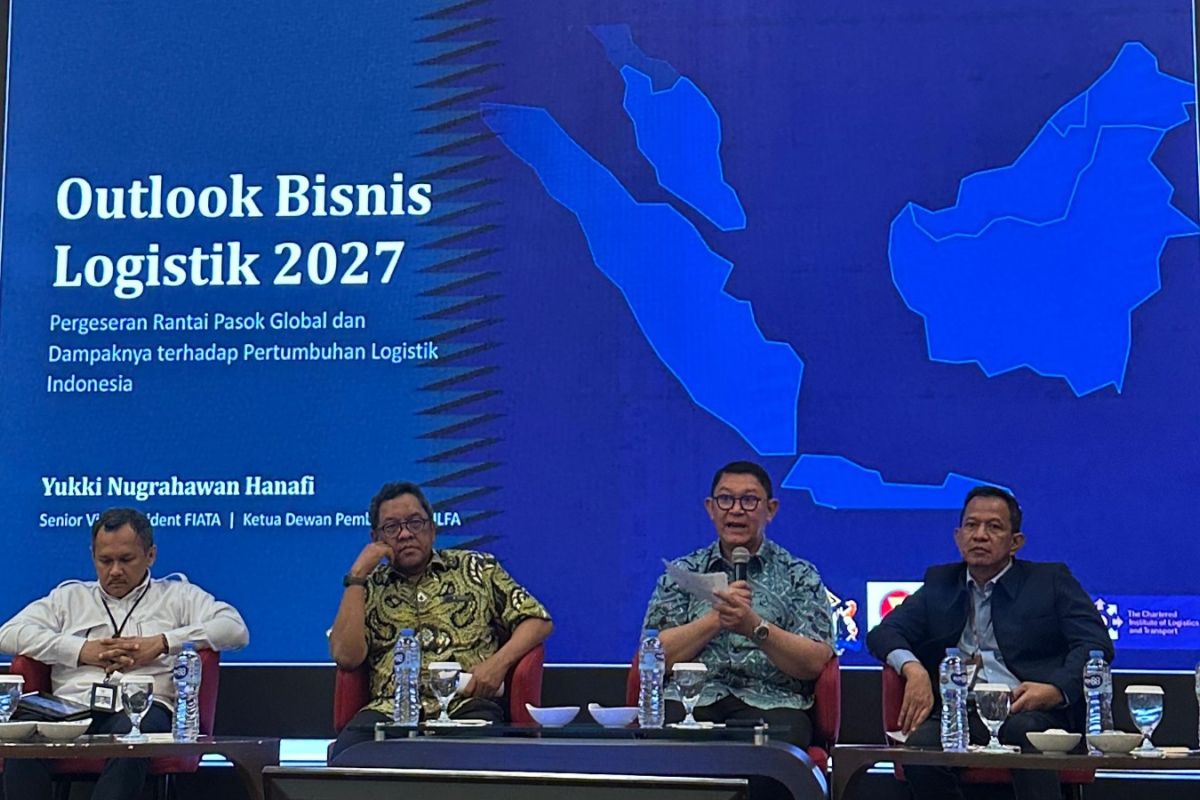
ALFI’s DPP Board of Trustees chairman, Yukki Nugrahawan Hanafi, said Indonesia needed to boost logistics productivity from upstream to downstream and accelerate trade digitalisation to take advantage of this opportunity.
“Logistics costs will not fall simply by cutting tariffs. The key is end-to-end productivity through the integration of land transport—by road and rail—with sea and air transport,” Yukki said in a statement received in Jakarta on Thursday.
Yukki, who is also Senior Vice President of the International Federation of Freight Forwarders Associations (FIATA), said around 90 per cent of domestic logistics movements still rely on road transport, followed by sea at 9 per cent, rail at 1 per cent and air at less than 1 per cent.
He said improving road quality and port performance, addressing cargo imbalances in eastern Indonesia, and strengthening intermodal connectivity were necessary to make goods distribution more efficient.
In his outlook for the logistics sector in 2027, Yukki identified eight strategic issues: economic growth, geopolitical risks, structural problems in domestic logistics, digitalisation, changing customer needs, business-model transformation, consolidation among global companies, and supply-chain diversification.
“The outlook for growth in the logistics sector remains positive, but we must stay alert. Logistics costs remain highly sensitive to disruptions, both external and domestic,” he said.
Domestically, he identified three areas requiring attention: implementation of the policy to prohibit vehicles exceeding dimensional and load limits (over dimension over loading/ODOL), the electrification of logistics fleets, and implementation of Presidential Regulation No. 41 of 2026 on Strengthening National Logistics.
Globally, he added, trade fragmentation and geopolitical tensions were increasing the risk of disruption to strategic shipping routes, with potential effects on fuel prices and freight costs.
Yukki urged logistics companies to develop interoperable data systems and the government to strengthen the National Logistics Ecosystem (NLE) to improve competitiveness.
“Customers are not only sensitive to changes in shipping costs; they also want delivery certainty, transparent access to information about the delivery process, and alternative solutions if a shipment is disrupted,” he said.
Logistics businesses also need to shift towards productivity-based models and strengthen service specialisation, collaboration and digitalisation to respond to consolidation among global companies.
Meanwhile, supply-chain diversification resulting from trade tensions between the United States and China is creating investment opportunities in ASEAN, particularly in electric-vehicle ecosystems, artificial intelligence and digital infrastructure.
Earlier, Coordinating Minister for Infrastructure and Regional Development Agus Harimurti Yudhoyono said on Wednesday (25 November) that land transport accounted for 49.6 per cent of logistics costs, followed by sea transport at 25.5 per cent, warehousing at 10.6 per cent and administration at 8.5 per cent.
Through Presidential Regulation No. 41 of 2026, the government aims to reduce the national logistics-cost-to-gross-domestic-product (GDP) ratio from 14.29 per cent in 2022 to 12.5 per cent by 2029 and 8 per cent by 2045.
Source: jawawa.id (https://jawawa.id/newsitem/alfi-intermodal-integration-will-strengthen-indonesias-position-as-an-asean-logistics-hub-1795693944)
Originally published by Antara (Indonesian) (https://www.antaranews.com/berita/5880675/alfi-integrasi-antarmoda-perkuat-ri-sebagai-simpul-logistik-asean), translated from Indonesian