
Alfamart and Indomaret Employees Face Extinction as Warning Signs Emerge in China
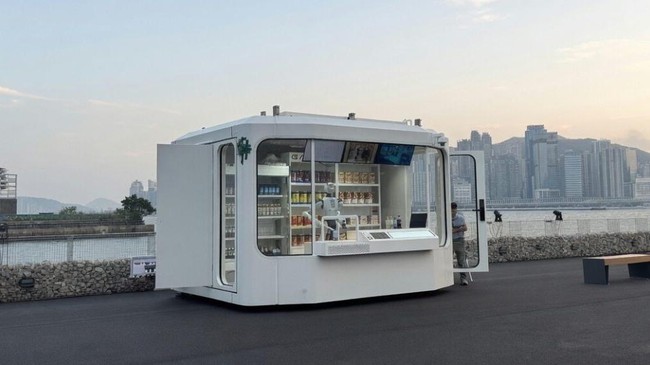
Jakarta, CNBC Indonesia – The wave of artificial intelligence (AI) disruption continues to shake up the global business landscape, and the retail sector is no exception. Increasingly aggressive automation ambitions now have the potential to trigger mass layoffs of human-based jobs.
From a corporate perspective, this step is seen as extremely attractive. Why not? Efficiency suddenly skyrockets. Imagine a convenience store capable of operating non-stop 24 hours a day without complaints from tired employees, annual leave entitlements, benefit demands, or pressure for wage increases.
This phenomenon is no longer mere science fiction, but a new reality pioneered by Chinese technology giants that is now encircling the Hong Kong market.
An autonomous robotic shop named ‘Ro-bodega’ has officially begun operating in the commercial district of Hung Hom, Hong Kong. The arrival of this smart store has inevitably caused a stir, whilst sending a chill wind through conventional retail industry players.
The real threat posed by Ro-bodega lies in the complete absence of human labour. From start to finish—from restocking goods to order taking and checkout—everything is fully controlled by a humanoid robot named Xiao Gai.
The 1.67-metre robot, developed by Beijing-based AI start-up Galbot, is not only skilled at physical work. Xiao Gai has also been equipped with generative AI capabilities, enabling it to communicate fluently and courteously with customers in multiple languages.
The range of products on offer is also comprehensive, including snacks, fresh drinks and over-the-counter medicines. These are precisely the goods commonly found at Indonesian minimarket giants such as Indomaret and Alfamart.
The Ro-bodega venture is backed by fresh funding from the Hong Kong Investment Corporation, evidence that the commercial penetration of AI is becoming increasingly institutionalised.
Galbot’s management claims the novelty effect of Xiao Gai has successfully boosted visitor traffic by up to 40%. Not content with a single location, Galbot has immediately set an aggressive expansion target, aiming to launch 100 robot-based capsule stores across 10 major cities.
Danger Signal for Domestic Retail
The rapid adoption of service robots is clearly a warning sign for Indonesia’s retail industry. If the capital expenditure calculations for this technology become cheaper and reach a point of economies of scale, it is not inconceivable that human-free convenience stores will soon seize the Indonesian market.
If that scenario materialises, the positions of cashiers and shop assistants—long the backbone of national employment absorption—will slowly but surely be displaced by machines.
Nevertheless, the transition to the robotics era is not without its flaws. In Stockholm, Sweden, an AI agent managing a coffee shop once made headlines after ‘burning’ through its budget in a single month ordering 3,000 pairs of useless rubber gloves. Meanwhile, elsewhere, a service robot went viral after ‘going berserk’ and throwing cutlery at customers.
However, history has proven that technological disruption can never be halted. For millions of retail workers, the threat of automation is no longer merely a threat on paper, but a bitter reality that has already begun serving customers on the streets of China.
Source: jawawa.id (https://jawawa.id/newsitem/alfamart-and-indomaret-employees-face-extinction-as-warning-signs-emerge-in-china-1785912681)
Originally published by CNBC Indonesia (https://www.cnbcindonesia.com/tech/20260805112440-37-756700/pegawai-alfamart-indomaret-terancam-punah-tandanya-muncul-di-china), translated from Indonesian