
Alert! Muslim Nuclear Giant Attacked by Drones, Threatens Brutal Retaliation
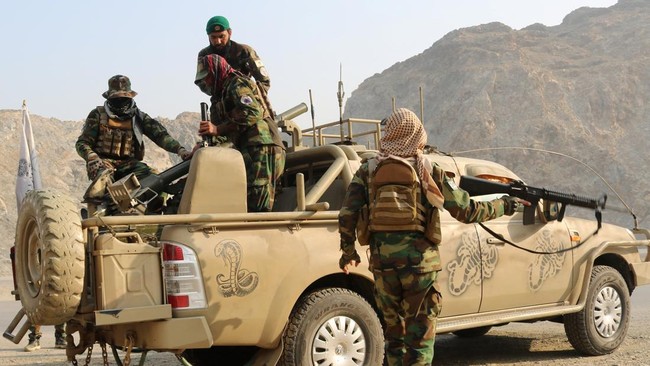
The Pakistani military has officially announced its success in shooting down four unmanned aerial vehicles (drones) launched by the Afghan Taliban group into the Balochistan region. This armed tension erupted just hours after the Afghan Ministry of Defence unilaterally claimed that its air force had successfully bombarded centres alleged to be bases for the ISIL (ISIS) group in the Pishin district of Balochistan, as well as several parts of the Khyber Pakhtunkhwa region.
Quoting an Al Jazeera report on Wednesday (01/07/2026), Pakistan’s Inter-Services Public Relations (ISPR) division stated that all infiltrating drones were detected by radar immediately after crossing the national border. “Military personnel subsequently neutralised the combat devices using sophisticated countermeasures, while simultaneously accusing the Taliban of deliberately providing full protection and support to terrorist organisations,” the ISML stated.
On the other hand, the Kabul Ministry of Defence insisted that their air operations in the Pishin district were aimed at disabling planning centres for sabotage actions in Afghanistan without causing civilian casualties. This exchange of attacks follows a series of bloody incidents last Saturday, when the Jamaat-ul-Ahrar armed group attacked a paramilitary complex in Karachi, killing three personnel.
Pakistan responded on Monday by launching airstrikes into the provinces of Paktia, Paktika, and Kunar, which killed 25 militants, although the Taliban government claims that 36 civilians were also killed.
Escalation Control Strategy and the Failure of Diplomacy
The escalation of this drone warfare represents a new phase in the cycle of conflict between the two neighbouring countries, which has been intensifying since October 2025. Several Pakistani officials, speaking on condition of anonymity, told Al Jazeera that Islamabad is currently choosing to implement a strategy of ‘controlled escalation’.
“This will involve the military responding brutally to every attack from non-state actors, but being more selective in retaliating against official attacks from the Afghan Taliban government,” one official noted.
This defensive stance was adopted after Pakistan declared ‘open war’ on Saturday (27/02/2026) through the ‘Ghazab-lil-Haq’ (Wrath for Justice) military operation following Taliban attacks on border posts. Efforts for peace through international mediation were previously attempted by Qatar and Turkey, resulting in a ceasefire last October, as well as China-led negotiations in Urumqi last April, which temporarily reduced the intensity of the war for two months.
“The latest escalation is a continuation of the skirmishes observed regularly over the last two years. Pakistan’s airstrikes in Afghanistan have become reactionary, without any real change in the frequency of militant attacks,” analysed Fahad Nabeel, head consultant at Islamabad-based Geopolitical Insights.
Mutual Political Interests as Hostages
Observers believe this prolonged conflict has shifted from a mere border security issue into a tool for mutual political leverage, used to mask the domestic security failures of both governments. Throughout 2025 alone, Pakistan recorded 699 terror attacks within its borders, resulting in 1,034 deaths, while ACLED documentation shows at least a dozen drone launches into Pakistani territory since February.
South Asian insurgency researchers assert that this conflict will never end as long as both parties are unwilling to address their internal problems without exporting the conflict to their neighbours.
Pakistan is required to integrate military operations with long-term strategies to sever the roots of insurgency in its provinces, while the Taliban government in Kabul must face the legal reality that the TTP militant group has proven to use Afghan territory as a sanctuary for their families and propaganda.
“Pakistan has turned this into a sort of ‘new normal’, blaming its own security failures on Afghanistan. In essence, it is a case of mutual blackmail. Kabul accuses Pakistan of protecting anti-Taliban figures, and Islamabad accuses Kabul of sheltering the Pakistan Taliban (TTP),” criticised Rahim Nasari, a security analyst based in Quetta.