
Alert! Mount Anak Krakatau Erupts, Expert Issues Four Stern Warnings
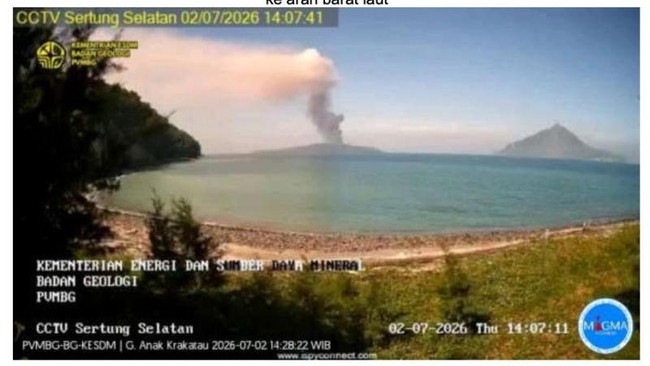
The Centre for Volcanology and Geological Hazard Mitigation (PVMBG) of the Ministry of Energy and Mineral Resources reported that Mount Anak Krakatau in Lampung erupted on Wednesday (8/7/2026) at 11:47 WIB. The ash column was observed reaching approximately 200 metres above the summit, or around 357 metres above sea level.
Field observation teams reported that the ash column was grey to black in colour with thick intensity, drifting towards the northwest. The eruption was recorded on a seismogram with a maximum amplitude of 50 mm and a duration of approximately 42 seconds.
“Currently, Mount Anak Krakatau is at Status Level III (Siaga) with the recommendation that the public, visitors, tourists, and hikers do not approach or conduct activities within a 3-kilometre radius of the active crater,” the Geological Agency stated.
Responding to the current situation at Mount Anak Krakatau, Daryono, a member of the Indonesian Disaster Experts Association (IABI), stressed the importance of anticipatory mitigation measures for the potential impacts of the eruption. “Disasters do not come with a warning,” Daryono said on Wednesday.
He recommended four mitigation steps amid the Siaga status of Mount Anak Krakatau. First, he urged compliance with the access restriction zone. “Currently, authorities have established a danger radius of 3 kilometres from the active crater. Ensure that fishermen, tourists, and residents do not approach this radius due to the risk of incandescent material ejection, pyroclastic flows, and gas,” Daryono said.
Second, he called for heightened preparedness in coastal areas. “Given the history of the Sunda Strait, communities along the coastline must have independent evacuation plans in the event of a strong earthquake or volcanic activity that triggers seawater anomalies,” he said. “Identify evacuation routes to higher ground and ensure that assembly points have been agreed upon with family or the local community.”
Third, he advised anticipating exposure to volcanic ash. “If the eruption produces widespread ash, protect your respiratory system and eyes, and manage your home environment and resources. Close doors, windows, and ventilation tightly to minimise the entry of micro-dust into the house. Secure drinking water sources by covering water tanks tightly to prevent contamination from acidic volcanic material.”
Fourth, he emphasised filtering information and avoiding hoaxes. “Situations like this often trigger the spread of inaccurate information. Always validate reports of volcanic activity through official channels to ensure the data you receive is the latest fact.”
Previously, on 27 June 2026, the Geological Agency released an official statement regarding signs of increased activity at Mount Anak Krakatau. Since 1 June 2026, the Sentinel satellite had detected SO2 gas emissions and thermal anomalies, as well as the appearance of hotspots in the crater since 10 June 2026. According to the agency, although not accompanied by an increase in deep volcanic earthquakes and deformation, the increase in shallow volcanic earthquakes indicated surface magma dynamics at Mount Anak Krakatau.
Subsequently, from 26 June 2026, the intensity of tremor earthquakes increased, accompanied by heightened crater smoke intensity, grey in colour with a light volcanic ash content drifting west-northwest. These signs of increased surface magmatism could mark the beginning of heightened activity at Mount Anak Krakatau leading to an eruption.
On Thursday, 2 July 2026, at 14:05 WIB, an eruption occurred at Mount Anak Krakatau in Lampung, with an ash column observed reaching approximately 200 metres above the peak, or around 357 metres above sea level. The ash column was observed to be grey to black with thick intensity, leaning towards the northwest. The eruption was recorded on a seismogram with a maximum amplitude of 23 mm and a duration of approximately 20 seconds. Later that day, at 16:30 WIB, the Geological Agency announced that the activity level of Mount Anak Krakatau had been raised from Level II (Waspada) to Level III (Siaga).