
Al Islam Bandung Polytechnic Launches New Medical Imaging Radiology Programme
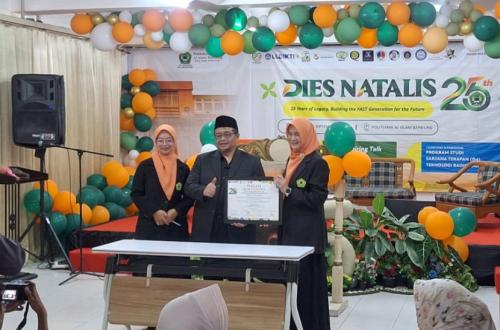
Commemorating 25 years of service in health vocational education, Politeknik Al Islam Bandung (PAIB) held the peak of its 25th Anniversary on Saturday, 26 September 2026. Under the theme “25 Years of Legacy: Building the FAST Generation for the Future”, this momentum serves not only as a reflection of the institution’s journey but also marks a new chapter in the development of health vocational higher education in West Java.
A primary agenda during the 25th Anniversary celebrations was the official launch of the Applied Bachelor’s (D4) programme in Medical Imaging Technology (TRP). Having received operational permits on 4 August 2026, this programme is part of PAIB’s strategic steps to strengthen its contribution to the development of healthcare human resources, particularly in the field of radiology.
The Director of Politeknik Al Islam Bandung, dr. Shiane Hanako Sheba, MKM., MCE., stated that the establishment of the Medical Imaging Technology programme is not only the fulfilment of the Foundation’s mandate as outlined in the institution’s development milestones, but also a manifestation of PAIB’s responsibility to prepare professional, competent, and adaptive healthcare workers capable of meeting the dynamic needs of healthcare services.
This commitment is reflected in the vision of the programme: to become an Islamic, highly applicable, and excellent programme in the utilisation of Artificial Intelligence (AI) for advanced medical imaging, adhering to international standards.
Through this developmental direction, students are prepared to master competencies relevant to modern radiology services. Career development for graduates may include advanced imaging in CT, MRI, and DSA modalities, the operation of teleradiology and PACS systems, radiation protection, quality assurance (QA/DS), as well as managerial and leadership roles within radiology service units.
As the only Medical Imaging Technology programme in Bandung, its presence does more than just add a new study programme to PAIB; it becomes part of a radiology education ecosystem that integrates professional competence, technological utilisation, character building, and readiness for future healthcare needs.
West Java Still Requires Thousands of Radiographers
During the talk show “Beyond the X-Ray: The Future of Radiology, Competence, and Career Opportunities”, the Head of the West Java Provincial Health Office, dr. R. Vini Adiani Dewi, MMRS., presented the current state of radiographer human resource needs in West Java.
Based on the 2026 projection for radiological healthcare human resources presented during the anniversary, West Java requires 7,744 radiographers, while current availability stands at only 3,068. Consequently, there is a deficit of 4,676 radiographers, with a fulfilment rate of only approximately 39.6 per cent.
This demand is expected to increase alongside various government programmes aimed at strengthening healthcare services and referral systems. One such initiative is the SIHREN programme (Strengthening Indonesia’s Healthcare Referral Network), which enhances referral hospitals through various medical equipment and imaging technologies. The increase in facilities and diagnostic modalities must be accompanied by an adequate supply of radiographers to ensure equipment is utilised optimally for public service.
This situation underscores that meeting the demand for radiographers is not merely about quantity, but also about the equitable distribution and readiness of human resources to support the transformation of healthcare services.
Advancing Technology, Transforming Radiographer Competence
The Chairperson of the Indonesian Radiographers Association (PARI) West Java Region, Drs. YUSUF ISKANDAR, S.ST, highlighted during the talk show that technological advancements have changed how radiology services are delivered and have increased the competency demands on radiographers.
These developments include the use of Computed Radiography/Digital Radiography (CR/DR), Picture Archiving and Communication System (PACS), Radiology Information System (RIS), Artificial Intelligence (AI), and teleradiology to support medical consultations across different regions.
Technological shifts mean that radiographer competence is no longer limited to the technical ability to operate imaging equipment. Radiographers are now required to possess digital skills, an understanding of radiation safety, evidence-based practice, analytical skills, quality assurance capabilities, and the ability to collaborate with various health professions.
From Local Needs to Global Competency Standards
The issue of developing radiological personnel competence was also a key discussion point at The 1st PAIB International Conference on Fostering Sustainable Synergy Across Health, Education, and Economic (IC-HEES) 2026.
The President of the International Society of Radiographers and Radiological Technologists (ISRRT), Napapong Pongnapang, Ph.D., in the session “Radiographer Competency Development & Global Health Integration”, emphasised the importance of enhancing radiographer competence, harmonising educational standards, advancing Continuing Professional Development (CPD), and improving digital proficiency within the radiography profession.
Perspectives from the government, professional organisations, and the international community all indicate that the increasing need for radiographers must go hand-in-hand with improving the quality and competence of radiological professionals.