
Akprind University Develops Egg Incubator to Empower Village Farmers
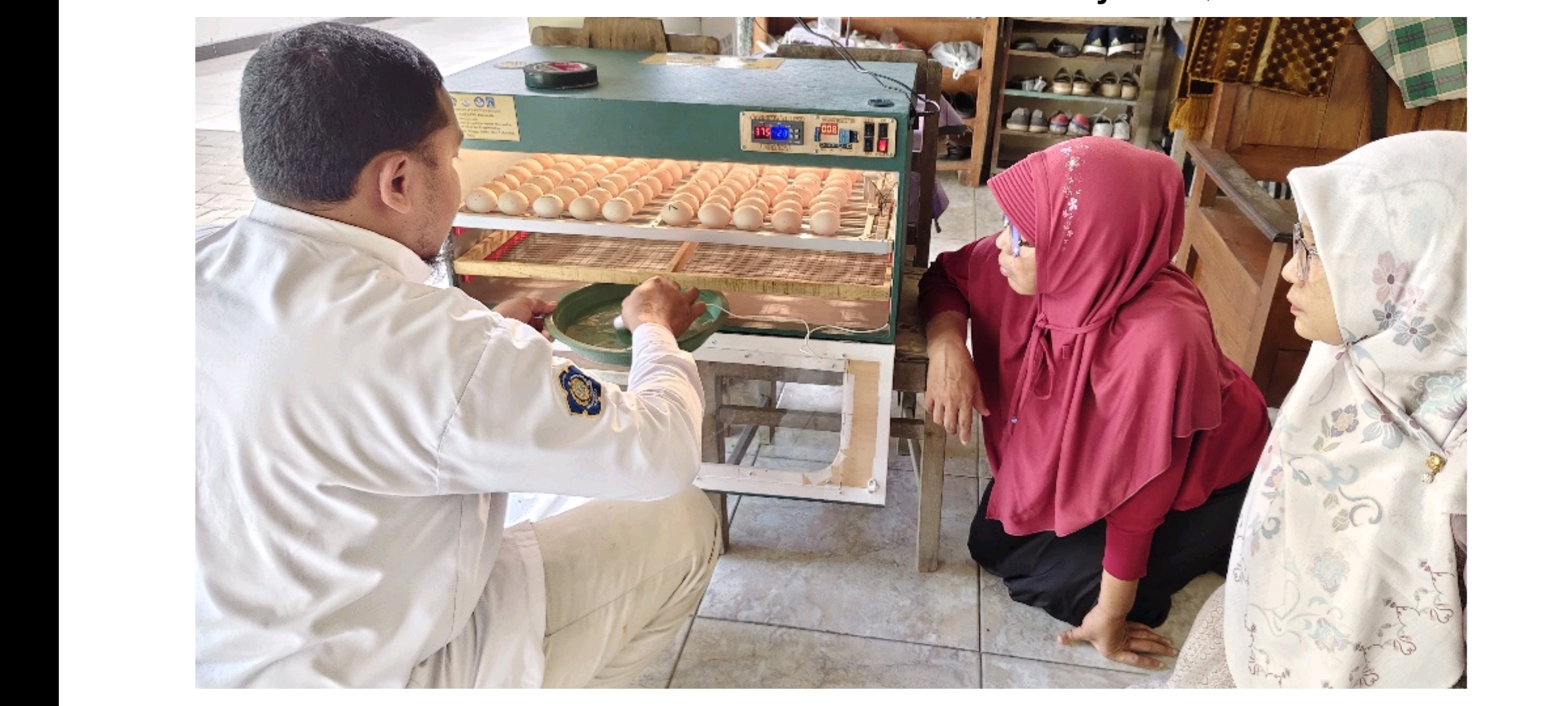
Universitas Akprind Indonesia (UAI) has developed an appropriate technology in the form of an Elba chicken egg incubator to support improved hatching success and community livestock business independence. The technology has been implemented at the Mekar Rejeki Women Farmers Group (KWT), Sendangtirto Village, as part of efforts to strengthen food security while developing new sources of income for the village community.
The development of this incubator is part of the 2026 Assisted Village Empowerment Programme, supported by the Directorate of Research and Community Service, Directorate General of Research and Development, Ministry of Higher Education, Science, and Technology. The programme carries the theme ‘Integrated Circular Economy Village Model Based on Livestock, Agriculture, and Fisheries for Food Security and Strengthening the Local Economy.’
The programme is chaired by Rahayu Khasanah, with members Toto Rusianto and Ani Purwanti from Universitas Akprind Indonesia. The implementation also involves Ahmad Pramono from Universitas Sebelas Maret (UNS). This cross-university collaboration combines competencies in engineering, animal husbandry, and community empowerment.
The incubator was developed to help maintain stable environmental conditions during the incubation process for Elba chicken breeding, thereby increasing the percentage of eggs that successfully hatch. The technology developed by the Universitas Akprind Indonesia team is equipped with a digital temperature and humidity monitoring and control system. The machine also features a closed incubation chamber, an air circulation system, neatly arranged egg racks, and a transparent window on the front. Another advantage is its simple design, making it easy for community group members to operate.
Toto Rusianto, a member of the implementation team and a Mechanical Engineering lecturer at Universitas Akprind Indonesia, explained that the egg incubator applies the principles of heat transfer and air circulation so that heat is distributed evenly throughout the incubation chamber. ‘From a Mechanical Engineering perspective, the main challenge is maintaining stable and even temperature and humidity conditions inside the incubation chamber while keeping it energy-efficient, easy to operate, and easy for the community to maintain,’ Toto said in a press release.
Programme Chair Rahayu Khasanah explained that the development of the incubator is not only aimed at producing a device but also at building a more measurable chick production system. ‘This technology is expected to help the community manage the hatching process more consistently. Assistance is needed so that the machine can be utilised independently and does not stop at being merely equipment aid,’ Rahayu stated.
Sendangtirto Village Head Amir Junawan welcomed the application of this appropriate technology. According to him, the Elba chicken incubator aligns with the village government’s efforts to develop productive economic activities based on local potential. Dependence on chick supplies from outside the region can be reduced, while the hatching results can be used for group livestock development or marketed to other farmers. ‘The application of this technology is expected to open new business opportunities, improve the skills of group members, and support the availability of food resources for the community. We hope that assistance will continue so that the machine can be utilised and maintained sustainably,’ Amir said.
The presence of the incubator from Universitas Akprind Indonesia has the potential to create a broader business chain, from the production of hatching eggs and the supply of chicks to the rearing of laying hens. This programme is expected to become a model for technology-based village empowerment that can be replicated in other farming groups or regions to strengthen food security and the local economy.