
Akprind Team Introduces IoT-Based Drip Irrigation to Magelang Farmers
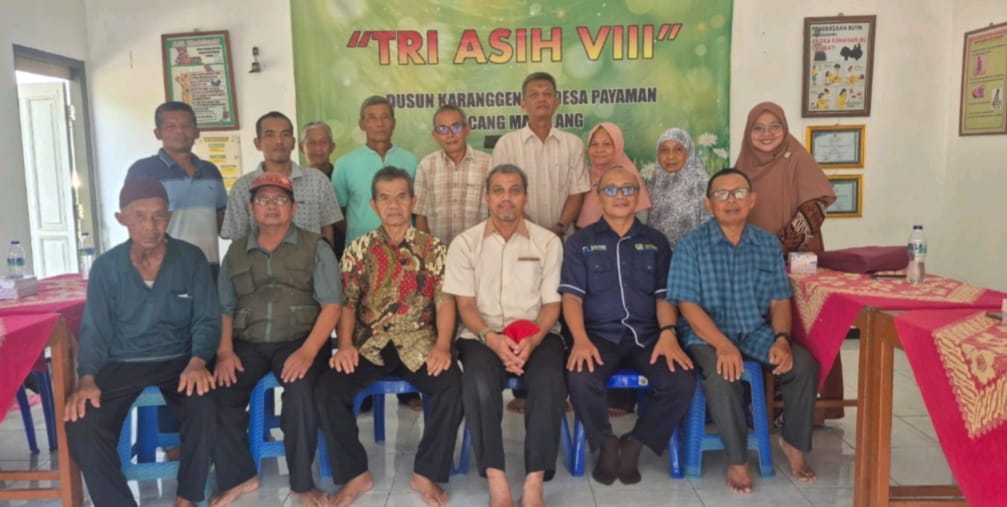
The Community Service Team (PkM) of Universitas Akprind Indonesia has provided training on Internet of Things (IoT)-based drip irrigation to the Rukun Makmur I Farmers’ Group in Karanggeneng, Payaman Village, Secang District, Magelang Regency, Central Java.
The training, held in July 2026, was aimed at helping farmers overcome water shortages and improve the efficiency of agricultural irrigation. Most of the Karanggeneng community work as farmers, with paddy fields covering around 45 hectares and about 70 households belonging to the farmers’ group.
Agricultural land in the area consists of rain-fed paddy fields that depend on the availability of surface water. This condition makes farming activities highly influenced by the seasons. Limited irrigation channels mean farmers can only plant rice once a year.
The distance of the fields from residential areas is also an obstacle when farmers use PLN electricity to operate pumps. Besides requiring long cables, the water supply from available irrigation channels often only reaches the fields in the afternoon with limited flow.
Muchlis, head of the Universitas AKPRIND Indonesia PkM team, said the training was provided to introduce technology that can optimise the use of available water.
“The aim of this activity is to provide education and technology transfer regarding an IoT-based drip irrigation system. The main advantage of this irrigation system is that it saves water. Water is delivered directly to the plant roots as needed,” said Muchlis.
According to Muchlis, farmers showed enthusiasm during the training. They actively asked questions about the drip irrigation mechanism, which is a new technology for the local farmers’ group.
The PkM team will also provide mentoring after the training so that farmers can apply the technology in their fields. The programme received funding from the Directorate of Research and Community Service, Directorate General of Research and Development, Ministry of Higher Education, Science, and Technology through the Community Service Funding Programme, Community Partnership Empowerment Scheme for the 2026 fiscal year.
PkM team member Sigit Priyambodo explained that the introduced irrigation system works automatically by utilising humidity and temperature sensors.
“When the installed humidity and temperature sensors send a signal that the plants need water, the system will run irrigation automatically,” said Sigit.
The system’s electricity needs will be met through a solar power plant (PLTS). Thus, the system can be applied in fields far from the electricity grid.
Another team member, Rahayu Khasanah, said the technology also allows fertiliser application to be carried out simultaneously with irrigation, known as fertigation.
“Fertilisation can also be done together with watering, known as fertigation, thereby saving labour,” she said.
The head of the Rukun Makmur I Farmers’ Group assessed that the training provided benefits for farmers. The drip irrigation system is considered capable of saving water and reducing the need for farmers to monitor their fields directly.
According to him, a system that can be monitored via mobile phones helps farmers oversee irrigation conditions without having to visit the fields frequently.