
AKINCI vs MQ-9 Reaper: A Duel Between Two Unmanned Aerial Powerhouses That Has the US on Edge
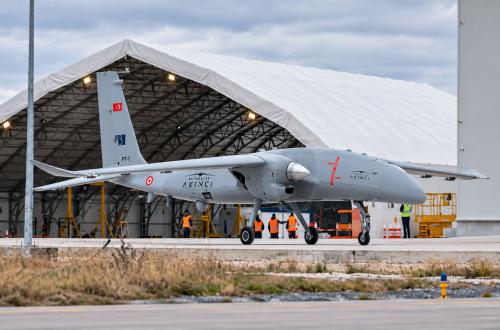
JAKARTA — Competition between Turkey and the United States in unmanned combat aircraft technology has entered a new phase after the Bayraktar AKINCI completed a series of weapons tests in September and October 2026. As Turkey expands the strike capabilities of the twin-engine drone, the US military is accelerating development of a replacement for the MQ-9 Reaper, following a reduction in numbers caused by the retirement of older aircraft and losses during military operations.
The developments invite comparison between two heavyweight combat drones designed for long-range surveillance and precision strikes. AKINCI was developed by Turkish company Baykar and can carry a range of domestically produced weapons, while the General Atomics MQ-9 Reaper has nearly two decades of operational experience.
On 9 October 2026, Baykar announced that AKINCI had successfully hit a target using the Morfoz Guidance Kit (MGK), developed by Turkish defence company Aselsan. The test took place in the Gulf of Saros after the drone took off from the Çorlu Flight Training and Test Centre in Tekirdağ Province.
The next development came during the Ateş Serbest-2026 military exercise in Polatlı, Ankara, on 13 October, which Baykar announced two days later. Two AKINCI aircraft carried out different missions: one conducted a strike with guided munitions, while the other detected aerial and ground targets using the MURAD active electronically scanned array (AESA) radar.
At around the same time, the United States was facing a different problem with the MQ-9 Reaper. A Congressional Research Service (CRS) report dated 23 September 2026 revealed a shrinking inventory of the drone and plans by the US Air Force to develop a replacement platform called the Massed Modular Aircraft (MMA).
The comparison between the two drones is no longer limited to flight speed, weapons capacity and surveillance capability. Cost, the ability to withstand enemy air defences and the capacity of industry to sustain production are increasingly important factors.
AKINCI Is Heavier, but the Reaper Has a Greater Payload Capacity
The Bayraktar AKINCI is an unmanned combat aircraft developed to carry out intelligence, surveillance, target acquisition and reconnaissance (ISTAR) missions. It is also designed to carry a range of air-to-surface weapons and several types of missiles for engaging aerial targets.
According to Baykar’s official specifications, AKINCI has a wingspan of 20 metres, a fuselage length of about 12.2 metres and a height of 4.1 metres. Its maximum take-off weight (MTOW) is 6,000 kilograms.
AKINCI can carry a payload of up to 1,500 kilograms, according to the manufacturer’s specifications. This includes mission equipment and weapons, which can be fitted according to the chosen configuration.
One of AKINCI’s main features is its two turboprop engines, mounted on its wings. Baykar offers engine configurations rated at 450, 750 or 850 horsepower each, depending on the variant.
The MQ-9 Reaper, by contrast, is powered by a single Honeywell TPE331-10 turboprop engine with a maximum output of about 900 horsepower. According to a US Air Force fact sheet, the drone has a wingspan of about 20.1 metres, a length of 11 metres and a height of 3.8 metres.
The standard MQ-9A has a maximum take-off weight of about 4,760 kilograms. AKINCI therefore has a higher maximum weight, although the two drones have almost identical wingspans.
However, a higher maximum weight does not automatically mean a greater payload capacity. General Atomics lists the MQ-9A’s payload capacity at about 1,746 kilograms, while some US military fact sheets give a figure of about 1,701 kilograms, depending on the configuration used as a reference.
Of that capacity, about 1,361 kilograms can be carried externally by the MQ-9A. The distinction between internal and external payload is important because the entire payload capacity cannot be treated as capacity for carrying bombs or missiles.
On the basis of these specifications, the MQ-9A’s total payload capacity is slightly higher than the 1,500-kilogram figure published for AKINCI. Actual weapons-carrying capability is also affected by sensor configuration, fuel, weapon hardpoints and aircraft balance limits.
Which Can Fly Higher and Stay Aloft Longer?
Long endurance is a key advantage of unmanned aircraft over some crewed combat aircraft. Drones of this type can monitor an area for hours while remaining ready to strike if needed.
Baykar says AKINCI can fly for more than 20 hours, according to the specifications on its official website. A technical brochure dated February 2026 also lists endurance of more than 24 hours, so the figures should be understood in light of the configuration and testing criteria used.
AKINCI has an operational altitude of about 30,000 feet and a service ceiling — its maximum operational altitude — of about 40,000 feet. These figures indicate its ability to conduct a range of surveillance and strike missions at altitude.
General Atomics says the standard MQ-9A can fly for more than 27 hours. For the Extended Range (ER) variant, additional fuel tanks can increase endurance to about 34 hours.
The MQ-9A has a published service ceiling of 50,000 feet, or about 15,240 metres. This is higher than the altitude limit listed in Baykar’s specifications for AKINCI.
In terms of speed, AKINCI has a cruising speed of about 150 knots and a published maximum speed of 240 knots. The MQ-9A also has a maximum speed of about 240 knots, while the US Air Force gives its cruising speed as about 200 knots.
These figures suggest that the MQ-9A has certain advantages in endurance and operational altitude, based on published specifications. But operational effectiveness cannot be judged by a single figure, as speed, fuel, weapons and time spent in the mission area affect one another.
Baykar lists AKINCI’s operational range as up to 6,000 kilometres. However, this cannot be directly compared with the MQ-9A’s published range of about 1,000 nautical miles, as manufacturers may use different definitions and mission profiles.
Source: jawawa.id (https://jawawa.id/newsitem/akinci-vs-mq-9-reaper-a-duel-between-two-unmanned-aerial-powerhouses-that-has-the-us-on-edge-1793868690)
Originally published by Republika (https://news.republika.co.id/berita/to0n9u451/akinci-vs-mq9-reaper-duel-2-jagoan-langit-tanpa-awak-yang-bikin-as-ketarketir), translated from Indonesian