
AirNav Indonesia and Telkom University Strengthen AI Research and Development
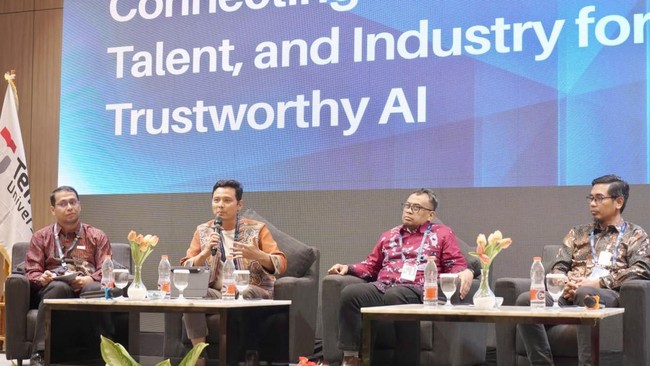
Jakarta, CNBC Indonesia — AirNav Indonesia and Telkom University are strengthening their research and development collaboration on artificial intelligence (AI) and cybersecurity. The agreement, covering the optimisation of laboratories and joint research into AI and cybersecurity technologies, was signed on the sidelines of the Summit on Advancement in Technology, Research, Industry and Academia (SATRIA) 2026 in Jakarta on Thursday (8 October 2026).
On the same occasion, Telkom University presented AirNav Indonesia with an award recognising its contribution and support for research, technology and innovation collaboration, particularly in AI and cybersecurity. The award was received on AirNav Indonesia’s behalf by its Director of Safety, Security and Standardisation, Capt Nurcahyo Utomo.
AirNav Indonesia Technical Director Zainal Arifin Harahap, who was a panellist at SATRIA 2026, said safety was the top priority in aviation. Over time, he added, safety must also go hand in hand with efficiency and sustainability.
“That is why we see AI as a supporting tool to make work easier and faster. But AI is not intended to replace people in decision-making, particularly decisions directly related to aviation safety,” he said, according to a press release on Friday (9 October 2026).
Zainal said the partnership followed up on a memorandum of understanding signed by the two parties in 2024 on the development, management and improvement of information technology.
Under the agreement, the parties will work together on laboratory optimisation and collaborative research and development. The scope also includes applying research findings, exchanging knowledge, expertise and information, and making use of research and development outputs according to their respective needs.
“We do not want technology to be developed simply because it exists. The most important thing is whether it is genuinely needed and can help us do our work. That is what we are looking at in our partnership with Telkom University,” Zainal said.
The collaboration has produced several initiatives, including a NOTAM AI Generator prototype, launched as an initiative in 2024 and given a soft launch in 2025. Other joint work includes a digital technology-based automated scheduling system for air traffic control (ATC) staff.
With AI, NOTAM generation can be completed in about one minute before being checked by a validator. AI is also being developed to assist with scheduling and rostering ATC personnel, while decisions directly affecting safety remain with people.
“As well as exploring the implementation of NOTAM AI, we are currently developing an AI-based application to schedule and allocate duties for ATC personnel. ATCs must not work continuously for two hours, and the gap between shifts for one person must not be less than 15 hours. We will use AI to manage these arrangements. With a large number of personnel, doing this manually would be difficult and time-consuming,” Zainal said.
Faudzan Adziman, Director General of Research and Development at the Ministry of Higher Education, Science and Technology, praised AirNav Indonesia’s decision to involve universities in addressing industry challenges. He said research should begin with real-world problems and aim to produce useful solutions.
“The key is that if we do not know what problem we are trying to solve, we should not conduct the research. AirNav initially took a risk by involving a university, but the benefits afterwards are very significant. This kind of collaborative model should continue to be encouraged to strengthen Indonesia’s technological sovereignty and competitiveness,” Faudzan said.
He urged AirNav Indonesia and Telkom University to keep their collaboration focused on solving problems faced by industry.
“Identify the industry problem you want to solve, then develop a solution. Once trust has been established, it will be easier to build something bigger. Understanding the challenges industry faces is essential to ensure that research genuinely meets its needs,” he said.
Angga Rusdinar, Telkom University’s Vice-Rector for Research, Innovation and Cooperation, said research and development results would not be applied immediately in AirNav Indonesia’s operations. Each output could undergo testing, evaluation and validation based on the needs and criteria agreed by both parties.
“AirNav Indonesia has real needs. That matters to us because good research must address a clearly defined problem. This partnership is therefore not only about producing research, but also about ensuring its results can be used,” he said. “Under this process, research is directed at real needs, developed into solutions and then tested before being put to use.”
SATRIA 2026 was held under the theme “Connecting Leaders, Research, and Industry for Trustworthy AI”. The forum brought together government, industry, universities and researchers to strengthen research collaboration, talent development and the application of AI and cybersecurity.
For AirNav Indonesia, strengthening its partnership with Telkom University is not simply about producing new technology; it is about ensuring research addresses real needs and benefits the work and services of air navigation.
Source: jawawa.id (https://jawawa.id/newsitem/airnav-indonesia-and-telkom-university-strengthen-ai-research-and-development-1791507107)
Originally published by CNBC Indonesia (https://www.cnbcindonesia.com/tech/20261009071156-37-774583/airnav-indonesia-telkom-university-perkuat-riset-dan-pengembangan-ai), translated from Indonesian