
AirNav and Boeing to optimise capacity at Bali's Ngurah Rai Airport
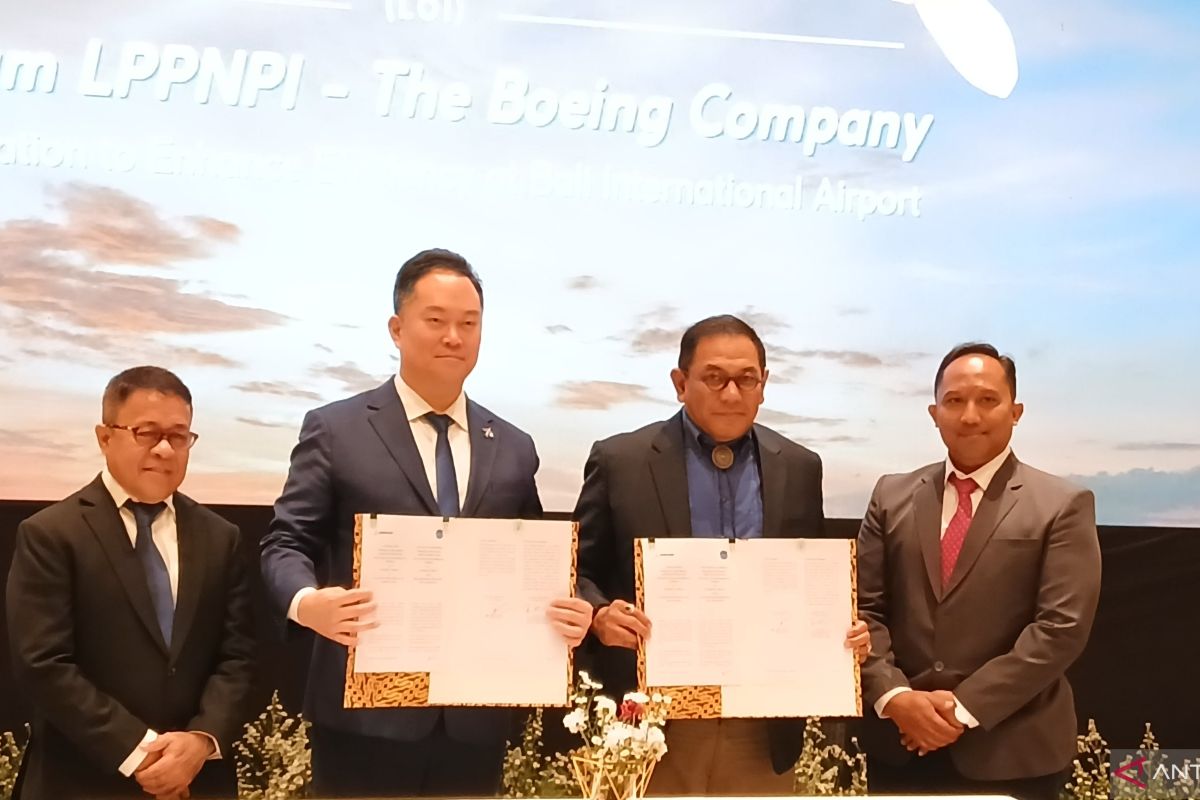
Tangerang (ANTARA) - Perum Lembaga Penyelenggara Pelayanan Navigasi Penerbangan Indonesia (AirNav Indonesia) has partnered with global aircraft manufacturer Boeing to boost the efficiency and operational capacity of aircraft movements at I Gusti Ngurah Rai International Airport in Bali.
AirNav Indonesia President Director Capt Avirianto Suratno said in Tangerang on Tuesday that the strategic cooperation is focused on reducing congestion of aircraft movements on the ground while increasing the utilisation capacity of the runway, in order to enhance flight safety and punctuality.
“Bali genuinely needs improvement because there is no parallel taxiway. So Boeing will help us work out how to improve safety, flights and time efficiency on the ground,” he said.
He explained that the absence of a parallel taxiway at Bali Airport demands far more tactical and integrated management of aircraft movements between the departure and arrival processes. The service capacity at Ngurah Rai Airport, he added, currently stands at around 33 aircraft movements per hour.
By combining Boeing’s advanced digital modelling technology with AirNav Indonesia’s systems and operational capabilities, the target is to raise capacity beyond the existing figure, particularly during peak hours (golden time).
“What we are looking at is not only current operating conditions, but also the various options that could make aircraft movements more efficient. Each option will be tested through modelling and simulation so that the resulting recommendations have a strong analytical basis,” he said.
Avirianto said the initial stage of the study involves operational modelling using a TAAM baseline model to represent the current operational conditions of I Gusti Ngurah Rai Airport.
The model, he said, uses a 24-hour flight schedule representing the airport’s normal operations. The modelling covers east flow and west flow, two operational configurations based on the direction of aircraft movement.
“The modelling results consist of operational statistical data and four-dimensional (4D) visualisations. AirNav Indonesia and Boeing will also conduct direct observations at I Gusti Ngurah Rai Airport together with Subject Matter Experts (SMEs) from air traffic control, airport operations, airlines, ground handling and airport planning,” he explained.
According to him, the observations may include the ATC tower, terminal radar facilities, ground handling operations centres, airline operations centres, airport planning and development units, as well as the airside areas. Once the baseline model has been validated using AirNav Indonesia’s operational data, the two parties will develop alternatives for improving operations.
These alternatives cover layout, ground movement procedures, the use of taxiways and aircraft parking areas, as well as movement sequencing and coordination.
“These alternatives will subsequently be tested through TAAM simulations. Boeing is expected to model up to three scenarios to assess the performance of each option before considering implementation,” he said.
Meanwhile, Indra Gunawan, Head of the Flight Safety Supervision and Data Sub-Directorate at the Ministry of Transportation’s Directorate General of Civil Aviation, viewed the cooperation between AirNav and Boeing as strengthening the commitment to delivering optimal air navigation services.
This strengthening step will be fully supported by the government through its policy of waiving dividend withdrawals, whereby all revenue is redirected towards developing the air navigation services sector.
“To this day, the government’s policy towards AirNav is that no dividends are withdrawn at all. So all revenue is indeed handed over to AirNav to develop navigation services,” he said.
He added that the various improvement measures and innovations currently under way are part of AirNav’s efforts to deliver the best possible service, especially in strategic tourism areas such as Bali.
“Our hope is that the AirNav-Boeing partnership will also serve as a vehicle for knowledge transfer for AirNav personnel, so that for other airports, AirNav’s own staff will be able to design improvements going forward, as has also happened with other state-owned enterprises,” he said.
Source: jawawa.id (https://jawawa.id/newsitem/airnav-and-boeing-to-optimise-capacity-at-balis-ngurah-rai-airport-1789459044)
Originally published by Antara (Indonesian) (https://www.antaranews.com/berita/5741648/airnav-dan-boeing-optimasi-kapasitas-bandara-ngurah-rai-bali), translated from Indonesian