
Airlangga Reveals Government's Strategy to Achieve 6% Economic Growth Target
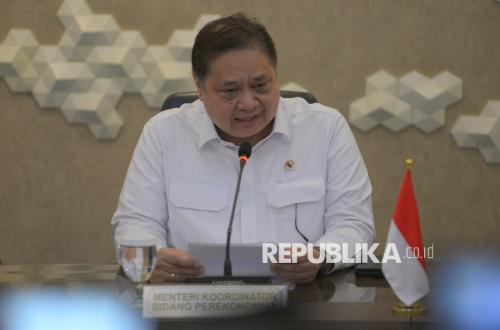
Coordinating Minister for Economic Affairs Airlangga Hartarto has detailed several indicators showing the resilience of the Indonesian economy amidst global uncertainty. The government, he said, is preparing new transformation-based economic growth engines to achieve a growth target of six percent in 2027.
“There are positive prospects for domestic economic growth, amidst major upheavals such as geopolitics, energy prices, food prices, and persistently high interest rates,” Airlangga said during a press conference for the 2027 Fiscal Year Government Work Plan and Financial Note at the Directorate General of Taxes office in Jakarta on Friday.
Airlangga stated that the global economic outlook is expected to improve next year. International institutions project world economic growth to reach around 2.8 percent this year, increasing to 3.1 percent in 2027. He noted that the Indonesian economy is also showing several positive developments, with first-semester growth reaching 5.45 percent, the highest in 13 years.
Several economic indicators also point to strengthening. The Gini ratio fell to 0.368 in March, while the open unemployment rate was recorded at 4.65 percent in May. On the consumption side, the consumer confidence index stood at 116.8, while the manufacturing PMI returned to positive territory with an index of 50.2.
Airlangga added that activity in the real sector is also increasing. The automotive sector grew 33.3 percent year-on-year, while electric and hybrid vehicle sales recorded growth of over 40 percent. Electricity consumption rose 10.8 percent, and cement sales increased 13.5 percent year-on-year. In the financial sector, third-party funds grew 10.21 percent, lending increased 12.67 percent year-on-year, and investment credit grew around 24.9 percent. Indonesia’s external resilience also remains intact, with foreign exchange reserves equivalent to 5.5 months of imports and a positive cumulative trade balance for January to June.
The government continues to maintain purchasing power through various stimuli, disbursing a total of Rp 70 trillion in the first quarter and Rp 26.34 trillion in the second quarter. These stimuli cover various policies, including tax incentives, transport subsidies, fee waivers, internship and vocational programmes, and food assistance.
Beyond maintaining current economic stability, the government is preparing new growth engines for 2027 based on economic transformation and the development of high-value-added sectors. These include high-value sectors such as digitalisation, semiconductors, and AI, as well as the revitalisation of resilient sectors like agriculture and energy. The government is also encouraging the establishment of a mineral commodity exchange to provide Indonesia with its own reference price. Other measures include enhancing investment and export competitiveness through deregulation, debottlenecking, and optimising international agreements, alongside the formation of an international financial centre in Indonesia.
Airlangga stated that this policy direction is supported by four main prerequisites: an attractive investment climate, regulatory certainty, macroeconomic stability, and a prudent and sustainable state budget. In the 2027 Government Work Plan, the government targets economic growth of six percent with an inflation rate of 2.5 percent. State revenue is projected to reach Rp 3,246 trillion, while state expenditure is set at Rp 4,097.2 trillion, resulting in a projected budget deficit of 2.4 percent of GDP, or Rp 671.2 trillion.