
Airlangga Reveals Effects of Zero QRIS Fees Before Retail Entrepreneurs
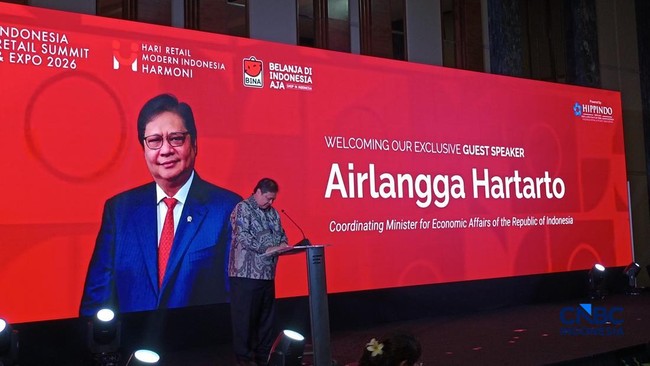
Jakarta - Coordinating Minister for Economic Affairs Airlangga Hartarto welcomed Bank Indonesia’s (BI) policy of making QRIS transaction fees free for merchants. According to him, the policy makes business actors, especially merchants, happy.
Airlangga said payment digitalisation is an important part of developing the retail sector. He noted that QRIS usage has now reached tens of millions of users and merchants.
“We are encouraging more modern, comprehensive, structural and adaptive trade. And we see that the QRIS payment system has been used by 65.77 million users and accepted by 44.86 million merchants, with 96.68 being MSME players,” Airlangga said in his presentation at the opening of the Indonesia Retail Summit and Expo at Swissotel PIK Avenue, Jakarta, Wednesday (26/8/2026).
Airlangga then touched on BI’s policy that made QRIS transaction fees zero for merchants.
“Yesterday it was launched… I don’t know whether retailers agree or not, the discount for merchants was zeroed by BI yesterday. So for QRIS, no fee is taken from merchants. So perhaps all merchants are happy, although I said several other things including QRIS, digitalisation requires investment especially for the safety and security of the system, which is now charged to consumers, not to merchants,” he said.
According to Airlangga, payment digitalisation does provide convenience for the retail sector. However, on the other hand, implementing the system also requires investment, especially for system security and safety aspects.
He said technological development is an inseparable part of retail business development. According to him, stock management, demand, and product selection increasingly require technology.
“Indeed, if we look at offline and online, offline is worth around US$125 billion and online US$61.18 billion. This means our trade is two-thirds offline and one-third online. This is certainly a convenience from a technological perspective. And if we look at retail in various countries, it cannot be separated from technological mastery for stock management, demand, and merchandise selection,” he explained.
Airlangga assessed that the retail sector continues to play an important role in the Indonesian economy. Household consumption in the second quarter of 2026 was said to still grow by 5.06% and contribute 53.32% to GDP.
“We see in the second quarter, consumption is still good at 5.06% growth and consumption remains the main driver of the Indonesian economy. This is an Indonesian asset because 53.32% is the contribution to GDP,” he said.
In addition, Airlangga mentioned that the consumer confidence index remains above 100 and the manufacturing PMI is above 50. These conditions are one of the bases for the government’s optimism about the economy in the second half of 2026.
“Then also the consumer confidence index is still above 100, and we also see several achievements including the manufacturing PMI which is above 50, showing our optimism for the second semester of 2026 and in the first semester of 2026 our growth was 5.45%. This is the highest growth in the last 13 years. So we thank retailers, we give applause to Indonesian retailers,” Airlangga said.
He encouraged the retail sector to continue growing and contributing to Indonesia’s economic growth target.
Previously, Bank Indonesia (BI) released a policy expanding the QRIS Merchant Discount Rate (MDR) to 0%, coinciding with the 81st Anniversary of Indonesian Independence on Monday, 17 August 2026.
“This is in line with the pillars of the Indonesia Payment System Blueprint 2030 and the government’s Asta Cita that BI will continue to encourage it to increasingly become a driver of inclusive, efficient and sustainable economic growth,” said BI Acting Governor Destry Damayanti at the Launch of the Expansion of QRIS MDR 0% and the Implementation of the Indonesian Credit Card (KKI) Retail Segment in Jakarta, Monday (17/8/2026).
She assessed that amid global economic dynamics still filled with uncertainty and challenges to people’s purchasing power, joint steps are needed from stakeholders to maintain the momentum of national economic growth.
On the other hand, changes in people’s increasingly digital behaviour have demanded that the payment system continue to develop adaptively, inclusively, safely and prudently. This is so that the payment system is able to answer the various needs of society, which can ultimately support national economic stability.
According to her, the payment system is not merely a means of transaction, but is the lifeblood of economic activity that connects society with business actors, connects innovation with productivity, and connects trust with economic growth.
“Therefore, every advancement in the payment system must lead to one goal, namely a pro-growth policy that provides real benefits to society while strengthening the resilience and competitiveness of the national economy. Departing from this spirit, Bank Indonesia launched two complementary policies in strengthening public consumption, increasing transaction efficiency, and encouraging the acceleration of the digital economy,” she explained.
BI’s first policy is to expand the QRIS MDR 0% policy for transactions up to Rp100,000 across all merchant categories, while the QRIS MDR 0% for micro business (Umi) category remains valid for transactions up to Rp500,000.
The expansion of QRIS MDR 0% will take effect from 1 October 2026. This policy will provide room for transaction cost efficiency for business actors so that the benefits of the digital economy are broader and more inclusive, thereby supporting the strengthening of people’s purchasing power.
In addition, the expansion of QRIS MDR 0% is expected to encourage acceptance and increase the use of digital payments.