
Airlangga Reveals B50 Impact: Indonesia No Longer Needs to Import Diesel, Saves US$177 Billion
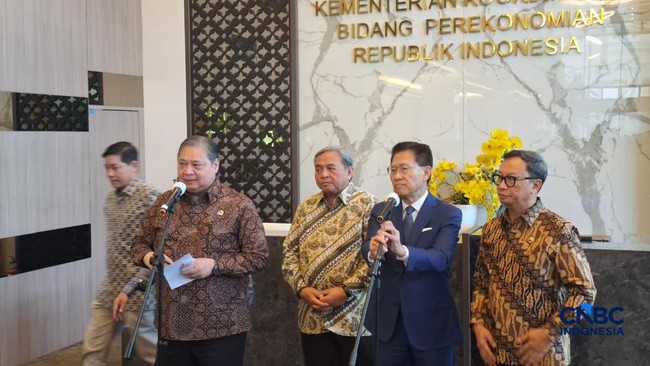
Jakarta, CNBC Indonesia – Coordinating Minister for Economic Affairs Airlangga Hartarto has revealed the impact of implementing the mandatory 50% biodiesel programme, known as B50.
Airlangga said that with B50 in place, Indonesia will no longer need to import diesel fuel and could save up to US$177 billion in foreign exchange reserves.
“Yesterday, President Prabowo launched the mandatory B50 programme. This shows that Indonesia can have its own strength. We no longer need to import diesel and can save up to US$177 billion in foreign exchange,” Airlangga said at a press conference at the Coordinating Ministry for Economic Affairs on Friday (10/7/2026).
Beyond saving foreign exchange, Airlangga added that the implementation of B50 will also contribute 44 million tonnes of CO2-equivalent towards achieving net zero emissions.
“B50 also contributes 44 million tonnes of CO2-equivalent towards net zero emissions,” Airlangga explained.
Earlier, President Prabowo launched diesel fuel blended with 50% palm oil, or B50, on Thursday (9/7/2026) at a Pertamina fuel station at the KM 57 rest area on the Jakarta–Cikampek toll road in Karawang Regency, West Java.
The launch marks an increase in the use of Fatty Acid Methyl Ester (FAME) biodiesel to 50%, up from the previous 40% blend, or B40, which has been in force since the start of 2025.
According to data from the Ministry of Energy and Mineral Resources, the biodiesel or FAME requirement for B50 rises to 16.7–18 million kilolitres, compared with the previous requirement of 14.9 million kilolitres under B40.
Meanwhile, the crude palm oil (CPO) requirement rises to 15.2–16.3 million tonnes under B50, up from 13.6 million tonnes under B40.
In terms of greenhouse gas emission reductions, the implementation of B50 will cut CO2 emissions by 44.46 million tonnes, up from 39.66 million tonnes under B40.