
Airlangga Reveals Anomaly in Indonesia-US Trade, Up 18% After New Tariffs
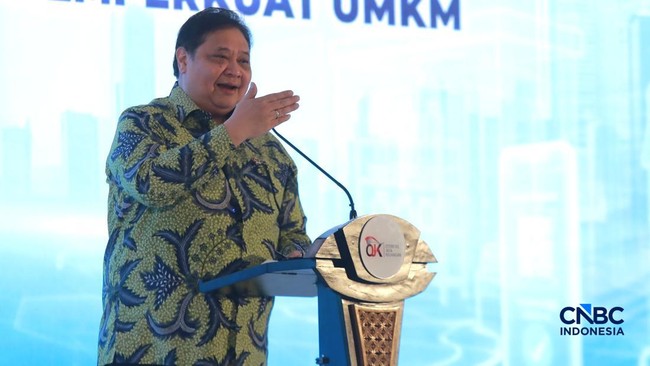
Coordinating Minister for Economic Affairs Airlangga Hartarto has revealed that Indonesia is one of the few countries to have successfully reached an agreement on reciprocal tariffs with the United States.
According to him, this achievement is an important asset for Indonesia in facing global economic uncertainty and the intensifying trade war between nations.
“I do not wish to discuss the trade war in depth, but in my view Indonesia is one of the few countries able to reach an agreement with the United States regarding reciprocal tariffs,” Airlangga said, as quoted from Detikcom, at the Industrial Summit 2026 in Jakarta on Wednesday (19/8/2026).
Airlangga assessed that the agreement has had a positive impact on trade relations between the two countries. Amid rising global trade tensions, the value of Indonesia’s trade with the US has actually shown a significant increase.
According to him, Indonesia-US trade grew by almost 18%, an achievement considered contrary to the trade slowdown trend experienced by many countries due to the trade war.
“This is an anomaly. Despite the trade war, our trade with the US has actually increased by almost 18%,” he said.
In addition to strengthening trade relations with the US, the government is also continuing to expand market access through various international trade agreements. One of the current focuses is the Indonesia-European Union Comprehensive Economic Partnership Agreement (IEU-CEPA).
Airlangga said the ratification process for IEU-CEPA is expected to be carried out by the European Parliament between September and the end of this year.
“One of our major CEPA partnerships is with the European Union, which is expected to be ratified by the European Parliament in September or by the end of this year,” he said.
Nevertheless, the finalisation process of the agreement still faces a number of technical challenges. One of them relates to the official language of the agreement documents, which have so far only been available in English.
According to Airlangga, this situation is unusual for a number of European Union member states, so the Indonesian government is seeking a middle ground so that the implementation of the agreement can be carried out according to target.
“Although there is an unusual obstacle because the documents are only provided in English, we are trying to make it a compromise with European Union countries so that it can be implemented at the beginning of next year,” he said.
Furthermore, Airlangga revealed that Indonesia currently has around 25 economic cooperation agreements with various countries and regions. In addition, there are 13 other trade agreement negotiation processes still underway.
According to him, expanding this network of economic cooperation is one of Indonesia’s main strategies for maintaining economic growth amid various global challenges, ranging from the pandemic, geopolitical conflicts, to international trade turmoil.
“So, in my view, we currently live in a global world full of challenges. We have faced a pandemic, war, and various events that have occurred in rapid succession over the past two to three years, yet we must still deliver prosperity for our people,” Airlangga said.