
Airlangga Receives Reports of Thin Retail Stock in Indonesia, Why?
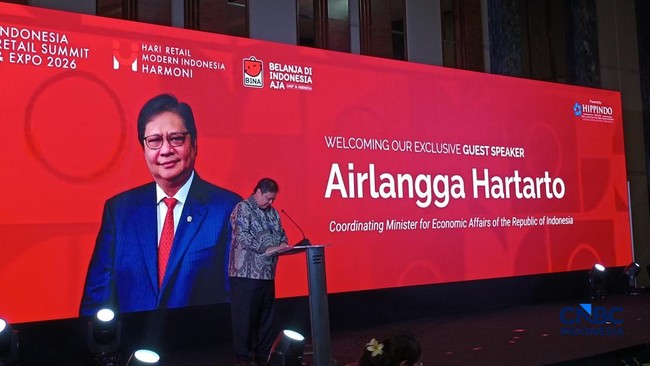
Jakarta, CNBC Indonesia - Coordinating Minister for Economic Affairs Airlangga Hartarto has revealed complaints from retail business players regarding thinning stock levels. This condition particularly affects products whose supply chains still depend on overseas sources.
Airlangga stated that stock and distribution issues are among the matters that need to be urgently addressed so that public spending activity remains within the country.
“Of course, several things that also need to be encouraged are distribution and also stock. I have received a lot of input that the stock is thin, especially for goods that involve flows from abroad. But of course, we hope that the flow of goods can also be encouraged from within the country,” Airlangga said in his presentation while opening the Indonesia Retail Summit and Expo at Swissotel PIK Avenue, Jakarta, Wednesday (26/8/2026).
According to Airlangga, stock availability is important because limited goods should not cause Indonesians to choose to shop abroad.
“And of course, this will become a shared task with the Minister of Trade (Budi Santoso), because we do not want thin stock to result in Indonesians shopping elsewhere, abroad. But with larger stock, of course, more people will shop,” he said.
Complaints regarding goods supply were also conveyed by retail business players. Secretary General of the Indonesian Shopping Centre Tenants and Retailers Association (Hippindo) Haryanto Pratantara said that product completeness, price, and variety are among the reasons why tourist shopping activity in Indonesia is not yet optimal.
“The second factor in Indonesia’s economic growth is the tourism sector. And the key to tourism always involves three main things: tourist attractions, culinary offerings, and shopping. Indonesia has the first two, namely good tourist attractions and varied and very delicious cuisine. But unfortunately, tourists rarely come to Indonesia to shop,” Haryanto explained on the same occasion.
Haryanto said that shopping conditions in Indonesia are actually starting to become more attractive because prices can compete with neighbouring countries. However, product availability and variety remain a problem.
“Only recently has shopping in Indonesia become more popular, due to one main reason that we have actually voiced to the government, namely that shopping in Indonesia is now cheaper. Unfortunately, this is because the Indonesian rupiah exchange rate is relatively weak. But it shows that Indonesia’s prices can compete at least with neighbouring countries. If the quantity of goods is also varied and always up to date with new arrivals, Indonesia should be able to attract more tourists, because the three main elements of tourism are fulfilled: tourist attractions, culinary offerings, and shopping,” he explained.
According to Haryanto, the issue of product completeness also causes Indonesians to choose to shop when travelling abroad, including for global brand products that are actually already available in Indonesia.
“Moreover, we see that Indonesians go crazy shopping when they go abroad. And unfortunately, they mostly buy global brands that are actually already available in Indonesia. But why do they shop abroad and not in Indonesia? Because of product completeness, price, and variety,” he said.
Chairman of Hippindo Budihardjo Iduansjah also requested government support so that foreign brands that have contributed to Indonesia can more easily open stores and sell their products domestically.
“We have brands that are no less competitive, but we also hope for support for foreign brands that have contributed to Indonesia to open stores, create jobs, and pay taxes, and be given ease. Hippindo’s position will ensure harmonisation between local and global brands together, such as import ease and ease for branded foreign products to be sold in Indonesia so as to attract tourists, and the Belanja di Indonesia Aja (BINA) programme can run,” Budihardjo said.