
Airlangga: Indonesia's First-Half 2026 Economic Growth Reaches 5.45 Percent
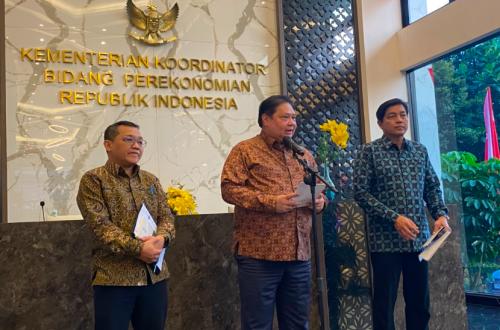
Coordinating Minister for Economic Affairs Airlangga Hartarto said Indonesia’s economic growth in the first half of 2026 remained positive, above the five percent level, amid various global challenges. He is optimistic that in the second half of 2026 the economy will grow even higher, reaching the 2026 state budget (APBN) target of 5.4 percent for the full year and making Indonesia one of the countries with the highest economic growth in Southeast Asia.
Airlangga said Indonesia has faced various challenges during the administration of President Prabowo Subianto, such as unresolved global conflicts in the Middle East and Eastern Europe. Other challenges include the development of trade wars and technological disruption.
“Amid such conditions, although various institutions see global economic growth averaging only above three percent, Indonesia was still able to grow by 5.29 percent (year on year/yoy) in the second quarter,” Airlangga said at a press conference on second-quarter economic growth at the Coordinating Ministry for Economic Affairs office in Jakarta on Wednesday (5/8/2026).
He noted that the second quarter of 2026 did not have a major momentum such as Lebaran. Therefore, the economic growth achievement of 5.29 percent (yoy) is considered positive and will continue to be pursued for improvement in subsequent quarters.
“This figure is quite good. Throughout the first half of 2026 we grew by 5.45 percent (yoy) and this growth maintains a seven-year trend of growth above five percent,” Airlangga said.
The economic growth achievement of 5.45 percent in the first half of 2026 is said to be one of the highest among Southeast Asian (ASEAN) countries.
“Growth of 5.45 percent throughout this semester is one of the top in ASEAN,” he stated.
However, compared to Vietnam, Indonesia’s economic growth is still lower. Vietnam’s economic growth was recorded at around eight percent.
“Then if we look at growth by region, this is interesting, Bali and Nusa Tenggara grew above the national level, at 6.1 percent. This shows that the tourism sector has been able to move to bring prosperity to the Bali and Nusa Tenggara regions, both from domestic and foreign tourists,” he explained.
Meanwhile, Java remains the centre of growth with a contribution to GDP of 56.4 percent. Its growth was higher than the national level, reaching 5.65 percent.
“This means the supply chain is the driver of the national economy,” he stressed.
By business field, the processing industry contributed 18.5 percent with growth of 4.52 percent. Meanwhile, the accommodation and food and beverage services sector grew by 10.6 percent.
“Of course this is supported by the President’s flagship programme, namely Free Nutritious Meals (MBG), as well as programmes related to the hotel and travel industries. Also worth noting is the construction sector, which grew above national economic growth at 6.68 percent,” he said.
Airlangga said the growth in the construction sector is in line with the target of building three million homes, supported through the Housing Financing Liquidity Facility (FLPP) and housing credit.
“Including People’s Business Credit (KUR), which for the first time we have pushed and launched. Initially the budget was Rp 37.5 trillion, increased to Rp 50 trillion. This will also be a driver in the second quarter and semester,” he stressed.
In addition, Airlangga continued, the government is also accelerating capital expenditure, especially in industrial estates and the development of various leading sectors, including the Merah Putih Village Cooperatives (KDMP).
Airlangga emphasised that the government will intensify various programmes capable of boosting economic growth, whether through government spending, investment or public consumption.
“Of course we are targeting this year in accordance with the APBN at 5.4 percent. So we must maintain the growth momentum above five percent in the second half. We expect investment to be the driver, followed by government spending, public purchasing power, as well as exports and imports,” Airlangga concluded.
Source: jawawa.id (https://jawawa.id/newsitem/airlangga-indonesias-first-half-2026-economic-growth-reaches-5-45-percent-1785934407)
Originally published by Republika (https://ekonomi.republika.co.id/berita/tjaqdq423/airlangga-pertumbuhan-ekonomi-semester-i-2026-capai-545-persen-salah-satu-tertinggi-di-asean), translated from Indonesian