
Airlangga: Indonesia's Economy Cannot Be Dictated by One or Two Rating Agencies
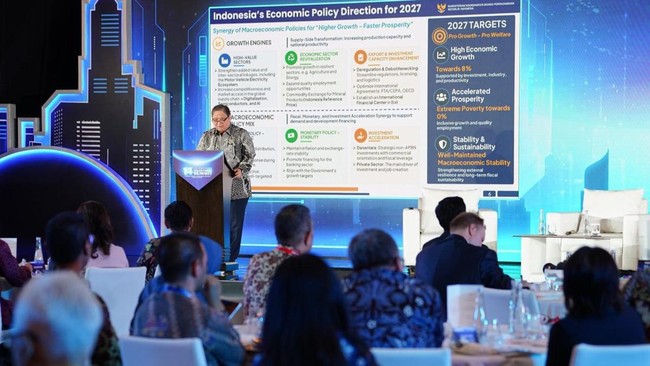
Jakarta, CNBC Indonesia - The Coordinating Minister for Economic Affairs of the Republic of Indonesia, Airlangga Hartarto, has emphasised that Indonesia will determine its own economic conditions. He stated that the nation’s economy cannot be determined by the assessments of only one or two rating agencies.
“We cannot be dictated by one or two rating agencies to say whether Indonesia’s economy is good or not,” he said during his opening remarks at the 14th US-Indonesia Investment Summit at the St. Regis Hotel, South Jakarta, on Tuesday (6/10/2026).
Airlangga explained that Indonesia’s fiscal condition is more conservative compared to other nations. The current state budget deficit of -2.3% is smaller than that of other countries such as the US at 5.8%, India at 4.4%, and Japan at -60%.
“If we compare investment growth between countries, Indonesia demonstrates more conservative fiscal control,” Airlangga noted.
Regarding the debt burden, Indonesia’s debt ratio stands at 41%, which is far lower than the US at 123.3%, India at 83.1%, and Singapore at 171.3%.
“This shows that Indonesia’s macroprudential policy is actually more conservative than the countries mentioned earlier,” said Airlangga.
However, he observed that US-based rating agencies tend to be harsher towards Indonesia compared to other nations. Nevertheless, Airlangga emphasised that the Indonesian economy remains strong.
“Therefore, we are not afraid or worried. Our economy remains robust. We cannot be dictated by one or two rating agencies to determine whether Indonesia’s condition is good or bad. We are the ones who determine whether our condition is good or not, and we are the ones who decide the future of Indonesia,” he concluded.
He went on to present Indonesia’s economic performance, which has recorded figures above the global average. Specifically, quarterly economic growth stands at 5.05%, inflation is at 3.28%, investment has increased by 7% compared to last year, and the consumer confidence index remains steady at 108.5.
Furthermore, Airlangga stated that Indonesia’s Gini ratio is at 0.36, the poverty rate has dropped to 8.7%, and the open unemployment rate is around 4.65%.
Additionally, he revealed that next year Indonesia is targeting economic growth of 6%. Airlangga stated that the government will strengthen high-value-added sectors, revitalise resilient industries, and expand export and investment capacities supported by digitalisation, semiconductors, and Artificial Intelligence (AI).
In this regard, Indonesia’s fiscal policy will act as a catalyst, while monetary policy will maintain financial stability amidst uncertainty.
“Our fiscal policy will be catalytic, whereas monetary policy will maintain stability and serve as a buffer against uncertainty and commodity price volatility, including fluctuations in oil and gas prices,” Airlangga concluded.
Source: jawawa.id (https://jawawa.id/newsitem/airlangga-indonesias-economy-cannot-be-dictated-by-one-or-two-rating-agencies-1791276970)
Originally published by CNBC Indonesia (https://www.cnbcindonesia.com/news/20261006131140-4-773754/airlangga-ekonomi-indonesia-tak-bisa-didikte-oleh-1-2-lembaga-rating), translated from Indonesian