
Airlangga Highlights Market Diversification, Global Competitiveness for Furniture Industry
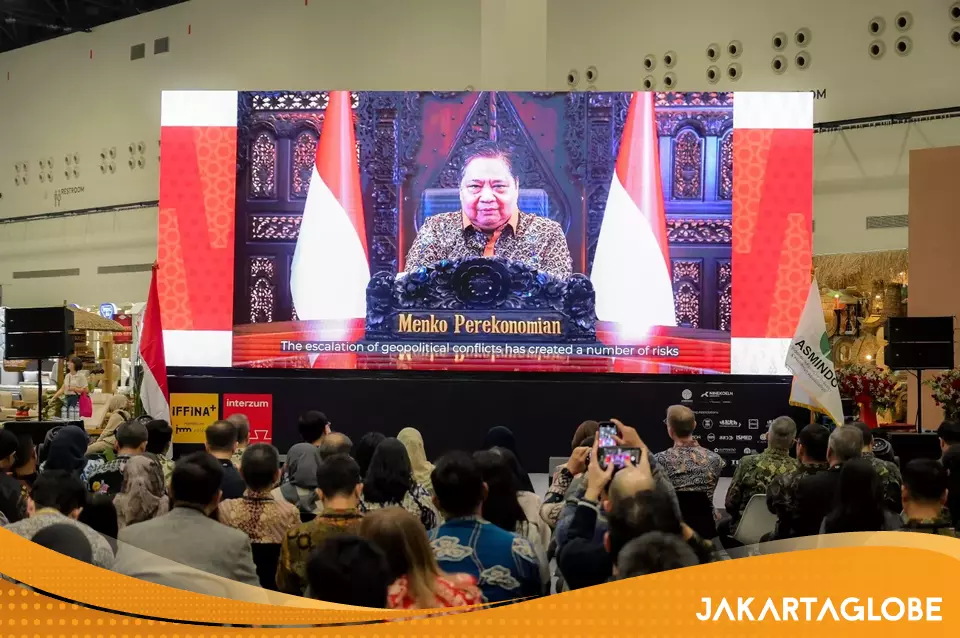
Airlangga Highlights Market Diversification, Global Competitiveness for Furniture Industry
Jakarta. Indonesia is seeking to diversify its furniture export markets and reduce its reliance on the United States, which absorbs around 60% of the country’s furniture exports, as global uncertainty raises risks for the domestic industry.
Chief of Economic Affairs Minister Airlangga Hartarto said expanding access to international buyers and building direct business relationships were essential to mitigating external risks and strengthening the industry’s competitiveness.
“The IFFINA+ exhibition is important as a way to mitigate risks by expanding markets, building direct relationships with international buyers and reducing export dependence on certain markets,” Airlangga said in a virtual address at the International Furniture and Craft Fair Indonesia (IFFINA+) 2026 on Thursday.
Indonesia’s manufacturing industry contributed 18.50% to gross domestic product (GDP) and grew 4.52% year-on-year. Furniture manufacturing was among the stronger-performing subsectors, expanding 11.82%, while other manufacturing industries grew 12.22%.
Indonesia has maintained a furniture trade surplus since 2021. In 2025, furniture exports reached $2.39 billion, compared with imports of $1.92 billion, generating a surplus of $473.31 million.
Despite its export performance, Indonesia ranked 25th among the world’s furniture exporters in 2025, with a market share of just 0.77%, highlighting room to expand its presence in the global market.
Airlangga said the industry needed to improve product quality, design, sustainability and trade promotion to capture more international demand. Consumer preferences are shifting toward functional, adaptable furniture made from environmentally friendly materials, he added.
Indonesia’s abundant timber and rattan resources offer opportunities to develop products that meet these preferences. The country produced 57.46 million cubic meters of roundwood in 2024, with around 20% of national log production used as raw material by the wood-processing industry. Indonesia also produces more than 80% of the world’s rattan.
However, the industry’s structure presents challenges to productivity and competitiveness, particularly among smaller businesses.
“Small and medium industries account for nearly 99.79% of the country’s 4.45 million industrial businesses and employ 65.52% of industrial workers. Given their scale, these businesses still face technological constraints, while productivity also has room to improve,” Airlangga said.
He added that businesses needed to adapt to the standards, regulations and consumer preferences of their export destinations.
To support the sector, the government has introduced fiscal incentives, financing facilities and programs to improve industrial productivity. These include government-borne income tax for eligible workers under Article 21, financing through the Labor-Intensive Industry Credit scheme, and machinery and equipment restructuring programs to improve efficiency.
The government is also facilitating export promotion to help businesses reach new markets. Other measures include controlling roundwood exports, strengthening product standards and the Timber Legality Verification System (SVLK), and promoting green industry practices to increase domestic value added.
Airlangga closed by expressing appreciation to the Indonesian Furniture and Handicraft Industry Association (ASMINDO) for organizing IFFINA+ 2026, expressing hope that the exhibition would generate trade deals, partnerships and broader international market access for Indonesian furniture and handicraft products.
He urged international buyers, importers and investors to explore partnerships with Indonesian manufacturers, while encouraging domestic businesses to use the exhibition to build networks, understand market developments and strengthen their competitiveness.
Tags: Keywords: