
Airlangga: Green economy has potential to add 3 per cent to growth
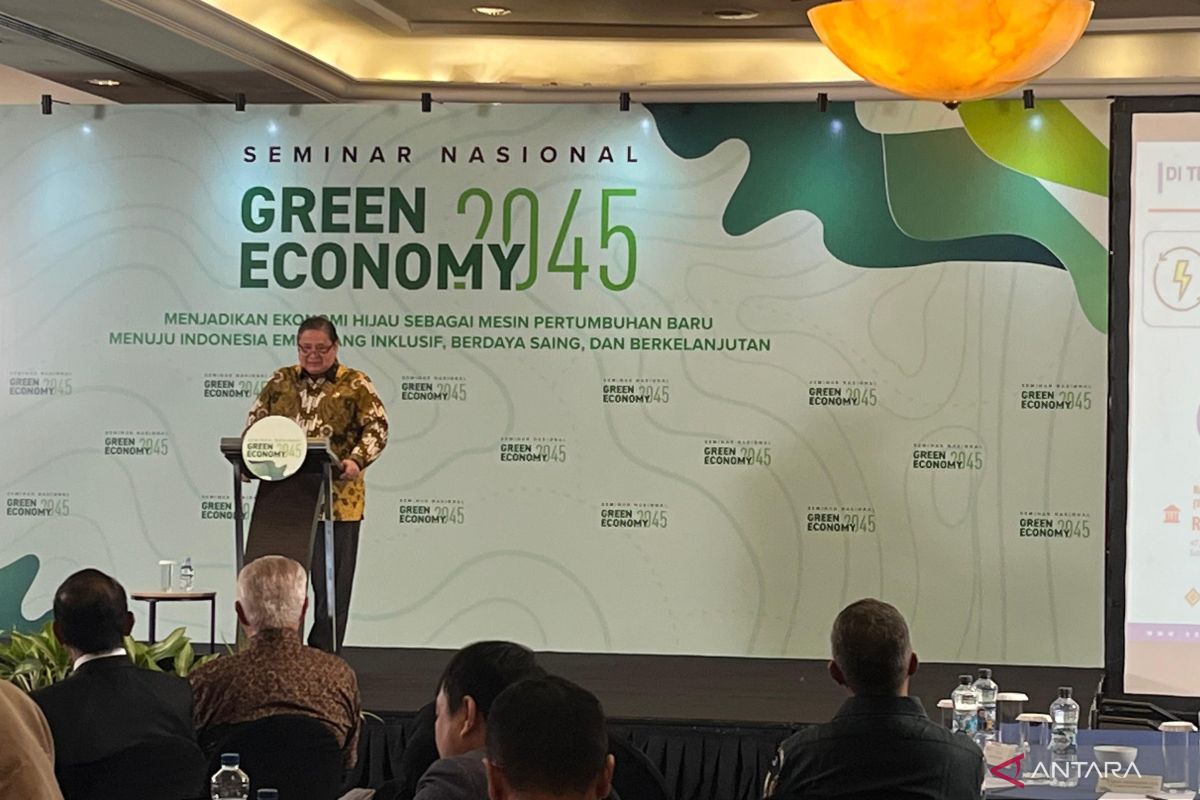
Jakarta (ANTARA) - The Coordinating Minister for Economic Affairs, Airlangga Hartarto, stated that the massive development of a green economy has the potential to provide an additional 2-3 per cent to national economic growth, alongside the influx of investment and the expansion of clean energy-based economic activities within the country.
“If we are currently growing at 5.45 per cent without massive green energy, then if this works on a large scale, with investments coming in and being executed domestically, an additional 2-3 per cent growth could be created,” Airlangga said in Jakarta on Tuesday.
According to him, the green economy sector is estimated to be able to employ up to 5.3 million people by 2029, which will be accompanied by a demand for skills more aligned with the development of the clean energy sector.
“Green energy requires a different, more skilled workforce. It is estimated that this sector could employ 5.3 million people by 2029,” he said.
Furthermore, he noted that Indonesia possesses strategic resources that can serve as vital capital in the development of green energy and downstreaming, particularly regarding strategic mineral commodities.
Downstreaming is considered increasingly important if supported by clean, reliable, and affordable energy. One of the flagship sectors is electric vehicles, which are capable of generating more than 60 times the added value.
The development of this ecosystem is seen as a way to position Indonesia as a strategic player in the global energy transition.
Several countries, including those in the European Union, the United States, and Canada, are reportedly seeking cooperation with Indonesia in the critical minerals sector.
This situation is described as an important momentum for Indonesia to develop its critical mineral potential while simultaneously strengthening the green energy industry.
In addition to minerals, Indonesia also possesses large reserves of silica sand, which has the potential to support the domestic solar panel industry.
He stated that Indonesia has a potential construction capacity for solar panels equivalent to 111 gigawatts per year. However, the increase in solar panel exports to the United States has resulted in Indonesian products being subject to import duties of up to 110 per cent.
In the steel sector, specifically stainless steel, Indonesian products also face import tariffs of 50 per cent in the United States, the European Union, and the United Kingdom.
Nevertheless, Indonesia is considered still capable of competing in the global market if such tariffs are applied equally to all countries.
From a financing perspective, the government is encouraging the use of green bonds and blended finance to support green economy investments, including the commitment of the Just Energy Transition Partnership (JETP), which is preparing more than 20 billion US dollars in funding for Indonesia.
Airlangga also linked the development of the green economy to the growth of the digital economy. According to him, green energy is one of the prerequisites for the development of digital economy infrastructure, including data centres.
He mentioned that Indonesia’s digital economy, currently valued at approximately 100 billion US dollars, has the potential to expand alongside the implementation of the Digital Economy Framework Agreement.
Source: jawawa.id (https://jawawa.id/newsitem/airlangga-green-economy-has-potential-to-add-3-per-cent-to-growth-1790683348)
Originally published by Antara (Indonesian) (https://www.antaranews.com/berita/5763384/airlangga-ekonomi-hijau-berpotensi-tambah-pertumbuhan-3-persen), translated from Indonesian