
Airlangga: Gold ETF Strengthens Financial Market Depth, Indonesia Has Opportunity to Overtake India
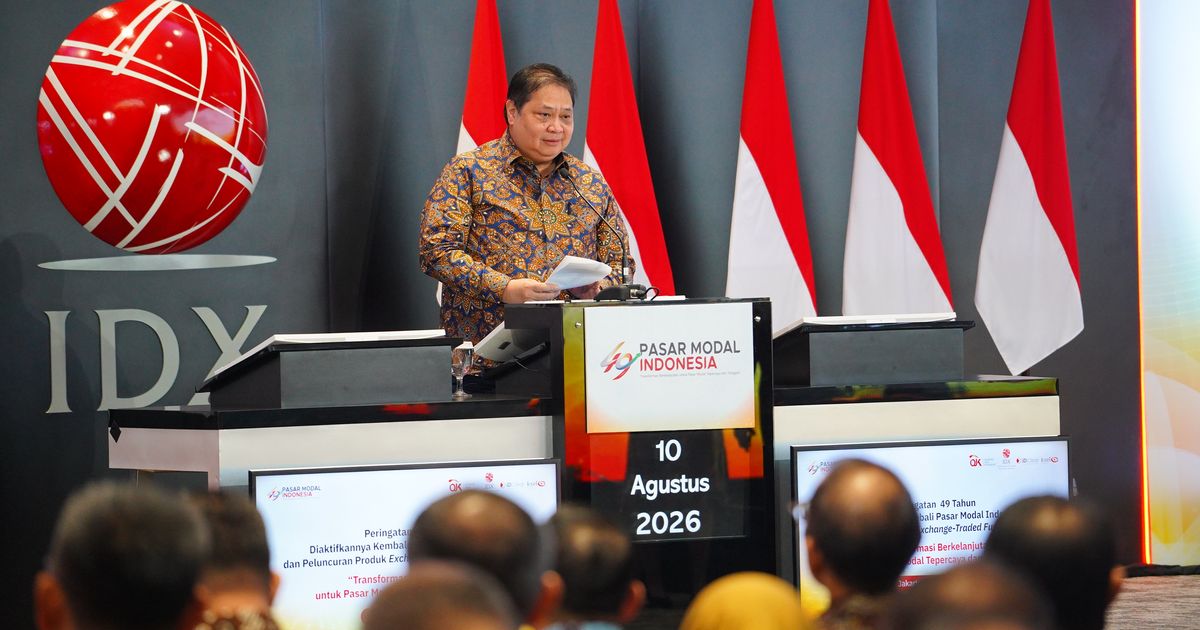
The government is encouraging the development of a Gold Exchange Traded Fund (ETF) as a new instrument to deepen Indonesia’s financial market while expanding investment choices for the public and institutional investors. With significant domestic gold potential, Indonesia is considered to have the opportunity to develop into one of the region’s primary gold ETF markets.
Coordinating Minister for Economic Affairs Airlangga Hartarto said the presence of a Gold ETF is not merely about adding an investment product to the Indonesia Stock Exchange (BEI), but also about building an ecosystem that connects the capital market with the bullion industry, banking, investment managers, custodian banks, insurance companies, and gold traders. “Gold not only adds investment options but also increases liquidity,” Airlangga said during the commemoration of the 49th anniversary of the reactivation of the Indonesian Capital Market and the launch of the Gold ETF in Jakarta.
Airlangga assessed the launch of the Gold ETF as an important momentum because Indonesia has a large gold asset base. He mentioned that gold within the Pegadaian ecosystem alone amounts to approximately 153 tonnes, with a value of around US$20 billion. This potential, he said, provides significant room for Indonesia to develop a Gold ETF, especially as the global Gold ETF market has grown rapidly, becoming a key instrument for investors seeking exposure to gold without holding physical bullion.
Based on validated data, global Gold ETF assets under management reached around US$559 billion in 2025, with holdings of approximately 4,025 tonnes of gold. The United States is the largest market with around US$200 billion in assets under management, followed by China with around US$45 billion and India with around US$17.5 billion. With its domestic gold base, Airlangga sees an opportunity for Indonesia to catch up with India’s gold ETF market.
One breakthrough highlighted is the opportunity for insurance companies to gain investment exposure to gold through the ETF. Previously, the scope for insurance companies to invest directly in bullion was relatively limited. Airlangga expressed his satisfaction that the ETF allows insurance firms to invest in gold, a move he said the government will continue to support.
The Gold ETF is also expected to form a more complete financial industry chain. The product will connect investment managers, custodian banks, bullion banks, gold dealers, and the Indonesia Stock Exchange, so that gold-based economic activity does not stop at physical gold trading but develops into a liquid financial instrument integrated with the capital market.
Airlangga also appreciated the Financial Services Authority’s (OJK) steps regarding the Electronic Gold Receipt (EGR), which can be classified as a security and recorded in the Gold ETF portfolio. This mechanism is important as it creates a bridge between physical gold ownership and investment instruments traded on the capital market. The government is concurrently examining the taxation aspects so that EGR transactions can develop competitively. Airlangga stated that he has discussed the Value Added Tax (PPN) and Income Tax Article 22 treatment for EGR transactions with the Ministry of Finance, aiming to create a level playing field and encourage EGR transactions to grow on par with other exchange-traded instruments.
The development of a Gold ETF holds strategic significance for Indonesia as it can transform the strength of domestic gold assets into a source of financial sector deepening. While most gold ownership has traditionally been in physical form, the ETF allows gold to gain a new dimension as an underlying asset for capital market instruments. This transformation has the potential to increase liquidity, broaden the investor base, add portfolio diversification alternatives, and open up long-term funding sources for the financial market, while providing investors with an instrument that is relatively easy to trade without the need to handle physical gold storage directly.
Airlangga stated that the development of new instruments is increasingly important as Indonesia’s economic financing needs continue to grow. He noted that the economy’s financing requirement in 2026 is around Rp7,400 trillion and is expected to increase to approximately Rp9,200 trillion by 2029. Therefore, the capital market and financial sector must deepen to become a source of development financing. He also emphasised that the development of new investment instruments is taking place while Indonesia’s economic fundamentals remain relatively strong amid slower global growth, with the economy growing 5.29 percent year-on-year in the second quarter of 2026 and 5.45 percent throughout the first half of the year.
Source: jawawa.id (https://jawawa.id/newsitem/airlangga-gold-etf-strengthens-financial-market-depth-indonesia-has-opportunity-to-overtake-india-1786380638)
Originally published by investortrust.id (https://investortrust.id/market/112385/airlangga-etf-emas-perkuat-kedalaman-pasar-keuangan-indonesia-berpeluang-salip-india), translated from Indonesian