
Airlangga: Global Uncertainty a Momentum to Strengthen Economic Foundations and AI
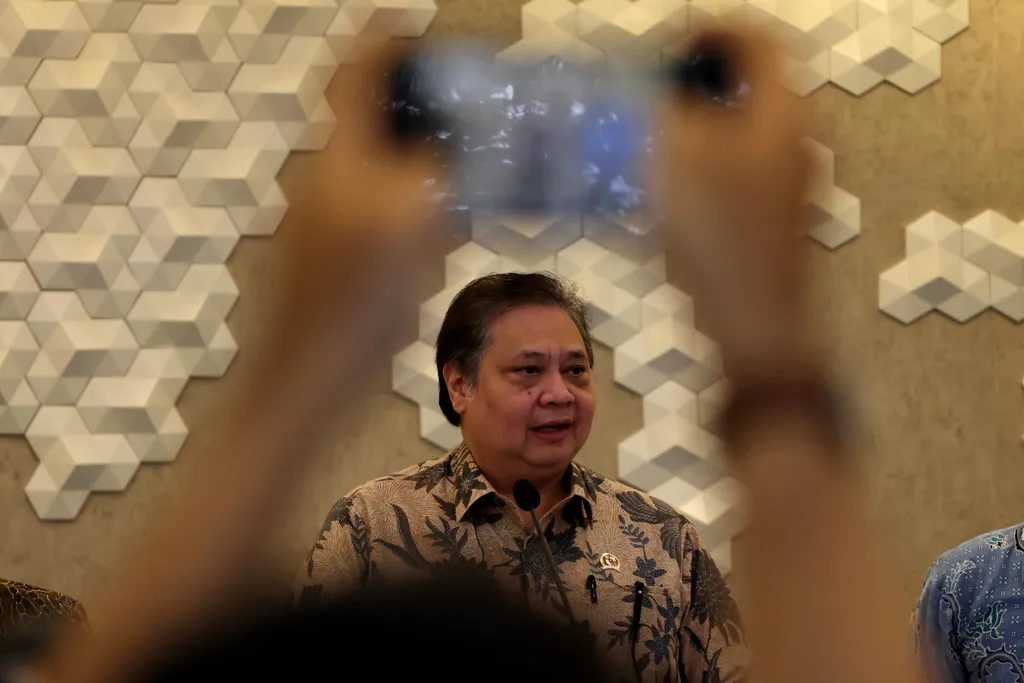
JAKARTA, KOMPAS — Global uncertainty resulting from geopolitical conflict and technological disruption is seen as a momentum for Indonesia to strengthen its economic foundations. The government is preparing to bolster energy resilience, digital infrastructure, and the artificial intelligence ecosystem so that Indonesia can attract new investment while strengthening its competitiveness in the region.
Coordinating Minister for Economic Affairs Airlangga Hartarto said this policy direction is the government’s strategy for facing various global challenges, ranging from the war in Ukraine and tensions in the Strait of Hormuz to AI developments that are changing the world’s economic landscape.
“Amid this uncertainty, the President’s directive is to strengthen food sovereignty and energy sovereignty,” Airlangga said at an event titled Kadin Diplomatic Economic at the Coordinating Ministry for Economic Affairs office in Jakarta on Friday. The event was attended by representatives from more than 67 countries, including 34 ambassadors.
According to Airlangga, one effort to strengthen energy resilience is being carried out through the implementation of B50 biodiesel. The programme is claimed to be able to halt diesel imports, saving approximately Rp 177 trillion in foreign exchange while reducing emissions by around 44 million tonnes of carbon dioxide equivalent.
The government has also begun running a 100-gigawatt solar power plant programme expected to support the development of the battery industry, both for electric vehicles and energy storage systems. Investment in this sector, Airlangga said, has flowed into several industrial areas in Central Java and East Java.
In addition to energy, the government is positioning artificial intelligence as one of the new engines of economic growth. To support its development, the government is strengthening digital infrastructure through the construction of submarine cable networks connecting Batam, Riau Islands, with Singapore, and Bitung, North Sulawesi, with the United States.
This infrastructure is expected to accelerate the development of data centres in Indonesia. Currently, national data centre capacity has reached 580 megawatts, while projects still in the investment stage amount to approximately 1.3 gigawatts.
The government is also partnering with chip design company Arm to train around 15,000 technicians and engineers as part of developing the national semiconductor ecosystem.
In the international trade sector, the government is accelerating Indonesia’s accession to the Organisation for Economic Co-operation and Development and the Comprehensive and Progressive Agreement for Trans-Pacific Partnership. Airlangga also asked ambassadors from friendly countries to help oversee the realisation of various investment commitments agreed upon during President Prabowo Subianto’s visits to several countries.
Vice Chairman Coordinator for Foreign Affairs at the Indonesian Chamber of Commerce and Industry James Riady assessed that the government’s policy direction in the AI sector sends a positive signal to business actors and the diplomatic community. According to him, the development of digital infrastructure, including international landing points and data centres, shows that Indonesia is preparing to become a computing hub in the Asia Pacific region.
“We hear that AI will become Indonesia’s centre stage. Many data centres are coming in, and in the future there will be tens of billions of US dollars in investment to build computing centres with the most advanced GPUs,” said James.
He said this information was welcomed positively by the ambassadors present at the forum. According to James, certainty in the direction of digital economic development is an important factor in increasing investor confidence in Indonesia.
James assessed that Indonesia has the opportunity to become one of the major powers in the Pacific region alongside the United States and China if it can capitalise on the momentum of digital transformation and maintain the investment climate.
Airlangga also dismissed concerns over the weakening of the rupiah exchange rate, which briefly touched the range of Rp 18,000 per US dollar. According to him, Indonesia’s economic fundamentals remain intact. He noted that economic growth is still at 5.61 per cent, inflation remains controlled within the government’s target, the annual trade balance is still in surplus, and banking conditions remain healthy with growth in third-party funds and credit continuing to increase.
“Various institutions such as the World Bank, IMF, and OECD also still estimate Indonesia’s economic growth to be in the range of 5 per cent. So, relatively, everyone assesses our economy as safe and solid,” said Airlangga.
Source: jawawa.id (https://jawawa.id/newsitem/airlangga-global-uncertainty-a-momentum-to-strengthen-economic-foundations-and-ai-1783759814)
Originally published by kompas.id (https://www.kompas.id/artikel/airlangga-ketidakpastian-global-jadi-momentum-perkuat-fondasi-ekonomi-dan-ai), translated from Indonesian