
Airlangga: Global Economic Slowdown Poses Financing Challenge
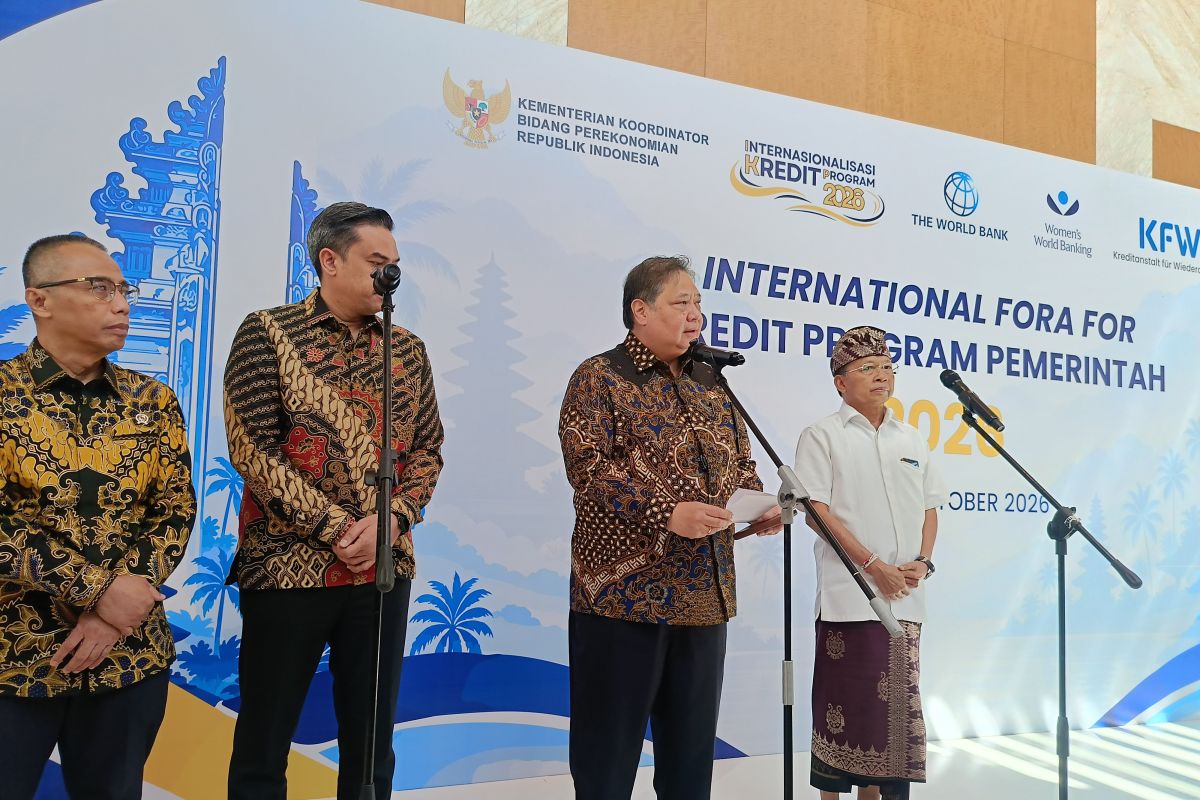
Badung, Bali (ANTARA) — Indonesia’s Coordinating Minister for Economic Affairs, Airlangga Hartarto, said global economic uncertainty could increase financing challenges for Indonesia, particularly as the government seeks to boost economic growth to eight per cent.
Speaking at the International Fora for Government Credit Programmes in Nusa Dua, Badung Regency, Bali, on Thursday, Airlangga said various international institutions, including the International Monetary Fund (IMF), forecast that global economic growth would slow to around three per cent.
“We remain in a state of uncertainty,” Airlangga said.
He said global oil prices had risen by about 70 per cent to more than US$100 a barrel. Meanwhile, a conflict that has continued for more than six months has shown no signs of resolution.
According to Airlangga, these conditions have also put pressure on the cost of financing. He cited the latest yield on 10-year Indonesian government bonds (SBN), recorded at 7.21 per cent.
“The challenges ahead will become greater, while we also need to recognise that achieving eight per cent growth will require substantial investment,” he said.
Despite the external situation, Airlangga said several indicators showed that Indonesia’s economy remained relatively resilient. He said economic growth had reached 5.45 per cent, while inflation at 3.29 per cent remained within the target range of 2.5 per cent, plus or minus one percentage point.
He also said investment grew by 7.3 per cent from January to September. The industrial confidence index stood at an expansionary 52.4, while the national consumer confidence index was recorded at 118.1.
Airlangga said the government was seeking to sustain growth momentum by strengthening domestic demand, investment, downstream processing and the productivity of micro, small and medium-sized enterprises (MSMEs).
“Every rupiah of financing, including programme credit, must be directed as productively as possible,” he said.
He added that improving financing productivity was essential to ensure available resources generated a greater economic impact amid global uncertainty.