
Airlangga Clarifies Social Assistance Decile Controversy: A 12th Decile Is Impossible
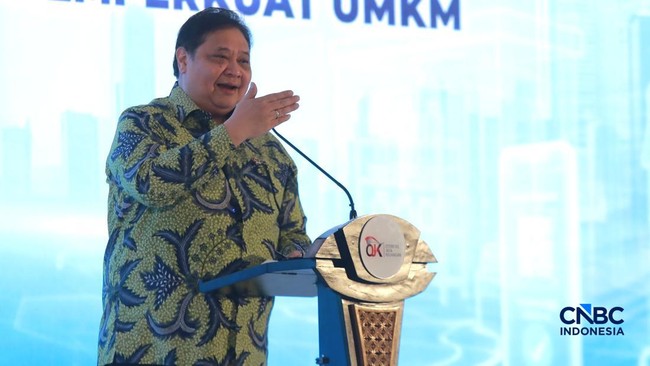
Coordinating Minister for Economic Affairs Airlangga Hartarto has spoken out regarding the decile distribution scheme used by the government as a reference for distributing social assistance and, in future, for restricting consumption of Pertalite fuel. According to Airlangga, the government will not increase the number of deciles. This is because a decile is a family welfare group measured based on socio-economic variables including individual information (employment, education), housing information (house condition, electrical capacity) and asset ownership.
Citing the Ministry of Social Affairs’ social assistance checker, there are 10 deciles, each containing 10% of families in Indonesia. Decile 1 comprises families with the lowest 10% welfare level, while decile 10 comprises families with the highest 10% welfare level. “No (it will not be added), deciles always go up to 10, just like 0-100%, it is roughly impossible to have 0-120%. Decile 12 would be 120%,” he explained at the Coordinating Ministry office on Friday (21/8/2026).
Regarding the controversy over decile status in the community, Airlangga revealed that the Central Statistics Agency (BPS) is still conducting the 2026 National Socio-Economic Survey, or Susenas. “BPS is currently conducting an economic census, we will just wait for the economic census,” said Airlangga.
As is known, many members of the public have tried to check their decile status independently. They are generally surprised because their decile status does not match their economic and social conditions. This has been widely discussed on social media.
In accordance with Minister of Social Affairs Decree Number 79/HUK/2025, the decile distribution serves as the basis for determining which community groups are entitled to receive various forms of social assistance. The categories of social assistance recipients based on deciles, according to the decree, are as follows:
Family Hope Programme (PKH): received by Decile 1 to Decile 4 groups.
Sembako Programme: received by Decile 1 to Decile 5 groups.
Health Insurance Contribution Assistance: received by Decile 1 to Decile 5 groups.
Social Rehabilitation Assistance Programme: received by Decile 1 to Decile 5 groups.
Social Welfare Programme within the Ministry of Social Affairs: received by Decile 1 to Decile 5 groups or according to the assessment results of each programme.
Based on these provisions, deciles 1 to 5 are the priority groups for receiving social assistance, while deciles 6 to 10 are not a priority for receiving social assistance because they are considered to already have a sufficiently high level of welfare.
However, the scope of social protection can be expanded under certain conditions, such as during the Covid-19 pandemic. During that period, social assistance recipients were expanded to include community groups in decile 6. The following is a breakdown of the decile distribution:
Decile 1: 10% Poorest Population
Decile 2: 10% Poor and Vulnerable Population
Decile 3: 10% Poor and Vulnerable Population
Decile 4: 10% Poor and Vulnerable Population
Decile 5: 10% Population with Moderate Expenditure
Decile 6: 10% Population with Moderate Expenditure
Decile 7: 10% Population with Upper-Middle Expenditure
Decile 8: 10% Population with Upper-Middle Expenditure
Decile 9: 10% Population with Upper-Middle Expenditure
Decile 10: 10% Richest Population