
Airlangga Business Community Forum Unites Entrepreneurs, Banks, and Government to Strengthen Business Ecosystem
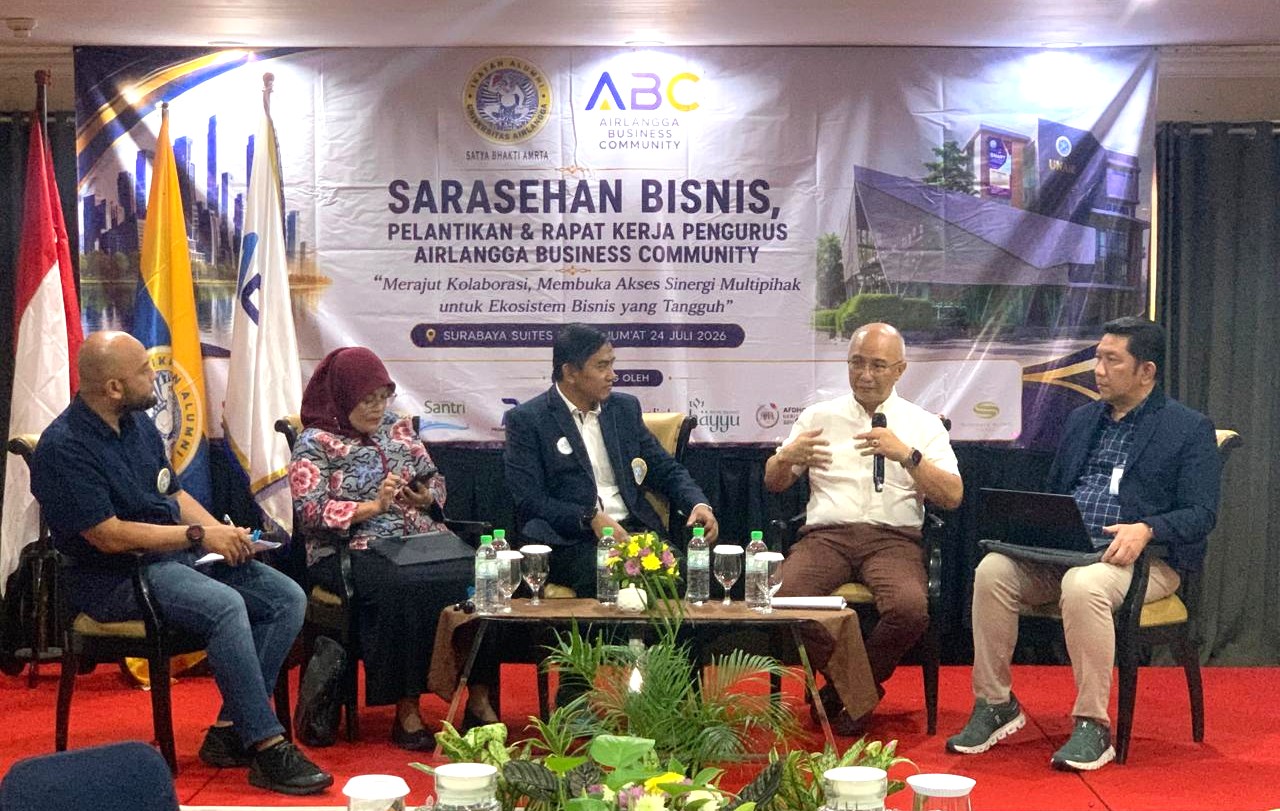
SURABAYA – Business players can no longer rely solely on capital and markets to survive amid competition. Collaboration with banks, government, universities, investors and fellow entrepreneurs has become an essential part of driving business growth and helping companies move up a class.
That idea formed the common thread of the National Business Gathering held by the Airlangga Business Community (ABC), an organisation under the Universitas Airlangga alumni association (IKA UNAIR), at the Surabaya Suites Hotel on Friday (24/7/2026).
Themed “Weaving Collaboration, Opening Access to Multi-Party Synergy for a Resilient Business Ecosystem”, the forum brought together entrepreneurs with banking circles, government, academics, investors, state and regional-owned enterprises (BUMN-BUMD), and startup founders.
Airlangga Business Community Chairman Dicky Fanani said the challenges facing the business world are no longer limited to increasing production and selling products. Entrepreneurs must also have access to financing, investment, technology, knowledge and networks that can connect them with new opportunities.
“That is why ABC wants to be the connector that brings together business players, industry, financial institutions, government and academics in one mutually reinforcing ecosystem,” Dicky said.
According to him, the strength of the Universitas Airlangga alumni network holds great potential if developed into concrete business collaboration.
ABC therefore wants to go beyond functioning merely as a gathering place for alumni entrepreneurs. The network is being directed towards becoming an ecosystem capable of opening access to markets, financing, investment, research and business partnerships.
The gathering marked one of the first steps in implementing the ABC Blueprint 2045, a long-term plan that places collaboration as one of the foundations for developing alumni businesses.
ABC seeks to match entrepreneurs who need financing with financial institutions, businesses needing innovation with universities, and the business world needing regulatory support with government.
At the forum, Adik Dwi Putranto, Chairman of the East Java Chamber of Commerce and Industry (Kadin), represented by Tri Prakoso, Vice Chairman for Oil and Gas Affairs at Kadin East Java, highlighted the importance of business organisations as a “home” for entrepreneurs.
Tri compared Indonesia’s business institutional framework with Germany’s. According to him, the institutional structure for entrepreneurs in Indonesia still faces challenges because not all business players are strongly connected through business organisations.
This situation means that the function of business organisations cannot stop at being a place to build networks.
Advocacy, according to Tri, is one of the essential functions when entrepreneurs face obstacles, ranging from regulation, licensing and product standardisation to other issues affecting business development.
The need for such assistance is felt most acutely by micro, small and medium enterprises (MSMEs).
Tri cited the approach taken by the Banyuwangi Regency Government in assisting MSME players. According to him, Banyuwangi can serve as an example of how business mentoring is carried out in stages and sustainably.
MSME players are not simply encouraged to sell products. They are also guided to record business progress, obtain household industrial food permits (PIRT), meet halal certification requirements and improve product standardisation.
Such an approach shows that MSME problems do not always stop at capital.
The ability to manage a business, meet legal requirements, maintain product quality, understand consumers and expand markets also determines whether a business can move up a class.
This is where collaboration between government, business organisations, financial institutions, universities and businesses becomes important.
Business meets research
Universities also occupy a strategic position in this ecosystem. Collaboration between the business world and higher education can help entrepreneurs solve problems requiring research and innovation.
One example raised at the gathering was the development of edamame. As a plant originating in subtropical climates, developing edamame in tropical regions faces the problem of matching seed varieties to soil and climate conditions.
To address that challenge, research collaboration was undertaken with a university in Thailand to obtain seed varieties better suited to tropical conditions.
That example shows how market demand can become an entry point for collaboration between business and science.
For entrepreneurs, the ability to read market behaviour is just as important as the ability to produce goods.
Products should not be made simply because producers are able to make them. Products must be developed based on consumer needs and market changes.
The ability to analyse behaviour can even be used in negotiation processes to read the tendencies, responses and likely decisions of the other party. Knowledge of human behaviour can therefore also become part of business decision-making strategy.
Access to capital and investment
Another issue drawing attention is access to financing and investment. Ahmad Nuruddin, Micro and Pawning Area Manager at Bank Syariah Indonesia, outlined sharia financing opportunities that business players can utilise to grow their businesses.
Meanwhile, Shovitushololihah, Secretary of the East Java Investment and One-Stop Integrated Services Office (DPMPTSP), discussed the role of the investment climate in driving regional economic growth.
Regulatory certainty, service convenience and communication between government and business players are essential parts of building a healthy investment climate.
For ABC, matching financing access with business readiness is important. Additional capital alone does not automatically make a business grow if it is not accompanied by markets, governance, innovation and adequate networks.
Conversely, businesses with potential products and markets can also struggle to grow if access to financing and investment is limited.
The national gathering was attended by more than 50 participants from diverse backgrounds, including CEOs, company directors, Universitas Airlangga alumni business owners, representatives of BUMN and BUMD, banks, academics, investors and startup founders.
In addition to the discussions, the event included the inauguration of officeholders and a working meeting to draw up the organisation’s strategic programmes.
Dicky said ABC carries four core values in building the alumni business ecosystem: integrity, collaboration, benefit and sustainability.
These four values are directed towards encouraging the alumni network to produce collaborations that deliver real benefits for business players and the economy.
Through the ABC Blueprint 2045, the organisation wants to build a network that enables entrepreneurs to meet banks when they need financing, investors when they need expansion capital, universities when they need research and innovation, and government when dealing with regulation and investment development.
With this model, the alumni network is expected not to stop at meetings and exchanging business cards. ABC wants to turn connections into collaboration, collaboration into business opportunities, and those opportunities into businesses capable of growing sustainably.