
Airlangga Banks on Digital Economy to Drive Growth in 2027
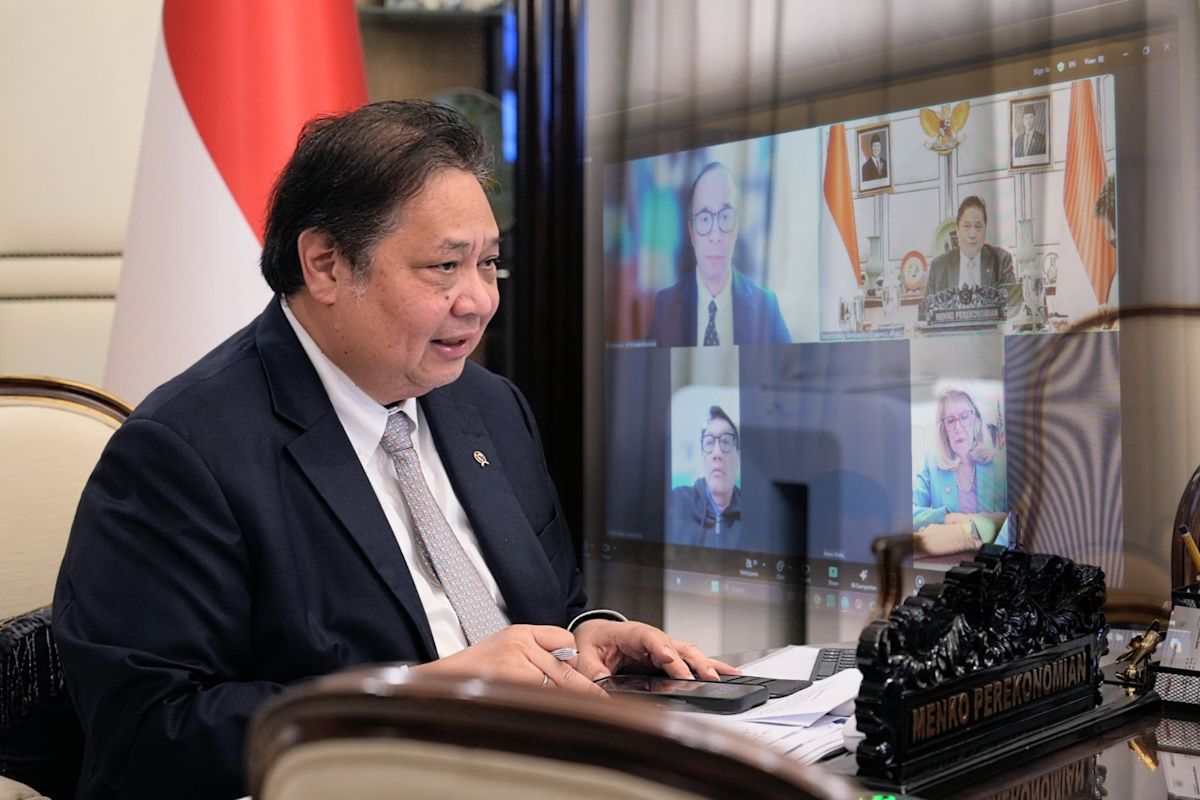
Indonesia’s economy grew by 5.45 per cent (cumulative) in the first half of 2026, providing a foundation for the target. For 2027, the Government is targeting growth of 6.0 per cent and inflation of 2.5 per cent.
Jakarta (ANTARA) – Co-ordinating Economic Affairs Minister Airlangga Hartarto is counting on the digital economy as a growth engine to achieve the 6 per cent economic growth target in 2027, through investment, productivity and higher-value exports.
Airlangga has positioned the digital economy as one of the mainstays for reaching the 6.0 per cent growth target in 2027.
“Indonesia’s economy grew by 5.45 per cent (cumulative) in the first half of 2026, providing a foundation for that target. For 2027, the Government is targeting growth of 6.0 per cent and inflation of 2.5 per cent,” Airlangga said in a confirmed statement in Jakarta on Sunday.
He said the target required three conditions: investment growth higher than gross domestic product (GDP) growth, increased worker productivity, and stronger value-added exports. Investment needs to grow by 8–9 per cent, with investment realisation targeted at Rp2,258 trillion.
Within this framework, the digital economy is a measurable growth engine. Indonesia’s digital economy gross merchandise value (GMV) approached US$100 billion in 2025, up 14 per cent from the previous year.
Quick Response Code Indonesian Standard (QRIS) has 65.77 million users and 44.86 million merchants.
Airlangga said the digital ecosystem should be developed as an integrated value chain, supported by high-quality digital talent, semiconductor and artificial intelligence (AI) development, and adequate infrastructure, including data centres.
At the regional level, the Government has completed negotiations on the ASEAN Digital Economy Framework Agreement (DEFA), which is expected to be signed alongside the ASEAN Summit in the Philippines in November 2026.
Ratification of the ASEAN DEFA is targeted for completion within 180 days of signing.
A Boston Consulting Group study estimates that, with DEFA implemented, the ASEAN region’s digital economy could grow from US$1 trillion to US$2 trillion by 2030.
Growth in digital transactions needs to be matched by robust security. Bank Indonesia recorded 12.99 billion digital payment transactions in the third quarter of 2025, an annual increase of 38.08 per cent.
To protect the digital economy, the Government is preparing quantum-resistant cryptography to address the “Harvest Now, Decrypt Later” (HNDL) risk, in which encrypted data is stolen for decryption in the future using quantum computers.
The effort is supported by the adoption of post-quantum cryptography (PQC) and the establishment by the National Cyber and Crypto Agency (BSSN) of a national task force to prepare the transition to quantum-resistant cryptography.
On infrastructure, Airlangga stressed that land, electricity and water availability were key to data centre development.
He said operating data centre capacity stood at 600–700 megawatts, while projects in the pipeline totalled 1.3 gigawatts, with estimated investment of US$15–20 billion.
NVIDIA is also exploring an investment of US$4.5 billion (about Rp80.1 trillion) in the Batam Free Trade Zone, although discussions are still under way.
In trade, Indonesia’s e-commerce market is projected to grow by more than 14 per cent to US$71 billion, making it the largest e-commerce market in Southeast Asia.
The Government is targeting Rp40 trillion in transactions through the National Online Shopping Day (Harbolnas) by the end of 2026, up 10 per cent from Rp36.4 trillion in 2025, and will continue to strengthen the e-commerce ecosystem.
Meanwhile, international co-operation on AI through the World AI Collaboration Organization (WAICO) is expected to attract US$8–12 billion in investment between 2026 and 2030.
Airlangga stressed that achieving the economic growth target would require collaboration among the Government, businesses, academia and all stakeholders, so that growth is higher and more inclusive and its benefits reach the wider public.
Source: jawawa.id (https://jawawa.id/newsitem/airlangga-banks-on-digital-economy-to-drive-growth-in-2027-1792313441)
Originally published by Antara (Indonesian) (https://www.antaranews.com/berita/5794713/airlangga-andalkan-ekonomi-digital-pacu-pertumbuhan-ekonomi-2027), translated from Indonesian