
Aircraft Maintenance Still Fleeing Overseas, Batam Being Prepared as National MRO Hub
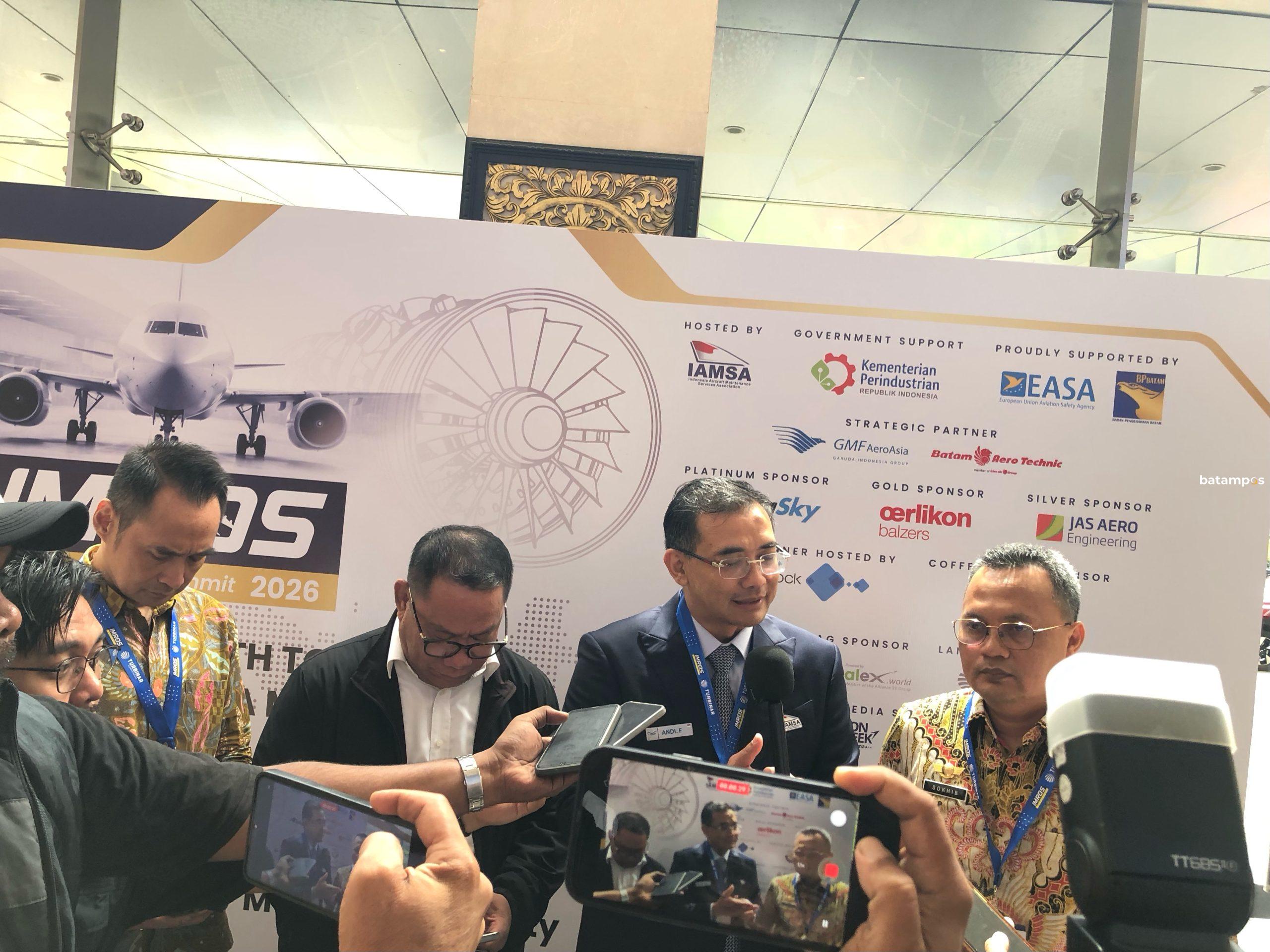
Indonesia is still losing billions of dollars in potential business from the aircraft maintenance sector. Despite possessing the largest aviation market in Southeast Asia, nearly half of the national fleet’s maintenance requirements are still handled overseas.
This situation has prompted industry players and the government to accelerate the strengthening of the Maintenance, Repair, and Overhaul (MRO) ecosystem, ensuring that Indonesia does not merely serve as a market but becomes a major player in the Asian region. This issue was highlighted during the Indonesia MRO Summit (IMROS) 2026 held in Batam on Monday.
The meeting brought together regulators, airline operators, MRO companies, aircraft manufacturers, and investors to discuss the future of the national aircraft maintenance industry.
Andi Fahrurrozi, Chairman of the Indonesia Aircraft Maintenance Services Association (IAMSA) and President Director of GMF AeroAsia, stated that Indonesia possesses significant capital to become a regional MRO service centre. High fleet growth, a vast domestic market, a competent workforce, and a strategic geographical position provide advantages that are difficult for other countries in the region to match.
However, he noted that these advantages have not yet been fully translated into industrial strength. “Growth alone is not enough. To remain competitive, we must build an industry that is resilient, innovative, and collaborative,” said Andi.
He explained that the national MRO industry has shown progress in the airframe maintenance sector, with approximately 90 per cent of work in that segment now handled domestically. However, challenges persist in the maintenance of aircraft components and engines, which remain heavily dependent on overseas facilities.
According to Andi, about 70 per cent of Indonesia’s aircraft engine maintenance work is still performed abroad. This dependency causes high-value business opportunities and foreign exchange to flow to other countries. “Our constraint lies in components and engines. The investment required is massive. Many Original Equipment Manufacturers (OEMs) are now building their own MRO facilities, making them increasingly exclusive,” he added.
Industry data shows that approximately 46 per cent of the national aircraft maintenance market is currently enjoyed by foreign businesses. This figure serves as an indicator that domestic industrial capacity is not yet able to capture all the needs available in the domestic market.
Consequently, IAMSA believes that the development of component and engine maintenance facilities must be a priority if Indonesia wishes to increase competitiveness and strengthen its position as an Asian MRO hub.
In addition to investment, industry players highlighted regulations that are considered to hinder business efficiency. One of the most frequent issues raised involves import restrictions and limitations (lartas) and the Harmonised System (HS) Code classification for aircraft spare parts.
Andi stated that the government has been discussing various regulatory relaxation schemes for the aviation industry over the past two years. Currently, businesses are awaiting the issuance of a Minister of Finance Regulation, which will serve as the technical basis for implementing these policies.
He noted that the government’s policy direction accommodates industry needs through adjustments to import duties on aircraft parts to make them more competitive, including several fiscal facilities intended to reduce national MRO operational costs. “The process is currently in the symbolic stage, and we are waiting for the Minister of Finance Regulation to be issued,” said Andi.
Industry players hope that regulatory simplification will accelerate the flow of components, reduce logistics costs, and increase the competitiveness of national MRO companies compared to neighbouring countries such as Singapore and Malaysia.
The government maintains that strengthening the MRO industry cannot be separated from the development of national connectivity and logistics systems. Rustam Efendi, Secretary Deputy for Connectivity at the Coordinating Ministry for Infrastructure of the Republic of Indonesia, stated that the success of the aviation industry is not determined solely by the number of airports or fleet growth. The availability of efficient maintenance facilities is also a key factor in determining the competitiveness of the aviation sector.
“If we want our aviation sector to be competitive, it is not enough to just talk about avtur or airport capacity. MRO is a vital component that determines the efficiency and sustainability of the aviation industry,” said Rustam.
According to him, the aviation sector has a significant multiplier effect on the national economy by driving investment, trade, and job creation. Therefore, the development of the MRO industry is part of the national infrastructure strengthening agenda.
Rustam stated that the government is now shifting its development paradigm from merely building physical infrastructure to creating integrated connectivity. “MRO supports the success of Indonesian aviation. Therefore, we are not just building airports, but also support systems integrated with industrial and logistics zones,” he said.
Under this strategy, Batam is projected as one of the primary hubs for the national MRO industry. Its location on international trade routes, proximity to Singapore, and the presence of industrial zones are considered vital assets for attracting aviation sector investment.
Nevertheless, Rustam cautioned that Indonesia cannot simply replicate Singapore’s development model. “We may learn from Singapore, but we cannot compare ourselves directly. Indonesia is an archipelagic nation with more than 17,000 islands. Therefore, the strategy is to build several hubs and cargo centres,” he remarked.
In addition to Batam, the government is also prioritising Jakarta, Surabaya, and Makassar as national connectivity hubs that will be integrated with industrial and logistics zones.
Source: jawawa.id (https://jawawa.id/newsitem/aircraft-maintenance-still-fleeing-overseas-batam-being-prepared-as-national-mro-hub-1781085040)
Originally published by metropolis.batampos.co.id (https://metropolis.batampos.co.id/perawatan-pesawat-masih-banyak-lari-ke-luar-negeri-batam-disiapkan-jadi-simpul-mro-nasional/), translated from Indonesian