
Air Quality in Pekanbaru Plummets to 'Very Unhealthy' Due to Forest Fire Haze
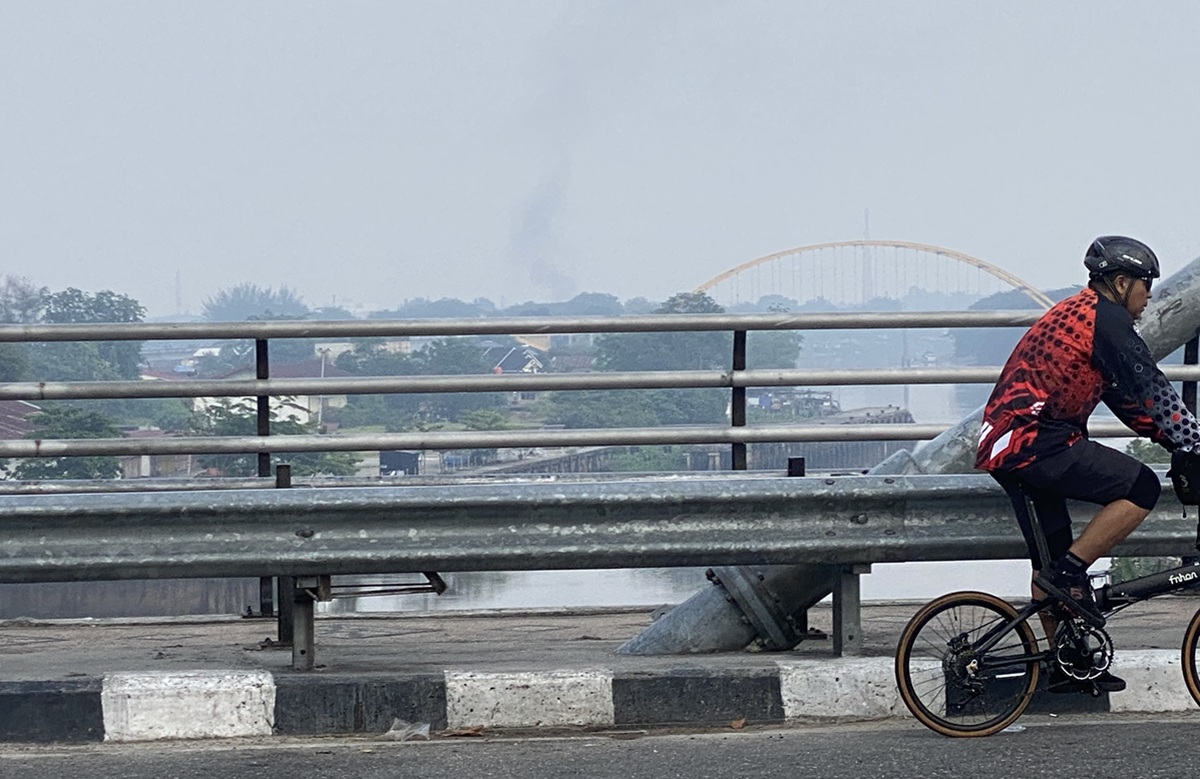
Thick haze blanketing Pekanbaru from forest and land fires (karhutla) in Riau Province has caused air quality in the city to plummet to a ‘very unhealthy’ level, with particulate matter recorded at 199.6 micrograms per cubic metre at around 1.00 a.m. Western Indonesia Time on Wednesday (12/8).
According to air quality data from the official website of the Meteorology, Climatology and Geophysics Agency (BMKG), air quality gradually improved in the morning with clear weather, but remained at an ‘unhealthy’ level with particulate matter of 57 micrograms per cubic metre at 7.00 a.m.
Visibility in Pekanbaru on Wednesday morning also improved compared with Tuesday night, when the haze was quite thick and began to smell. Activities continued as normal, with police officers seen escorting motorists around the end of Jalan Sudirman near the Siak IV Bridge.
Head of the Sumatra Forest Fire Control Centre, Ferdian Krisnanto, said a fire had occurred near Pekanbaru, specifically in Pandau Jaya sub-district, Siak Hulu district, Kampar regency, Riau, on Tuesday (11/8).
“The fire is now completely extinguished. The Manggala Agni Pekanbaru team, together with a joint team from the military, police and village officials, succeeded in putting it out,” he said on Wednesday (12/8).
“What is still in progress and requires continued handling is Pematang Pudu, on the Buluh Apo and Sungai Guntung sides,” Ferdian added.
He stressed that his team, together with ground and air firefighting crews using water-bombing helicopters, was working as quickly and effectively as possible to tackle the fires in Riau. “We will continue extinguishing operations until the fires are completely out and fully resolved,” he said.
Meanwhile, Okto Yugo Setiyo, coordinator of the Riau Forest Rescue Network (Jikalahari), expressed regret over the government’s negligence, saying it continued to repeat the same mistakes and appeared to waste public money as forest fires and haze disasters recurred every year.
“This is the impact of our provincial government’s stubbornness. Even though Regional Regulation No. 1 of 2019 on forest and land fire control already exists, it has never been implemented. Instead, they are too focused on ‘Green for Riau’, which does not touch the substance of our environmental problems,” he said.
He explained that the regulation mandates, first, the management of peatlands. It requires regional governments to (1) reorganise the management and use of peatlands in accordance with regional and provincial spatial plans, (2) review peatland permits, and (3) prepare peatland management and utilisation plans.
“Second, compliance audits. Every permit holder is required to conduct a compliance audit of the availability of forest and land fire control facilities and infrastructure every two years, involving the regional government. The audit results must be conveyed to the public as public information through print and electronic media,” he said.
Third, Okto said, regional government oversight. “Regional governments are required to supervise, evaluate and monitor the completeness and condition of forest and land fire control facilities and infrastructure for every permit holder periodically, at least once every six months, involving universities and environmental non-governmental organisations,” he said.
Fourth, action by regional governments against violations related to forest and land fires, including environmental pollution.
“The provincial government must begin focusing on rescuing and evacuating communities from the impacts of forest and land fires,” he stressed.
He emphasised the need for humanitarian services through victim identification, emergency assistance, victim evacuation and designated referral hospitals.
In addition, the provision of basic needs including clean water and sanitation, health services, education, and adequate shelter and housing. Protection for vulnerable groups includes rescue, evacuation, security and health services.
“Vulnerable groups consist of infants, toddlers and children, pregnant or breastfeeding mothers, people with disabilities, the elderly, and marginalised community groups. That is the mandate of a legitimate regional regulation made with public money. The provincial government should implement all of it,” he concluded.
Source: jawawa.id (https://jawawa.id/newsitem/air-quality-in-pekanbaru-plummets-to-very-unhealthy-due-to-forest-fire-haze-1786506658)
Originally published by Media Indonesia (https://mediaindonesia.com/nusantara/920866/akibat-kabut-asap-karhutla-kualitas-udara-pekanbaru-anjlok-jadi-sangat-tidak-sehat), translated from Indonesian