
AICJ Launches AI-Ready Learning Model at First Day of School Orientation
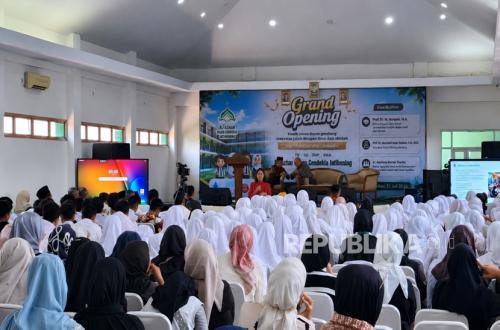
Al Azhar Insan Cendekia Jatibening (AICJ) began the School Environment Introduction Period (MPLS) for the 2026/2027 academic year with a Professor Goes to School event themed “Basic Education in the AI Era: Preparing Children of Faith, Culture, Intelligence, and Adaptability.” The occasion also marked the launch of the YDMS–Artificial Intelligence Meaningful and Religious Learning (AIM RL) learning model at the Islamic school.
The MPLS was attended by students, parents, teachers, foundation administrators and education partners. The opening of the new academic year was designed not merely as a ceremony, but also as a space for dialogue on the future of Indonesian education amid the rapid development of artificial intelligence (AI).
Professor M Baiquni, Chair of the Council of Professors of Universitas Gadjah Mada, discussed the importance of preserving humanism, adab and culture in education in the AI era. Meanwhile, Professor Muchtadi Intan Detiena addressed the changing educational landscape and the competencies that must be cultivated from basic education onwards so that pupils can face future challenges.
Ir. Mustafa Kamil Thahir, Chairperson of the Board of Trustees of the Darul Muqomah Sridjati Foundation, introduced the implementation of AIM RL as a learning model that integrates Qur’anic values, science, technology, creativity and artificial intelligence into the learning process.
On the same occasion, strategic cooperation agreements were signed with various education partners to strengthen collaboration in building a quality learning ecosystem.
The school also proclaimed the Jatibening 2026 Declaration as a joint commitment to developing education centred on character building, science, technology and the responsible use of AI.
Through the launch of AIM RL, AICJ reaffirmed its commitment to providing education that produces not only academically high-achieving graduates, but also individuals with integrity, critical thinking, creativity, leadership, social awareness and readiness to face global change without losing their identity, adab and Islamic values.
The event concluded with the symbolic handover of the educational mandate from the foundation to the teachers, from the teachers to the parents, and the pupils’ pledge, as a form of collective commitment to building a learning culture grounded in knowledge, compassion and responsibility. The closing underscored that educational success can only be achieved through the collaboration of all elements, not by the school alone.