
AI War Heats Up: China Leverages 1.4 Billion Population Data to Challenge Silicon Valley
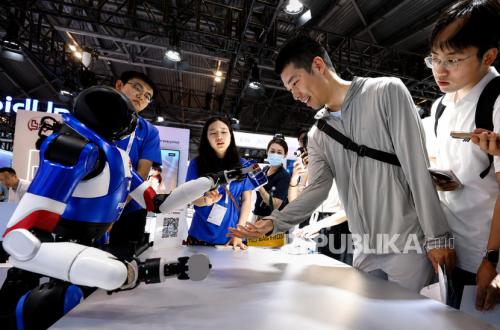
Amid intensifying technological competition between the United States and China, Beijing is preparing to host one of the world’s largest artificial intelligence forums. The Chinese government has announced it will hold the World Artificial Intelligence Conference (WAIC) 2026 and the High-Level Meeting on Global AI Governance in Shanghai next July.
The move is seen as more than just an ordinary tech conference. In the race towards Artificial General Intelligence (AGI), the development of humanoid robots, the battle for semiconductor chip markets, and AI-based military modernisation, WAIC is projected to be a stage for China to demonstrate its capacity as a major power in the global AI ecosystem.
‘China hopes to use this conference as an opportunity to further strengthen international cooperation in the field of artificial intelligence with all parties,’ said Zhou Haibing, Deputy Head of China’s National Development and Reform Commission (NDRC), during a press conference on Wednesday (18/6).
According to Zhou, AI governance is an issue that will determine the future of humanity and requires cross-border cooperation. He stated that China will continue to promote multilateralism, openness, and inclusiveness in the development of AI technology.
The statement comes as the technological rivalry between Washington and Beijing sharpens. In recent years, the US has tightened restrictions on the export of advanced chips and semiconductor equipment to China. In response, Beijing has accelerated massive investments to build national technological independence, including in generative AI models, data centres, cloud computing, and robotics.
For many analysts, the AI war has become a new chapter in 21st-century geopolitical competition. Whereas previously great power rivalry was determined by military strength and energy resources, mastery of algorithms, data, computing power, and chips is now the decisive factor in national power.
China has shown significant progress in recent years. Several of the country’s tech companies have launched generative AI models that are beginning to rival products from Silicon Valley. Additionally, China is leading in the development of industrial humanoid robots, which are projected to become the backbone of future manufacturing.
However, China’s strength in the AI race does not rest solely on massive investment or state support. One advantage that is difficult for other countries to match is the scale of its data. With a population exceeding 1.4 billion, China possesses one of the world’s largest data sources, spanning digital transactions, e-commerce activity, transport services, social media, and the use of various AI-based applications.
In the AI era, data is often referred to as the ‘new fuel’ that determines a model’s ability to learn, recognise patterns, and produce increasingly accurate decisions. The larger and more diverse the data set a country possesses, the greater its opportunity to develop a globally competitive AI system.
It is this advantage that leads many analysts to believe China has the strategic capital to compete with the United States in the race towards Artificial General Intelligence (AGI), a form of AI capable of performing various intellectual tasks just like a human. The race towards AGI is now seen as the ultimate goal of the global tech industry, as it has the potential to transform nearly every sector of human life.